
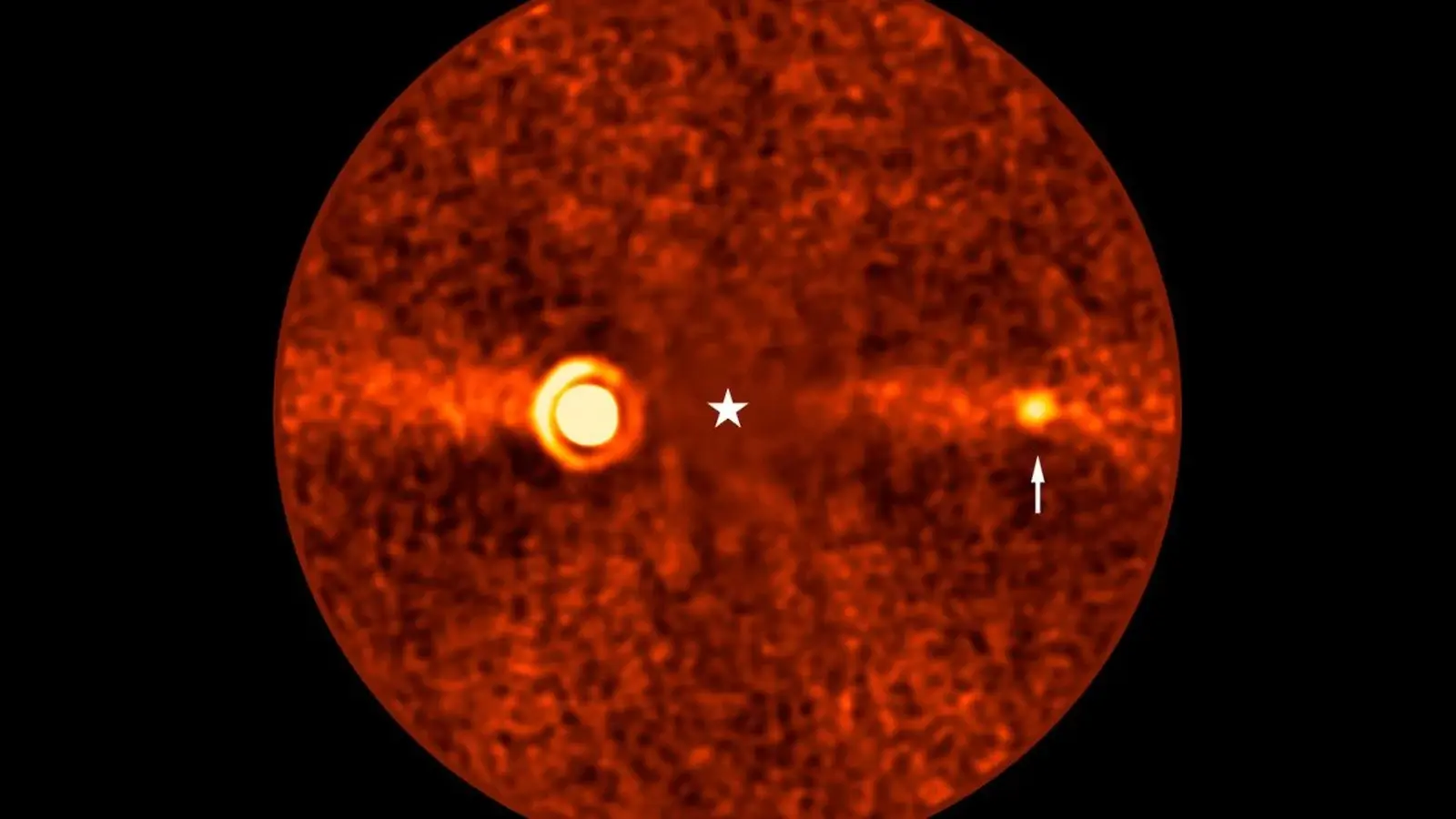
Imagine opening a dusty archive and finding a photograph of a person you never knew existed. That is the tone of the discovery announced for Beta Pictoris d, a planet so faint it slipped past astronomers for more than a decade.
Researchers first glimpsed Beta Pictoris d while revisiting observations of its much brighter sibling, Beta Pictoris b. The team, led by astronomers connected to the European Southern Observatory and the University of Edinburgh, combined fresh images from the Very Large Telescope with archival data from the James Webb Space Telescope to tease out a planet that had been hiding in plain sight.

The star Beta Pictoris.
A faint planet found by persistence, not luck
“This was a serendipitous discovery,” says Ben Sutlieff, co-leader of the study. The phrase is apt, but it understates the painstaking detective work behind the find. Astronomers were not searching blindly. They were examining Beta Pictoris b for subtle changes over time when the weaker signal of a new object emerged from the glare.
Beta Pictoris sits a mere 64 light-years away, in the constellation Pictor. The star is young by stellar standards, roughly 23 million years old, nearly twice the mass of the Sun, about 50 percent larger in radius, and about nine times brighter. Its youth shows. A broad debris disk surrounds the star, a chaotic region of dust and collisions where young planets and planetesimals still interact.
Multiple planets were already known in the system: Beta Pictoris b and c, both hefty gas giants roughly ten times the mass of Jupiter and glowing at very high temperatures. Beta Pictoris d is different. At roughly 2.4 times Jupiter's mass and an effective temperature near 330 degrees Celsius, it is cooler and much dimmer than its siblings. It orbits farther from the star, a separation comparable to Neptune's distance from the Sun, which contributed to why it was so hard to detect.

More than a decade's worth of observations, revealing the planet Beta Pictoris d.
Technical hurdles and what made the detection possible
Direct imaging of exoplanets is difficult because stars outshine their planets by factors of millions or even billions. Beta Pictoris d is roughly 100 times fainter than Beta Pictoris b, making it the faintest exoplanet ever directly imaged from the ground. To detect such a weak signal, astronomers stitched together many observations spanning years and exploited advances in image processing and infrared sensitivity.
Jayne Birkby, co-author and professor of astrophysics at the University of Oxford, put it plainly: “Planet d, it seems, has been playing a game of hide-and-seek with us for over a decade and only now can we say ‘found you!’” The discovery highlights how repeated, high-quality observations can reveal objects that remain hidden in single-epoch studies.
The combined dataset from ESO's Very Large Telescope and JWST archives allowed the team to confirm that the faint point source moved consistently with a bound planet rather than a background star. Importantly, the planet's orbital separation placed it in a region where intermittent visibility is expected: sometimes too close to the star to resolve cleanly, sometimes far enough away to be seen, and often swamped by dust and disk structures.
Direct infrared imaging has already revealed dozens of young, massive planets, some with temperatures exceeding 3,000 degrees Fahrenheit. Those worlds are blistering, luminous beacons compared with Beta Pictoris d. Detecting cooler, lower-mass planets like this one stretches the capabilities of current telescopes and analysis methods.
Why multiple-planet systems matter
Systems that host several directly imaged planets are precious to astronomers. They act as comparative laboratories. When planets form in the same disk, differences in mass, temperature, composition, and orbit reveal how formation and migration processes operate within a single environment.
“Systems with multiple directly imaged exoplanets are the holy grails of discoveries, because they can teach us a lot about what different exoplanets are like in the same formation environment,” Sutlieff said. Beth Biller, another researcher on the project, suggested that more lower-mass planets likely lurk in these systems and that upcoming instruments will uncover many of them.
Planned observatories, in particular the Extremely Large Telescope, will provide a substantial leap in sensitivity and resolution. That telescope is expected to find planets that current facilities cannot, revealing a richer and more diverse population of young, low-mass worlds.
Expert Insight
“Finding Beta Pictoris d is a demonstration of both patience and precision,” says Dr. Elena Moreno, an observational exoplanet scientist not involved in the study. “It shows how archival data can be as valuable as new observations, and why continuous monitoring of nearby young stars is essential. Each additional planet we pin down refines models of planet formation and migration.”
The detection also underscores the value of cross-facility collaboration. Combining long-term ground-based monitoring with space telescope archives widens the discovery space. As instruments advance and algorithms improve, the faint end of the planetary population will come into focus.
Conclusion
Beta Pictoris d is more than a catalog entry. It is evidence that the inventory of planetary systems near our Sun is still incomplete, especially at lower masses and cooler temperatures. The find is a reminder that discoveries can emerge when observers revisit known targets with new tools and fresh questions. In the years ahead, observatories on the ground and in space will likely turn more of these hidden worlds into known neighbors, deepening our understanding of how planetary systems assemble and evolve.

“The cosmos has always fascinated me. I write about space missions, astronomy, and the technologies pushing humanity beyond Earth.”

Discussion
Leave a Comment