
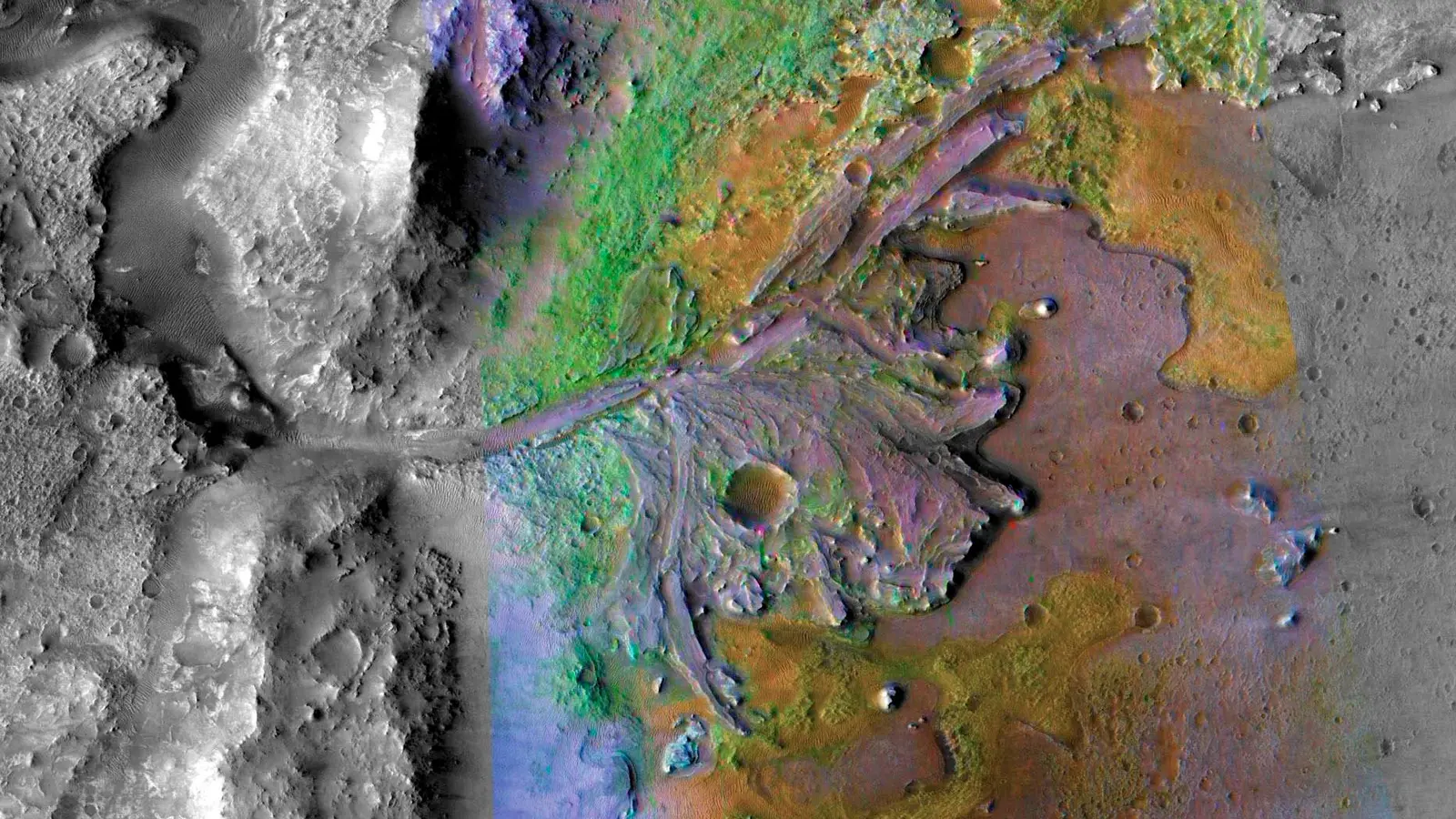
NASA's Perseverance rover has uncovered a layered water history in Jezero Crater: not a single wet episode, but several distinct floods and groundwater events that shifted Mars' chemistry from harsh and acidic to neutral and even alkaline — conditions increasingly favorable for life. Using a novel mineral-identification approach, researchers mapped 24 mineral types that act like chemical fingerprints of past environments, offering a clearer timeline of Jezero's watery past and new guidance for the rover's search for biosignatures.
How minerals tell Mars' environmental story
Rocks preserve the chemistry of the fluids that altered them. When volcanic rocks meet liquid water, new minerals grow; each mineral forms under a narrow set of temperatures, pH values and chemical conditions. By identifying those minerals across Jezero, scientists can reconstruct whether past waters were hot or cool, acidic or alkaline — and whether they could have supported life.
The new analysis used geochemical data from Perseverance's Planetary Instrument for X-ray Lithochemistry (PIXL), which blasts tiny spots on rock surfaces with X-rays and measures the emitted signals to derive elemental composition at unprecedented spatial resolution. Those measurements feed the Mineral Identification by Stoichiometry (MIST) algorithm, a tool developed at Rice University that matches PIXL chemistry to plausible mineral species while accounting for measurement uncertainty.
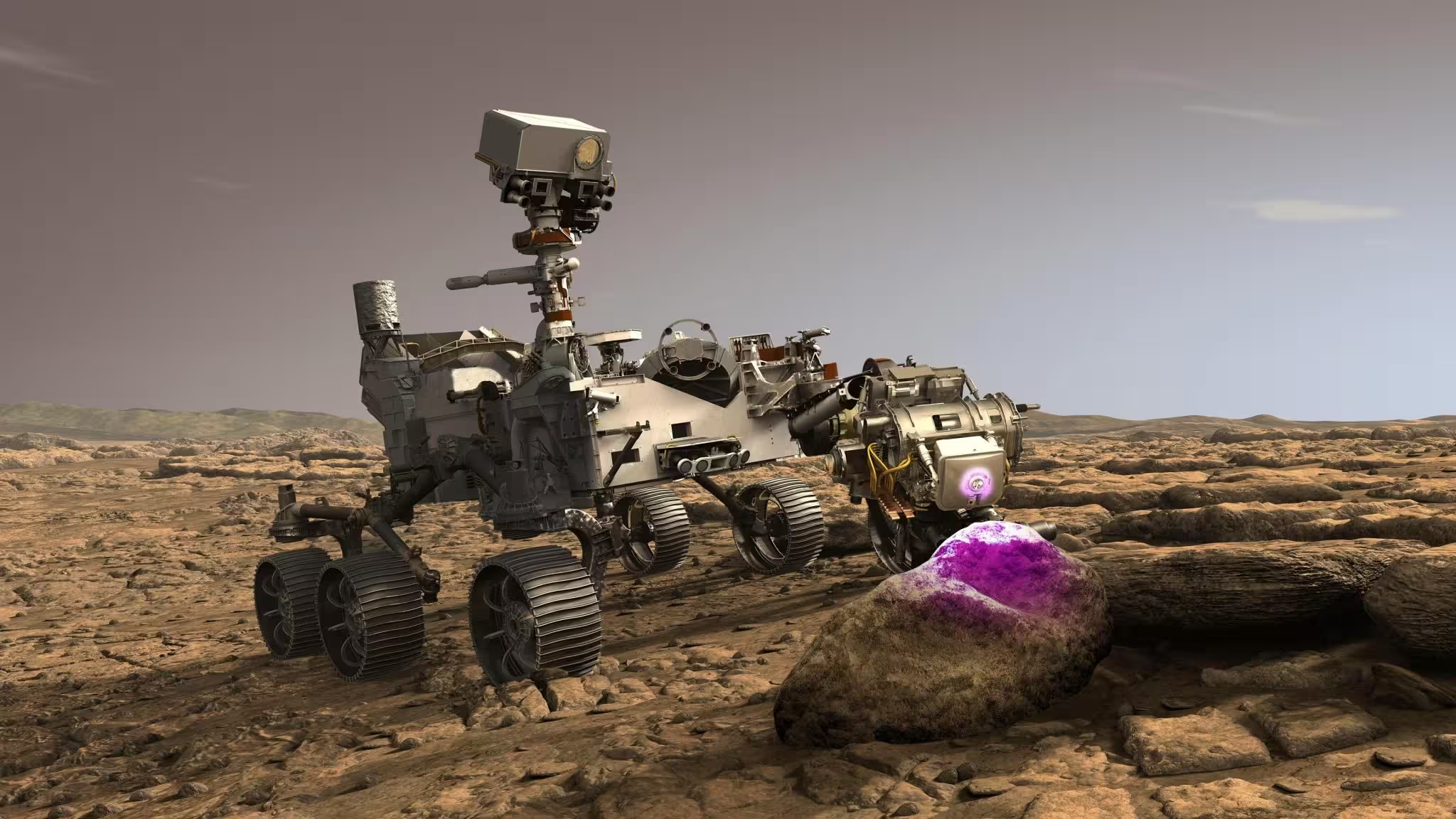
Perseverance’s PIXL at Work on Mars (Illustration): In this illustration, NASA’s Perseverance Mars rover uses the Planetary Instrument for X-ray Lithochemistry (PIXL). Located on the turret at the end of the rover’s robotic arm, the X-ray spectrometer helps search for signs of ancient microbial life in rocks. Credit: NASA/JPL-Caltech.
Three water phases emerge from Jezero's mineral record
Applying MIST to PIXL observations from the first three years of the mission, the team identified 24 distinct mineral species that reveal at least three temporally separate alteration episodes. Each phase carries different implications for habitability.
1. Hot, acidic fluids — the harsh opening chapter
The oldest alteration phase recorded on the crater floor shows minerals formed in high-temperature, low-pH fluids. Species such as greenalite, hisingerite and ferroaluminoceladonite point to hot, acidic conditions that would tend to break down organic molecules and make life as we know it difficult. However, extreme environments on Earth, from acid hot springs to hydrothermal vents, host specialized microbes, so these conditions do not entirely rule out habitability.
2. Neutral waters — a middle stage of calmer chemistry
A later stage produced minerals consistent with lower temperatures and near-neutral pH. Minerals like minnesotaite and clinoptilolite indicate milder fluids that are more chemically forgiving for complex organic chemistry. Minnesotaite appears across both the crater floor and the upper fan deposits, suggesting a broader footprint of neutral alteration.
3. Alkaline waters — the most life-friendly interval
The youngest recorded episode involved cooler, alkaline fluids that produced minerals such as sepiolite. Sepiolite is notable because on Earth it often forms in sedimentary settings that support abundant microbial life. Its widespread presence across the rover's explored areas suggests a later, basin-scale episode where lake or groundwater chemistry shifted to conditions that would have been highly favorable for habitability.
Methods matter: MIST and uncertainty handling
Mineral identification on Mars is challenging because returned-sample preparation and lab calibration are not available in situ. To address this, the MIST algorithm integrates PIXL's elemental maps with an uncertainty-propagation model. The team ran thousands of Monte Carlo–style iterations to test how measurement noise and compositional overlap might affect mineral matches. The result is not only a best-fit mineral list but also confidence levels for each identification — a crucial step when informing sampling decisions for possible future sample return missions.

Rice University graduate student Eleanor Moreland. Credit: Brandon Martin/Rice University
Why this matters for the search for life
These findings shift Jezero from a site that once simply held a lake to a dynamic system with evolving water chemistry. Multiple wet episodes raise the odds that habitable niches persisted intermittently over long intervals, increasing the chance that any emergent life could appear and leave detectable traces. The mineral archive produced by MIST will help contextualize samples Perseverance collects and, eventually, samples returned to Earth for detailed laboratory analyses.
The study also provides important context for other headlines about potential biosignatures at Jezero. The mineralogical baseline shows that environments like those observed at Sapphire Canyon were not isolated anomalies but part of a broader pattern of changing water chemistry across the crater.
Mission implications and future prospects
Perseverance's ongoing campaign will use mineral maps to prioritize sampling targets that preserve the most promising combinations of sedimentary textures and chemical environments. Future missions — including potential sample-return campaigns and orbital or landed follow-ups — will benefit from MIST's mineral inventory and its confidence metrics when selecting where to drill, cache and ultimately fetch.
Beyond Mars, the approach exemplifies how high-resolution in-situ geochemistry paired with robust statistical modeling can reveal environmental histories on other worlds. As instruments become more advanced and sample-return planning matures, datasets like this will be central to answering the biggest question: did life ever arise beyond Earth?

Kirsten Siebach, assistant professor of Earth, environmental and planetary sciences at Rice University. Credit: Jeff Fitlow/Rice University
Expert Insight
'Finding a sequence that moves from acidic and hot to neutral and then alkaline is exactly the kind of progressive change we would hope to see if habitability increased through time,' says Dr. Lara Mitchell, a planetary geochemist not involved with the study. 'It tells a story of environmental evolution, not a single snapshot, which raises the chance that Jezero preserved multiple windows where life could have emerged or been sustained.'
'MIST gives scientists a reproducible, quantified way to read that story,' adds Mitchell. 'When those rocks eventually come back to Earth, this mineral catalog will be essential for targeting the most informative samples for organic and isotopic tests.'
What comes next
Perseverance will continue to expand the mineral map across Jezero, integrate observations from other instruments (like SHERLOC and SuperCam), and refine MIST with new data. Meanwhile, mission planners and scientists will use these insights to design sampling campaigns that maximize the scientific value of each cached rock and increase the likelihood of detecting meaningful biosignatures if they exist.

“My work centers on sustainability, energy, and environmental science — examining how innovation can lead to a greener future.”

Discussion
Leave a Comment