

Giraffes are famous for their towering necks, but new research shows their extraordinarily long legs play a crucial — and previously underappreciated — role in keeping blood flowing to the brain. By lifting the heart closer to the head, long legs reduce the energetic burden of pumping blood uphill, an adaptation that helped giraffes thrive on the African savannah.
How long legs cut the heart’s workload
Most animals face a straightforward cardiovascular challenge: the taller the head relative to the heart, the more pressure the heart must generate to force blood upward. Adult giraffes routinely maintain systolic blood pressures above 200 mm Hg — more than twice the average mammal — so their hearts can supply oxygen to a skull perched two meters or more above the chest. That extreme pressure makes the giraffe heart energetically expensive; at rest the giraffe’s heart can consume more energy than the entire resting body of a human.
Researchers Roger Seymour and Edward Snelling quantified this cost in a study published in the Journal of Experimental Biology. They asked a simple evolutionary question: would a long neck by itself explain giraffes’ cardiovascular demands, or do long legs also matter?
The 'elaffe' thought experiment
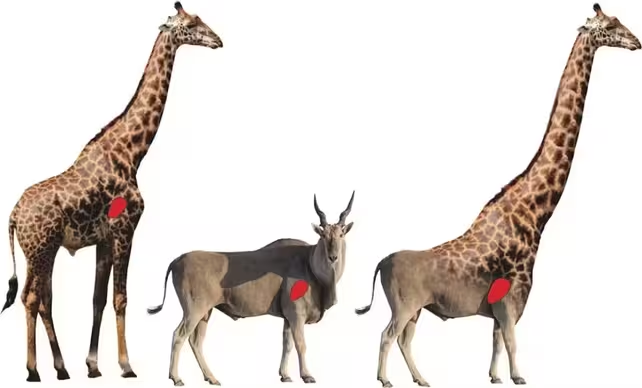
To test the idea, the team created a hypothetical animal — half eland, half giraffe — which they dubbed the "elaffe." This creature had the body and lower limbs of an African eland but a giraffe-length neck, creating a body plan in which the heart would sit much lower relative to the head than in real giraffes. Modeling the elaffe’s circulation exposed the energetic consequences of that arrangement: the heart would need to use around 21% of the animal’s total energy intake to pump blood to the brain, compared with roughly 16% in a real giraffe and only 6.7% in humans.
By elevating the heart closer to the head via long legs, real giraffes effectively save about 5% of their daily energy budget. That 5% translates into substantial biomass over time — the researchers estimate the annual energy saving could be equivalent to more than 1.5 tonnes of food. On a resource-limited savannah, that difference can mean better survival through droughts and more opportunities to breed year-round.
A trade-off: tall legs, awkward drinking
Evolution rarely hands out benefits without costs. Fossil and anatomical research, summarized in Graham Mitchell’s How Giraffes Work, suggests giraffe ancestors lengthened their legs before evolving extremely long necks. From an energy perspective this order is sensible: long legs reduce cardiovascular costs, while longer necks amplify them.
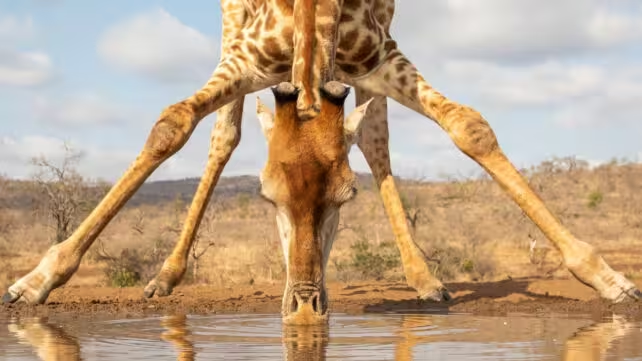
But long forelimbs force giraffes into a vulnerable posture when they lower their heads to drink. They must splay their forelegs and bend awkwardly, slowing the exit from a waterhole if a predator appears. Observational data show giraffes are disproportionately likely to leave a watering site without drinking, a behavioral consequence of the trade-off between height and safety.
How long can a neck get?
Physiological limits set a cap on how long terrestrial necks can become. Blood pressure increases approximately in direct proportion to neck height. If animals pushed neck length far beyond present giraffe dimensions, the energy required to power the heart would eventually exceed the energy available from the rest of the body.
Sauropod dinosaurs highlight this limit. Giraffatitan, a massive sauropod whose skeleton stands in the Berlin Natural History Museum, reaches around 13 meters tall with an estimated neck height of 8.5 meters. If a mammal-like circulation were scaled up to that neck length, the heart would need to generate roughly 770 mm Hg — nearly eight times typical mammalian blood pressure — an implausible physiological demand. That calculation helps explain why no land animal known to science likely exceeded the height of an adult male giraffe without special circulatory adaptations or different posture strategies.
Implications for evolution and biomechanics
This research reframes a classic story in evolutionary biology. The common textbook explanation — that neck elongation evolved primarily to reach high leaves — remains part of the narrative. But the energetic calculus shows long legs were not merely for stride or speed; they reduced the cardiovascular cost of vertical height and made extreme feeding strategies feasible.
Understanding these trade-offs matters beyond giraffes. Comparative physiology and biomechanical modeling can reveal which morphological changes are energetically feasible and which are self-limiting. That insight helps paleobiologists infer how extinct giants may have lived and prompts new questions about how modern large mammals balance feeding advantages against circulatory and predator-avoidance costs.
Expert Insight
"Evolution often finds clever compromises," says Dr. Maya Reynolds, a fictional comparative physiologist. "Giraffes didn’t just grow taller to reach leaves — they rearranged their body plan so the heart didn’t have to work as hard. It’s a reminder that visible traits like long necks are supported by less obvious changes elsewhere in the body, like limb length and vascular structure."
Future work could combine field observations, refined anatomical models and genetic studies to track when leg elongation first appeared in giraffid ancestors, and how cardiovascular adaptations co-evolved. For now, the lesson is clear: height is about more than what you can eat — it’s about how your heart can afford it.

“The cosmos has always fascinated me. I write about space missions, astronomy, and the technologies pushing humanity beyond Earth.”

Discussion
Leave a Comment