
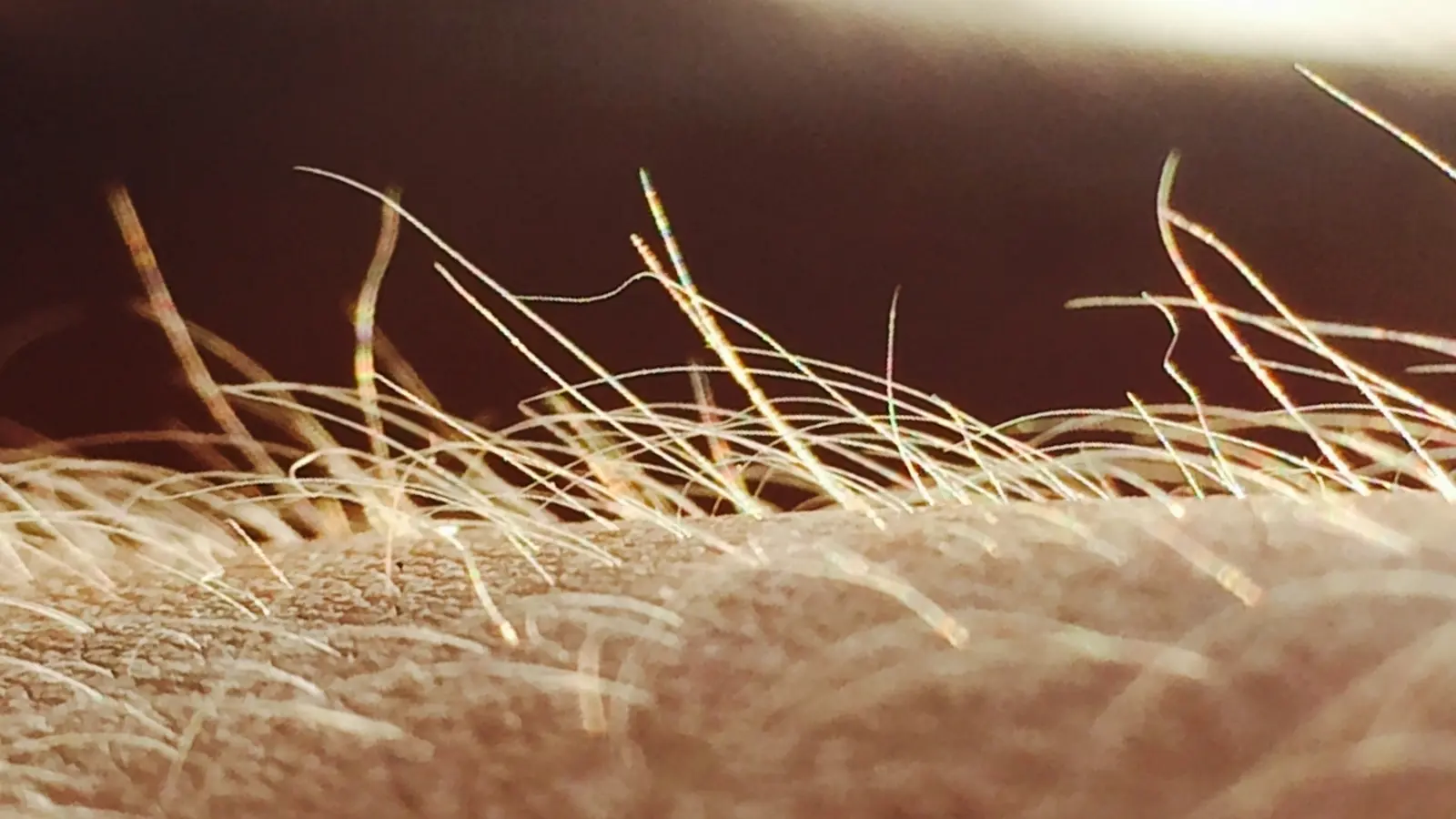
You feel it before you see it: a whisper of touch on the chin, a tickle behind the ear, a tiny betrayal on the skin that turns calm into compulsion. One quick scratch and relief follows. But why does such a faint brush sometimes trigger an almost reflexive need to scratch? Recent work in mice points to specialized vellus-like hairs and their dedicated nerve partners as a little-known sensory apparatus that turns hair movement into itch.
Small hairs, big job
Vellus hairs—those fine, almost invisible shafts sometimes called peach fuzz—aren't just cosmetic. In humans they blanket most of the body, and in other mammals similar hairs appear in particular places where skin is more exposed. In mice, scientists noticed a dense population of vellus-like hairs behind the ears and on the hind paws, areas where contact with the environment is frequent. These hairs do classic hair tasks, like helping regulate temperature, but they also seem wired to report the gentlest mechanical disturbances.

That observation flipped a question on its head. Researchers have long studied itch generated by direct skin damage or chemical irritants. Less attention has gone to the kind of itch that arises when hair itself moves across the skin. Why does a light brush sometimes produce intense discomfort? The new mouse experiments suggest there are dedicated anatomical and molecular players for that sensation.
How the sensation is wired
In a series of experiments, biologists at the University of Michigan mapped nerve endings associated with each vellus-like hair. They found a subset of fast-conducting sensory neurons physically coupled to these hairs. A feather-light deflection of the hair was enough to trigger electrical activity in these neurons and, downstream, an itch behavior in the mouse.
Two molecular names stand out. Piezo2, a mechanosensitive ion channel known to convert physical forces into neural signals, modulates the response. And a population of sensory neurons marked by TLR5 expression carries the signal toward the spinal cord. When researchers induced chronic skin inflammation in regions rich in vellus-like hairs, those specific neurons fired continuously and the mice scratched persistently. Flip off the genes that activate that neuronal population, and the same inflammation no longer produced itch.

The team uses the term trichoknesis to describe itch caused by hair contact. That label helps separate this mechanosensory pathway from classical chemically evoked itch. In other words, not all itch is the same. Different stimuli recruit different circuits, and these vellus-coupled pathways appear specialized for hair-associated mechanical itch.
Why mice matter here
It is always worth pausing before translating mouse biology to human health. Mice and people differ in hair types—rodents have multiple pelage hair forms while humans mainly have terminal and vellus hairs—but evolutionary conservation of genes and pathways makes mice valuable models. The discovery that certain hairs are hardwired to provoke itch suggests a potential route to intervene therapeutically.
Understanding how hair movement becomes a signal matters because chronic itch is a major clinical problem. Conditions like eczema, persistent insect-bite sensitivity, and contact dermatitis afflict millions, and existing treatments do not always work. If a specific neuronal population drives mechanical hair-evoked itch, then targeting that population or its molecular machinery could yield new therapies.

Clinical and research implications
That is exactly the direction the authors propose. “We need a new pathway to target if we want to treat chronic itch,” molecular biologist Bo Duan says. The implication is practical: drugs or gene therapies that dampen Piezo2 modulation in these neurons, block TLR5-linked signaling, or otherwise reduce hair-triggered input could reduce suffering in patients whose itch is disproportionately driven by mechanical stimuli.
There are additional angles worth tracking. Could subtle differences in human vellus hair density or innervation explain why some people are more sensitive to light touch? Do environmental changes that alter hair movement—humidity, clothing texture, or tiny parasitic contacts—exacerbate trichoknesis? Experimental work in humans and further comparative studies will be needed to answer these questions.
Expert Insight
"This study reveals a neat division of labor in the somatosensory system," says Dr. Maya Alvarez, a sensory neuroscientist not involved in the research. "Some circuits tell you about pressure and texture. Others, apparently, are wired to flag hair movement as a potential threat or nuisance. Recognizing these distinctions opens targeted ways to reduce pathological itch without blunting normal touch sensation."
Conclusion
Itch, it turns out, is not a single blunt instrument. For at least some forms of itch—those provoked by the slightest hair motion—biology has evolved a dedicated sensor-effector system. By revealing the hairs, neurons, and molecules involved, the new mouse work gives researchers a clearer map to follow toward therapies for chronic itch. The next step is careful translation: validating the same mechanisms in humans and testing interventions that can silence the complaint without robbing the skin of its protective senses.

“The cosmos has always fascinated me. I write about space missions, astronomy, and the technologies pushing humanity beyond Earth.”

Discussion
Leave a Comment