
.webp)
Encounter summary
A small near-Earth asteroid, designated 2025 TF, made a very close pass of our planet on 1 October 2025, skimming over Antarctica at 00:47:26 UTC at an altitude of approximately 428 kilometers (266 miles). That trajectory placed it well within the typical orbit range of the International Space Station (ISS), which circles Earth between roughly 370 and 460 kilometers.
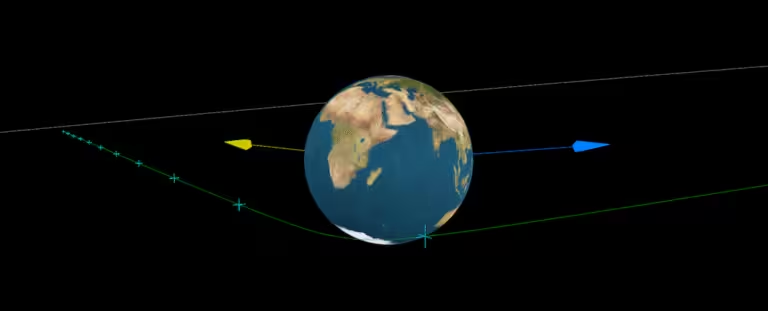
A diagram illustrating the path of asteroid 2025 TF (green line) during its close pass of Earth.
This approach ranks as the second-closest recorded non-impacting flyby. The closest confirmed non-impacting pass on record is asteroid 2020 VT4, which passed at about 368 kilometers in November 2020. It is important to emphasize these distances are for rocks that did not strike the surface; Earth has experienced far closer—and catastrophic—encounters in its geologic past.
Detection and tracking
2025 TF was not identified until after it had already passed Earth. The first public report came from observations at Kitt Peak-Bok Observatory in Arizona at 06:36 UTC, several hours after closest approach. Post-discovery analysis traced the object backwards to images recorded by the Catalina Sky Survey roughly two hours after its nearest pass.
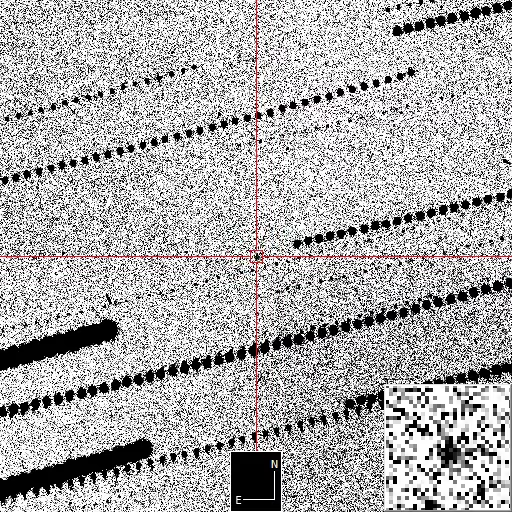
Asteroid 2025 TF, a few hours after its closest pass to Earth. (ESA/Las Cumbres Observatory)
The delay in detection illustrates a current limitation in our survey coverage: very small objects, on the order of 1–3 meters, are faint and easy to miss until they are very near. Automated survey telescopes routinely scan for potentially hazardous near-Earth objects (NEOs), but detecting meter-scale bodies at large distances remains challenging.
Size, risk and future outlook
Estimated at only 1 to 3 meters across, 2025 TF posed no significant threat. An object of that size would typically disintegrate or fragment in the upper atmosphere, producing a bright fireball and possibly leaving small meteorites on the ground. Had it entered, the event would likely have been a local spectacle rather than a hazard.
NASA Jet Propulsion Laboratory (JPL) orbital solutions show 2025 TF is now receding from Earth. Current projections place a future return in April 2087, but on that occasion it is predicted to pass no closer than about 8 million kilometers — roughly 21 times the distance to the Moon — so no future impact is expected from the present orbit.
Scientific context
Close flybys of small asteroids are scientifically valuable. They provide opportunities to refine detection methods, improve orbit determination for tiny bodies, and validate survey performance. Smaller objects like 2025 TF also offer natural laboratories for studying atmospheric entry physics and fragmentation dynamics.
"Events like this are reminders that our asteroid catalog is highly complete for large, hazardous objects but still incomplete for meter-scale bodies," said an orbital analyst at the Jet Propulsion Laboratory. "Expanding survey sensitivity and follow-up capability helps us close that gap and better characterize the population of near-Earth debris."
Conclusion
The October 2025 near-miss by 2025 TF was a close but low-risk encounter. Although the asteroid was discovered only after its closest approach, rapid follow-up observations allowed astronomers to reconstruct its path and size. Continued investment in sky surveys, follow-up networks, and cataloging will improve early detection of these small, fast-moving visitors and better prepare us for future close approaches.

“My work centers on sustainability, energy, and environmental science — examining how innovation can lead to a greener future.”

Discussion
Leave a Comment