
New research from Yonsei University is forcing cosmologists to rethink one of the most basic ideas about our cosmos: that its expansion is steadily accelerating. By re-examining type Ia supernova data and correcting for stellar-age effects, the team finds signs that dark energy may be weakening — and that the Universe could already be drifting into a decelerating phase.
A surprising twist in cosmic expansion
For nearly three decades, the idea that the Universe's expansion is accelerating — driven by an enigmatic force called dark energy — has been a cornerstone of cosmology. That conclusion, born from observations of distant type Ia supernovae in the late 1990s, won the 2011 Nobel Prize in Physics and shaped the standard cosmological model known as ΛCDM (Lambda Cold Dark Matter).
But a study published November 6 in Monthly Notices of the Royal Astronomical Society suggests a different story. Led by Professor Young-Wook Lee of Yonsei University, researchers applied a correction to supernova brightness that accounts for the ages of their host stellar populations. After making that adjustment, the supernova dataset no longer supports the simple ΛCDM picture with a constant dark energy term.
Why type Ia supernovae are suddenly under the microscope
Type Ia supernovae have long been treated as “standard candles”: explosions that, once calibrated, reveal distances across cosmological scales. However, the Yonsei team identifies an age-dependent bias. They report that, after standardization, supernovae arising from younger stellar populations appear systematically dimmer than those from older populations — an effect that could mimic or distort the signature of accelerating expansion.
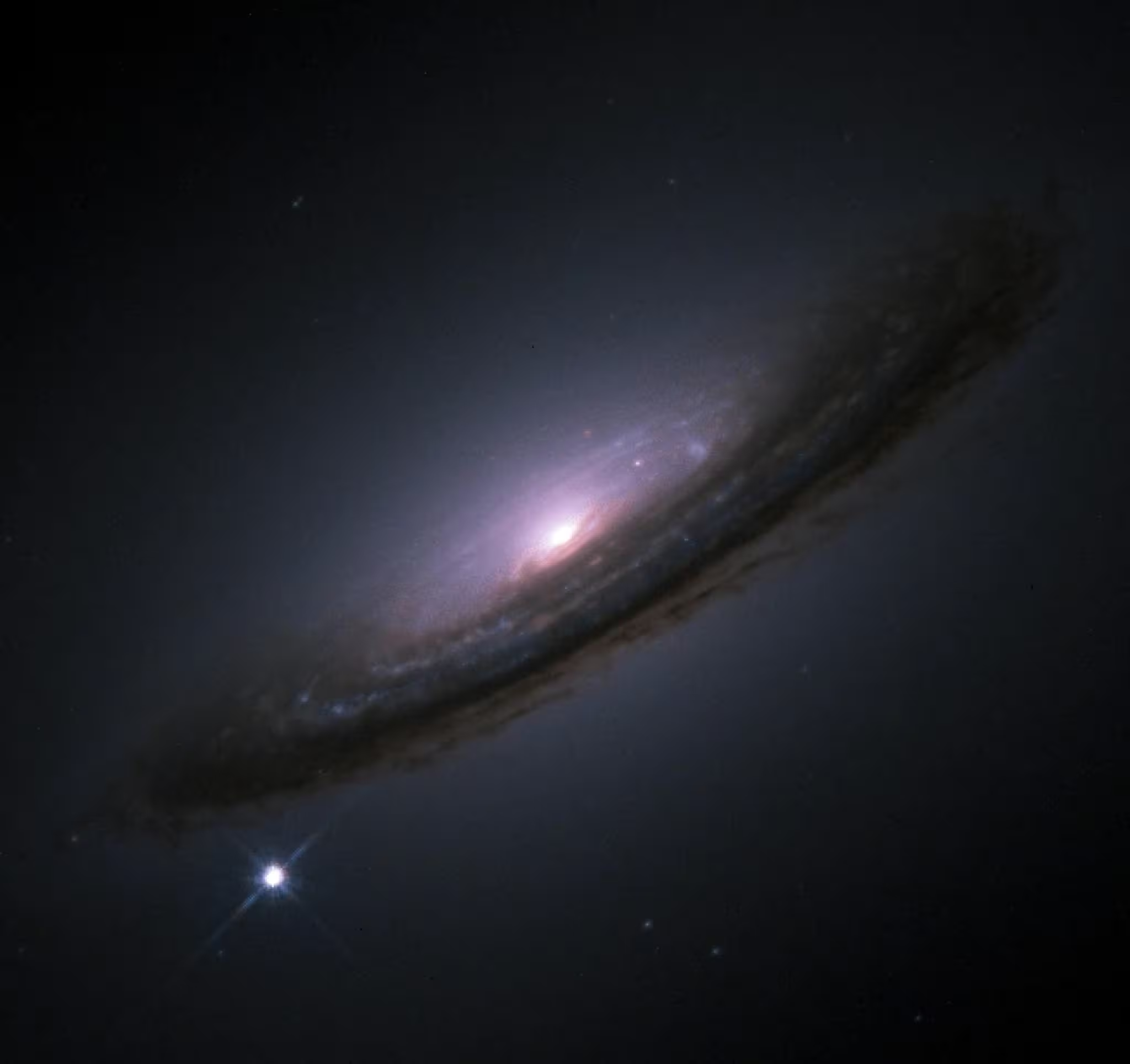
Researchers used type Ia supernovae, similar to SN 1994d pictured in its host galaxy NGC 4526, to help establish that the universe’s expansion may actually have started to slow. Credit: NASA/ESA, The Hubble Key Project Team and The High-Z Supernova Search Team
Using a large sample of 300 host galaxies, the team quantified this age-related trend with very high statistical confidence (reported at 99.999%). In practical terms, part of the dimming attributed to accelerating expansion could instead be caused by evolutionary differences in the stars that produce these explosions. Correcting for that “age bias” reshapes the cosmological fit.
How corrected supernova data reshape cosmology
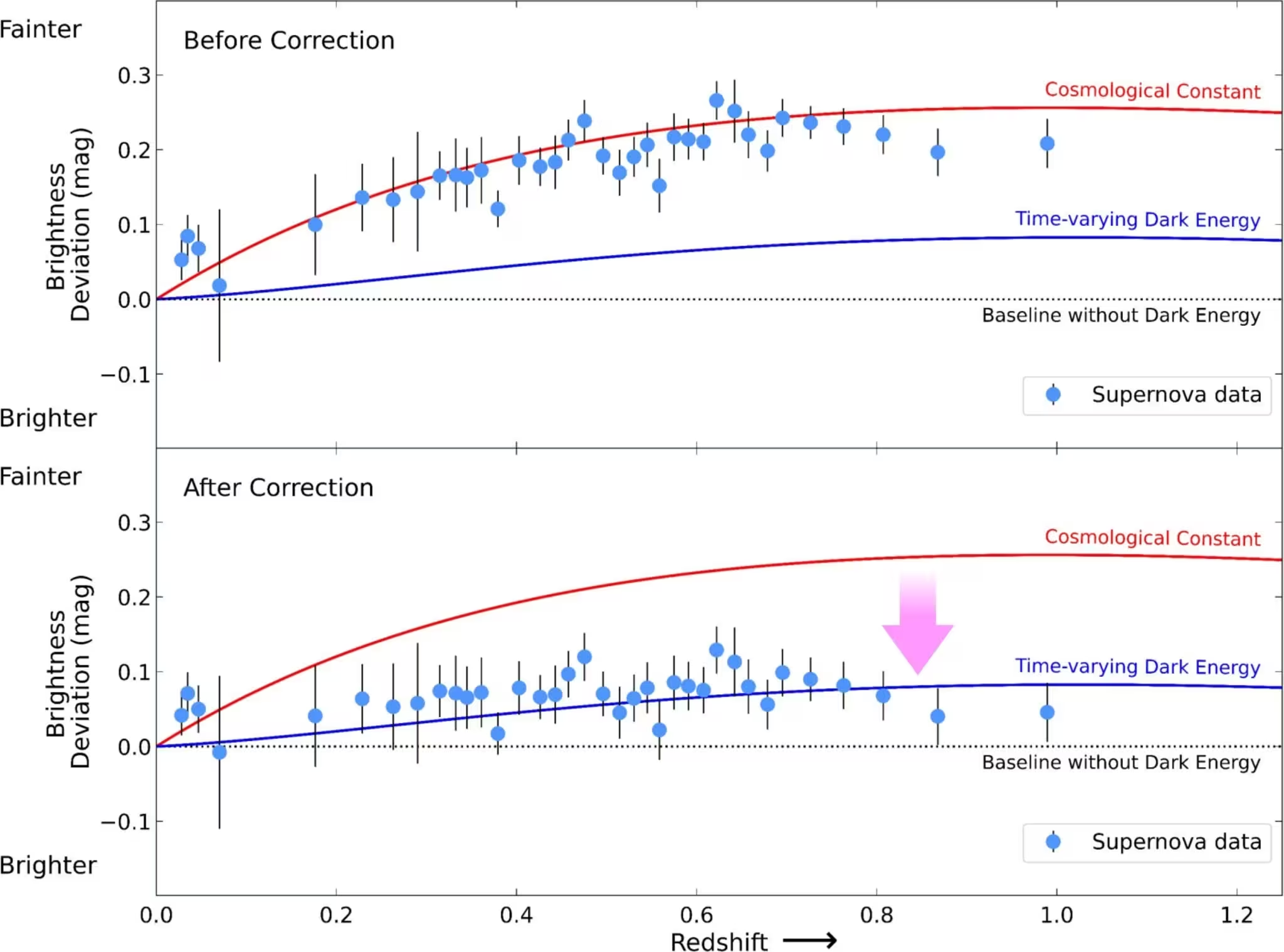
Once age-bias corrections were applied, the corrected supernova data diverged from the red ΛCDM curve typically used to describe a Universe driven by a constant dark energy term. Instead, the adjusted measurements align more closely with models that allow dark energy to evolve with time — models that mirror results from baryon acoustic oscillation (BAO) and cosmic microwave background (CMB) analyses.
The Hubble residual diagram before (top) and after (bottom) the age-bias correction. Corrections are applied to supernova data from the Dark Energy Survey project. After correction, the dataset no longer supports the ΛCDM model (red line) with a cosmological constant, but instead more closely fits with a time-varying dark energy model favoured by a combined analysis using only baryonic acoustic oscillations and cosmic microwave background data (blue line). Credit: Son et al.
In other words, once systematic stellar-age effects are removed, the supernova evidence by itself no longer forces the conclusion that cosmic expansion is accelerating today. Instead, it fits a picture in which dark energy declines over time — potentially strong in the past, weaker now — causing expansion to transition away from acceleration toward deceleration.
Where BAO and CMB fit into the picture
BAO — ripples in the distribution of galaxies left over from pressure waves in the early Universe — and the CMB, the afterglow of the Big Bang, provide independent distance and expansion measurements. The Yonsei team's corrected supernova results agree much more closely with BAO+CMB-only analyses than with the standard ΛCDM expectation.
This convergence matters because it removes a long-standing tension: the so-called Hubble tension, a discrepancy between the expansion rate inferred from local distance ladders (including supernovae) and that derived from the early Universe (CMB). If supernova distances were biased by stellar-age effects, correcting them could ease that disagreement and change the inferred properties of dark energy.
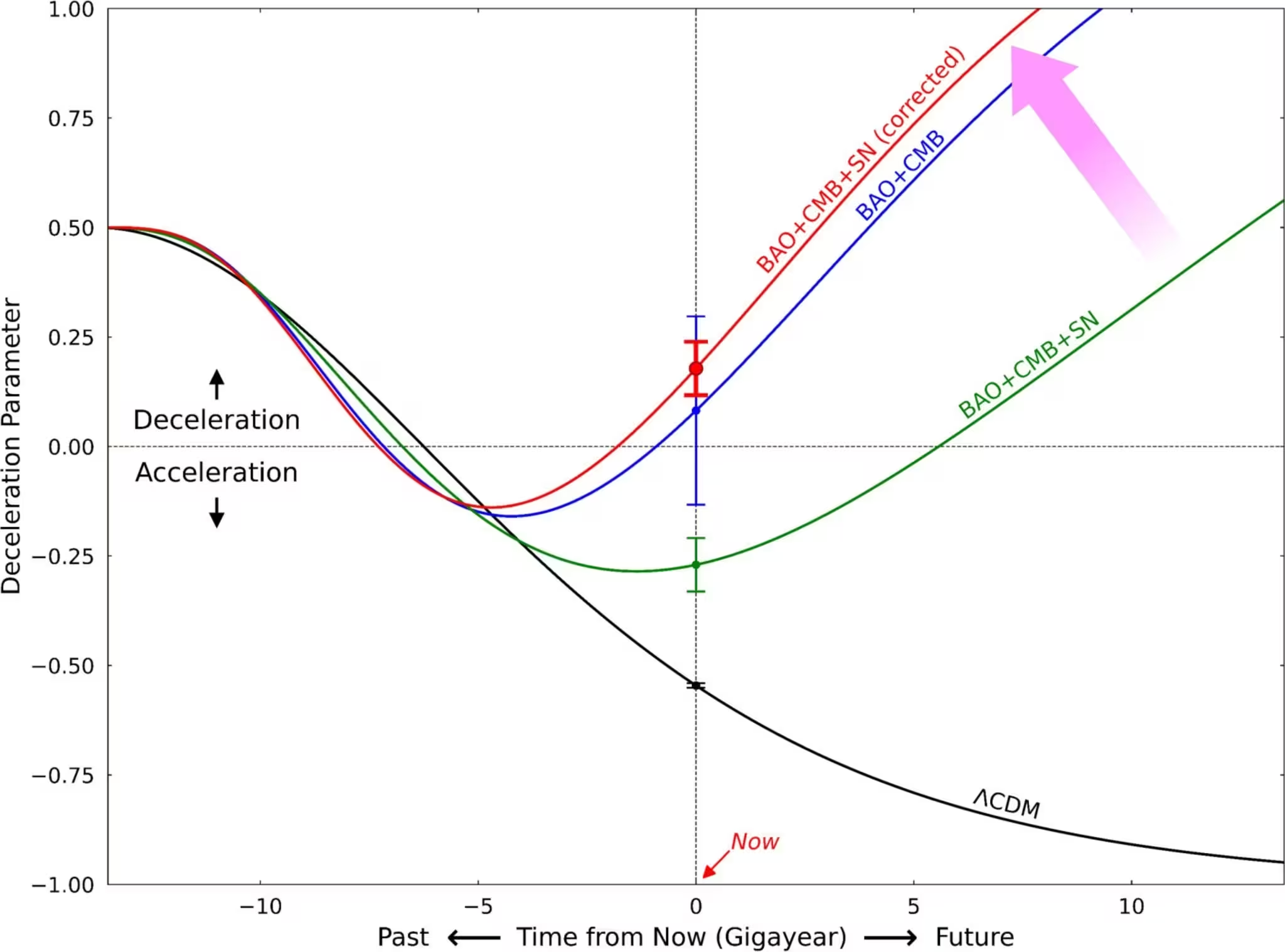
This diagram shows how the universe appears to be in a state of decelerated expansion (red line). The dotted vertical line marks the present epoch, while the black line shows the ΛCDM prediction. The green and red lines represent the new study’s model before (green) and after (red) age-bias correction, consistent with baryonic acoustic oscillations and cosmic microwave background data (blue line). Credit: Son et al.
Implications: dark energy that fades
The core implication of the corrected dataset is that dark energy may not be a constant property of space — a fixed cosmological constant — but rather a dynamic phenomenon that weakens over time. If dark energy decays or varies, the long-term fate of the Universe shifts: rather than perpetual acceleration toward ever greater separation of galaxies, cosmic expansion could slow, and structures may evolve differently than current ΛCDM forecasts predict.
Professor Lee summarized the importance bluntly: their analysis suggests that the Universe has already entered a phase of decelerated expansion in the present epoch. If verified, this would be a paradigm shift of the kind that has seldom been seen since dark energy’s discovery 27 years ago.
Confirming the claim: evolution-free tests and next-generation surveys
Recognizing the extraordinary nature of their claim, the Yonsei team is pursuing an “evolution-free test.” This approach isolates supernovae that come from uniformly young, coeval host galaxies across the full redshift range, reducing potential age-driven biases altogether. Early results reportedly support the main conclusion.
Looking ahead, the Vera C. Rubin Observatory — now conducting surveys with the world’s most powerful digital camera — will find tens of thousands of new supernova host galaxies. With precise age measurements for these hosts, astronomers will be able to test the age-bias correction with much higher precision within the next five years, according to research professor Chul Chung and co-lead PhD candidate Junhyuk Son.
After the Big Bang and the rapid expansion of the Universe some 13.8 billion years ago, gravity slowed it down. But in 1998, it was established that nine billion years after the Universe began, its expansion had started to speed up again, driven by a mysterious force. The new results suggest that acceleration might not be the current state after all.
Expert Insight
“This is exactly the kind of result that demands cautious curiosity,” says Dr. Maya Patel, an observational cosmologist at the Institute for Cosmic Studies (fictional affiliation). “The correction for host-galaxy age is a plausible systematic that could affect distance estimates. If further analyses with independent datasets confirm the effect, we will need to revisit how we model dark energy and interpret the Hubble tension. But extraordinary claims require multiple lines of consistent evidence — and that verification is now within reach thanks to DESI, Rubin, and other surveys.”
What this means for the big questions
If dark energy is indeed evolving, the stakes are high: we could learn about new physics beyond the standard model of cosmology, constrain theories that link dark energy to scalar fields or modified gravity, and refine predictions for the ultimate destiny of the cosmos. At the same time, the possibility that a subtle measurement bias has skewed decades of interpretation offers a humbling reminder about the importance of systematics in precision cosmology.
In practical terms, the scientific community will look for confirmation through: combining corrected supernova datasets with independent BAO and CMB measurements; applying the evolution-free test across larger samples; and using next-generation instruments (DESI, Vera C. Rubin Observatory, and space missions) to map expansion history with unprecedented detail.
The growing mystery of dark energy remains central. Despite composing roughly 70 percent of the Universe’s energy budget, its nature is still unknown. The Yonsei analysis adds a new angle: dark energy might be fading — and that change, once verified or falsified, could rewrite cosmology.
Related projects and instruments — from DESI's spectroscopic maps to Rubin's time-domain discoveries — will be critical in the coming years. Together, they can either cement this potential turning point in cosmic expansion or show that previous interpretations still stand. Either outcome will deepen our understanding of the Universe.

“The cosmos has always fascinated me. I write about space missions, astronomy, and the technologies pushing humanity beyond Earth.”

Discussion
Leave a Comment