
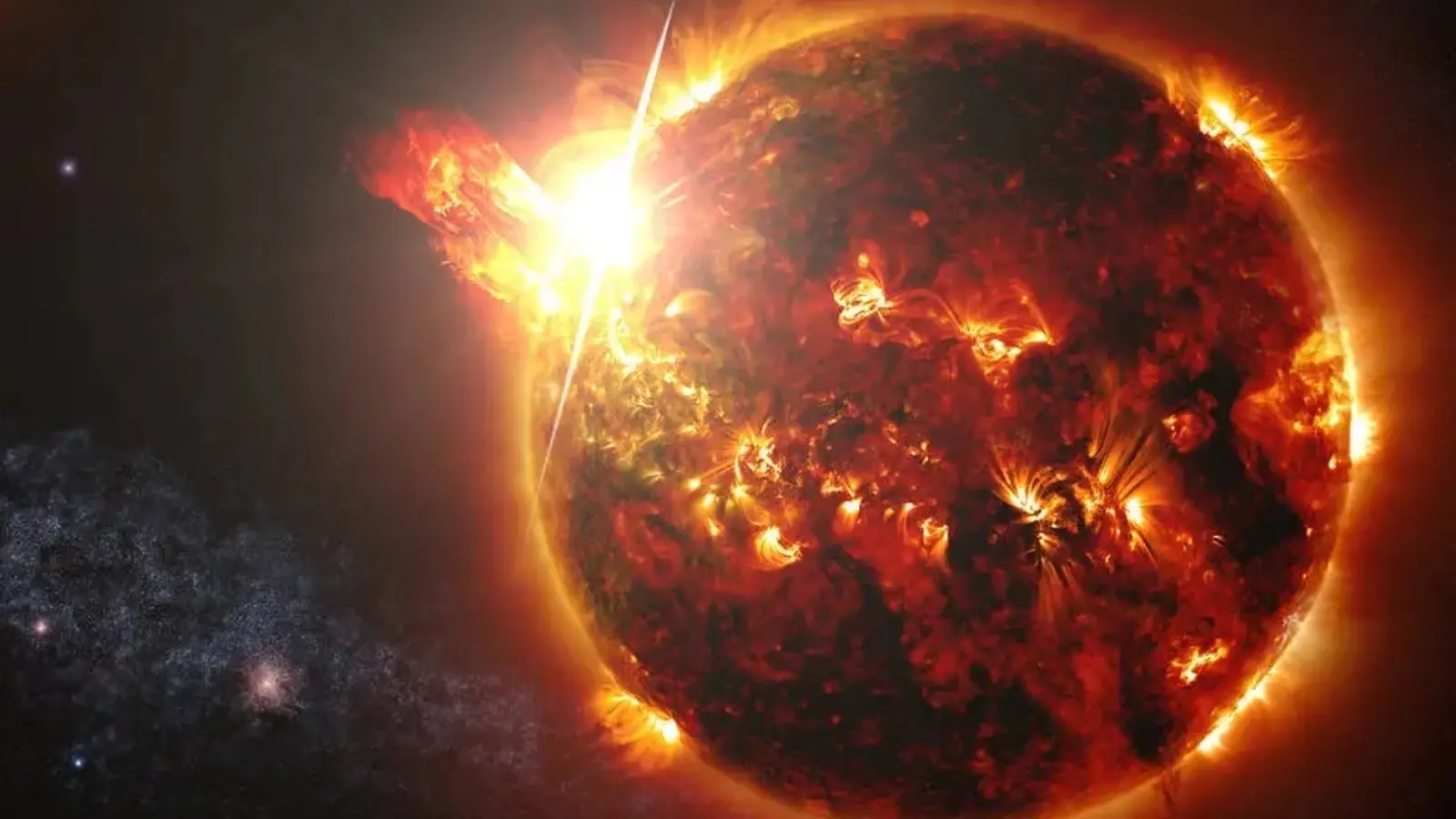
Astronomers have recorded, for the first time, a coronal mass ejection (CME) erupting from a star beyond our Sun — an explosion so powerful it could strip the atmosphere from nearby planets. The finding opens a new window on stellar space weather and raises questions about how hostile some exoplanet environments may be.

The Aurora Australis, also known as the Southern Lights, glows on the horizon over the waters of Brighton Beach in Dunedin on November 13, 2025.
A rare radio snapshot: how the storm was found
The discovery comes from an international team using LOFAR, the Low-Frequency Array — a European network of radio telescopes optimized for faint, low-frequency signals. LOFAR has been mapping extreme radio sources like black holes since 2016, but the team also retained background stellar data. Mining that archive revealed a one-minute radio burst on May 16, 2016, originating from a red dwarf star labeled StKM 1-1262, roughly 133 light-years away.
Why radio matters
Coronal mass ejections on the Sun are known to accelerate charged particles and produce radio signatures; detecting similar radio fingerprints from another star provides direct evidence of a stellar CME. LOFAR’s sensitivity to low-frequency radio waves allowed researchers to recognize the burst pattern and identify it as a CME rather than a flare or instrumental artifact.
Researchers estimate this stellar CME was at least 10,000 times more energetic than many solar storms we observe from the Sun. That intensity — sustained over even short time scales — would be devastating for a planet lacking a strong magnetic field or dense atmosphere.
Implications for exoplanets and habitability
Red dwarfs (M-dwarfs) are the most common host stars for Earth-sized exoplanets and have long been targets in the search for life beyond our solar system. But this new detection suggests their magnetic activity may be far more erratic and violent than previously appreciated. Powerful CMEs can erode atmospheres, strip water, and bombard planetary surfaces with high-energy particles — processes that reduce the odds for life as we know it.
"This is the first radio detection of a CME on another star and it inaugurates a new era for space weather applied to other star systems," said Philippe Zarka of the Paris Observatory, a co-author on the study. He and colleagues argue that characterizing stellar magnetic storms is essential for assessing exoplanet habitability.
Co-author Cyril Tasse explained that while LOFAR routinely includes stars in its fields of view, the team developed data pipelines that retain and flag transient stellar events. Their archival search, begun in 2022, is already paying off: the one-minute event in 2016 stood out as a powerful ejecta signature when reprocessed with algorithms tuned for stellar radio transients.
Context: what this means for space weather studies
On Earth, CMEs can disrupt satellites, power grids, and create auroras visible at high latitudes — and occasionally much farther south during extreme storms. Agencies such as NOAA monitor solar activity because of these societal impacts. Extending the concept of space weather to other star systems introduces a comparative perspective: not all suns behave like ours, and some stellar environments may be intrinsically hostile to atmospheres and life-bearing chemistry.
Beyond habitability, detecting CMEs on other stars helps astrophysicists test models of stellar magnetism, particle acceleration, and angular momentum loss. Future radio surveys, combined with optical and X-ray monitoring, can map the frequency and energy distribution of such events across stellar types.
Expert Insight
Dr. Maya Singh, an astrophysicist working on exoplanet atmospheres, commented: "This detection is a turning point. We now have direct evidence that some stars produce eruptions orders of magnitude stronger than the Sun's. For planets orbiting close to red dwarfs, repeated exposure to these storms could remove atmospheres in geological blink-of-an-eye timescales. That changes how we prioritize targets for biosignature searches."
Looking ahead, astronomers plan to widen archival searches and run dedicated monitoring campaigns with LOFAR and complementary instruments. By cataloguing stellar CMEs and their radio signatures, researchers aim to quantify how common extreme space weather is and refine models of exoplanetary environment evolution.

“My work centers on sustainability, energy, and environmental science — examining how innovation can lead to a greener future.”

Discussion
Leave a Comment