
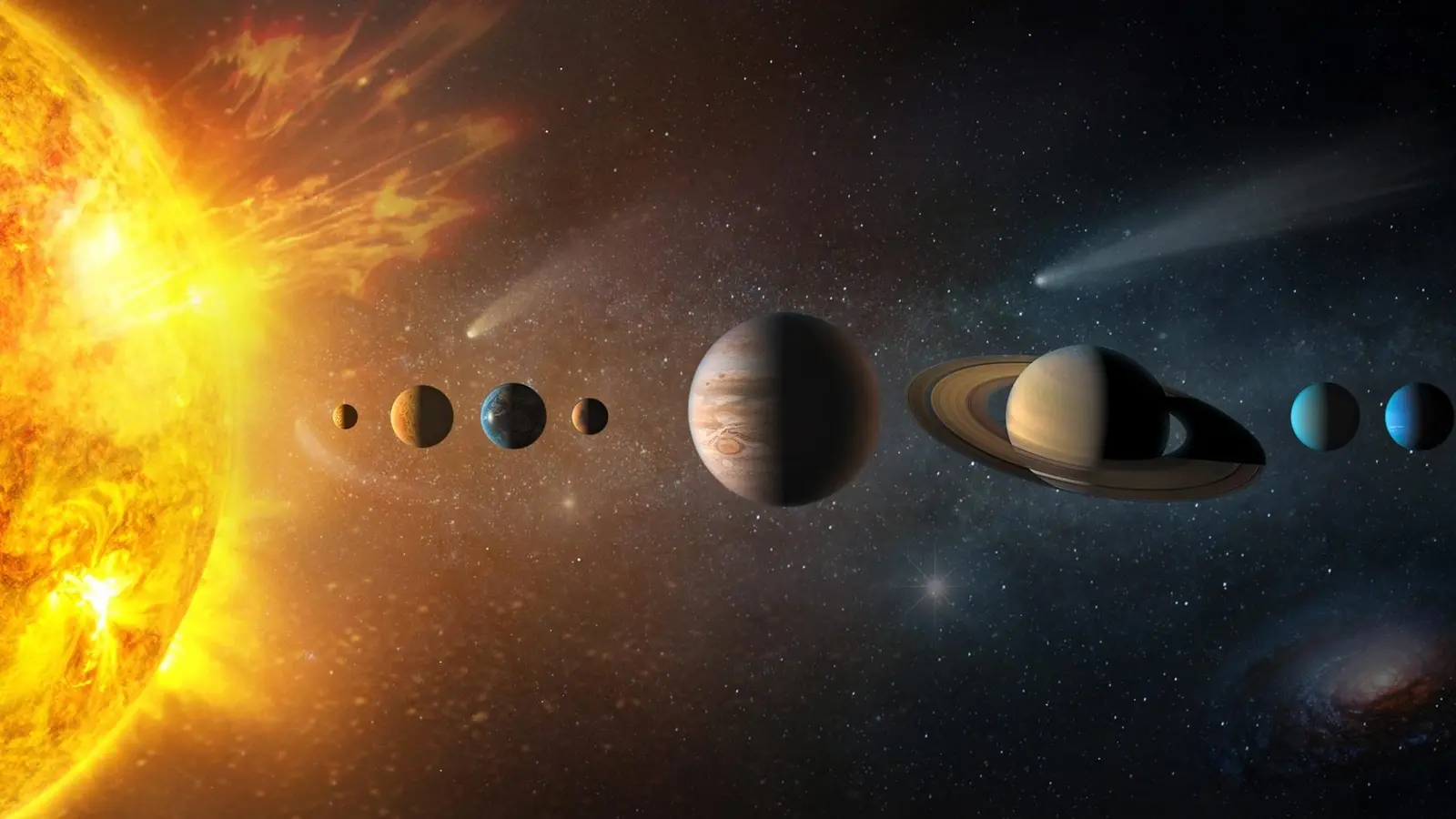
New measurements of distant radio galaxies suggest our solar system is racing through space far faster than standard cosmology predicts. A team at Bielefeld University reanalyzed radio-source counts and found a strong directional signal that challenges assumptions about the large-scale uniformity of the universe.
A new analysis of radio galaxies hints that our solar system is racing through the universe much faster than expected, defying key predictions of standard cosmology. Credit: Shutterstock
How did astronomers measure our cosmic motion?
Measuring the motion of the solar system relative to the cosmos relies on tiny asymmetries in the sky. As we move through space, the distribution of very distant sources — like radio galaxies and quasars — becomes subtly anisotropic: slightly more objects appear in the direction of motion than behind it. That preferred-direction signal is often called a dipole anisotropy.
To probe this effect, Lukas Böhme and colleagues at Bielefeld used data from LOFAR, the LOw Frequency ARray, together with two other large radio surveys. Radio wavelengths are ideal because they penetrate dust that would hide optical sources and reveal populations of galaxies that otherwise escape detection.
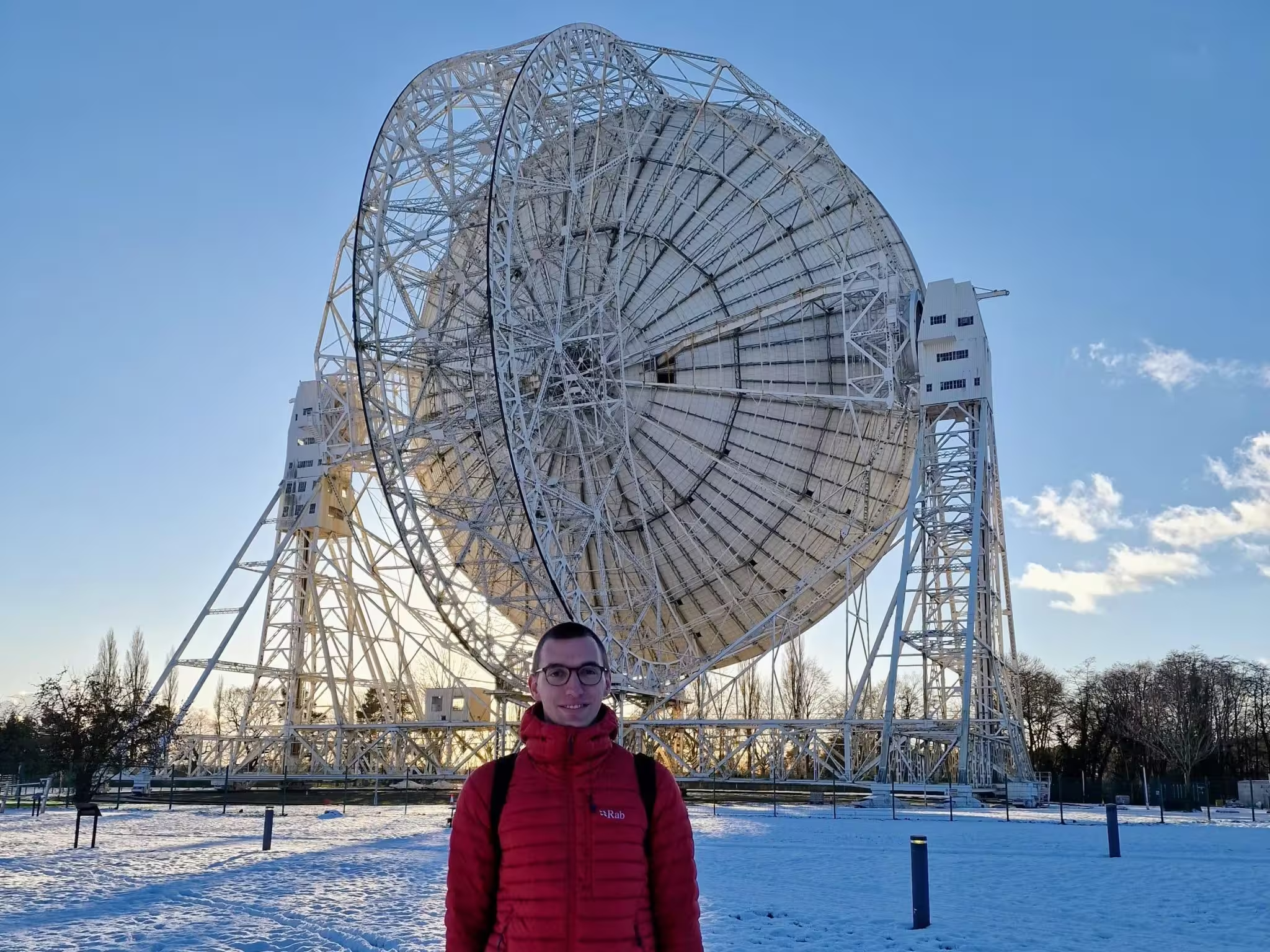
Bielefeld scientist Lukas Böhme, lead author of the study, in front of the Lovell Telescope at the Jodrell Bank Radio Observatory in England.
What did the team find?
Applying a refined counting method that accounts for multi-component radio sources, the researchers produced more robust uncertainty estimates. Instead of reducing the signal, this careful approach confirmed a surprisingly large dipole: the observed anisotropy in radio-galaxy counts is about 3.7 times stronger than predicted by the standard cosmological model.
Statistically, the combined datasets produced a deviation exceeding five sigma — a conventional threshold that signals a very unlikely chance fluctuation. In plain terms, the sky shows a directional excess of radio sources that is hard to explain under current assumptions about cosmic homogeneity.
Why this matters for cosmology
The standard model of cosmology assumes the universe is, on the largest scales, statistically uniform and isotropic. If our measured motion relative to distant radio galaxies is indeed three times larger than expected, two broad possibilities follow: either the solar system is moving anomalously fast, or the distant radio-source distribution itself is not as uniform as models assume.
Professor Dominik J. Schwarz, co-author and cosmologist at Bielefeld University, notes that the result forces a reexamination of basic premises: 'If our solar system is indeed moving this fast, we need to question fundamental assumptions about the large-scale structure of the universe,' he says. 'Alternatively, the distribution of radio galaxies itself may be less uniform than we have believed.'
Past anomalies have shown up in different catalogs, too. Infrared studies of quasars revealed similar directional discrepancies, suggesting the effect is not limited to a single instrument or frequency band. That cross-check strengthens the claim that the dipole is a real cosmological feature rather than a measurement artifact.
Methods and technical advances
The study combined LOFAR's deep low-frequency maps with two complementary radio surveys, boosting sky coverage and statistical power. A key methodological innovation was explicit treatment of sources made up of several radio components; counting each complex source correctly avoids bias and enlarges but clarifies error bars.
Researchers also quantified the signal in terms of velocity and statistical significance. A five-sigma excess implies the odds of the measurement arising from random noise are extremely small, prompting the community to consider systematic effects, survey selection biases, and astrophysical explanations for an inhomogeneous radio sky.
Implications and next steps for discovery
If confirmed, the finding could prompt revisions to models of large-scale structure formation or point to previously unrecognized clustering of radio-loud galaxies. Upcoming surveys with expanded sky coverage and independent radio telescopes will be crucial. Cross-checks with microwave background dipole measurements and infrared catalogs will help determine whether the discrepancy originates in our motion or the distribution of sources.
Expert Insight
Dr. Elena Martínez, an astrophysicist not involved in the study, comments: 'This result is provocative because it reproduces an odd signal across multiple wavelengths. Either we're missing some subtle observational bias that affects many surveys, or the cosmos is telling us something new about matter distribution on very large scales. Either way, it's exciting for observational cosmology.'
Follow-up work will test instrument systematics, refine source identification, and leverage independent datasets. The discovery illustrates how improved radio surveys and careful statistics can open new windows on fundamental cosmological questions.

“My work centers on sustainability, energy, and environmental science — examining how innovation can lead to a greener future.”

Discussion
Leave a Comment