
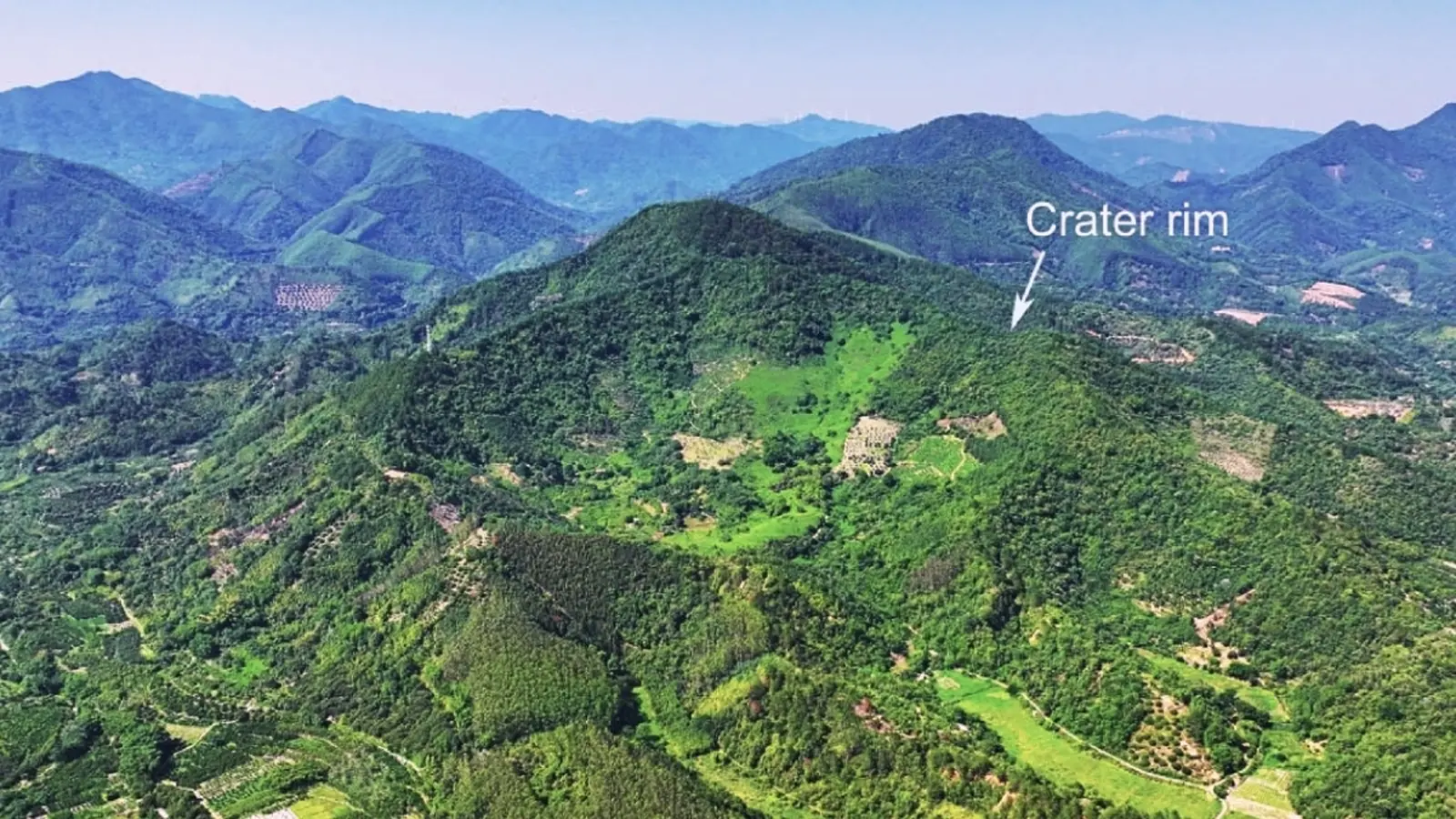
Researchers have identified a surprisingly large impact crater tucked into a forested hillside of Guangdong Province near Zhaoqing City. The newly recognized Jinlin crater is notable not just for its size — roughly the scale of a small town — but for its youth: evidence suggests it formed during the Holocene, after the last ice age ended about 11,700 years ago.
A hidden giant in a humid landscape
Measured between about 820 and 900 metres across and plunging some 90 metres deep, Jinlin eclipses the previous largest Holocene crater, Russia’s 300-metre Macha structure. Discovering such a well-preserved, large impact site in Guangdong — a region shaped by monsoons, heavy rainfall and high humidity — surprised scientists. Those climatic forces normally erase surface scars on timescales far shorter than the Holocene, leaving only subtle geological traces.
Part of the reason Jinlin survived lies in local geology. The crater sits within thick weathered granite that acted like a protective blanket, slowing erosion and preserving the basin’s shape. Field teams mapping soil profiles and measuring erosion rates used those data to constrain when the feature must have formed: likely in the early to mid-Holocene.
Microscopic fingerprints: why scientists say it's an impact
Not every circular depression is a meteor crater. To prove an extraterrestrial origin, researchers rely on shock-produced mineral textures and other unambiguous markers. At Jinlin, geologists found abundant quartz grains showing planar deformation features (PDFs) — microscopic, parallel lamellae inside quartz crystals that form only under extreme shock pressures.
Geophysicist Ming Chen, lead author of the study from the Centre for High Pressure Science and Technology Advanced Research in Shanghai, emphasizes the diagnostic value of these textures: "On Earth, the formation of planar deformation features in quartz is only from the intense shockwaves generated by celestial body impacts." Those shock pressures range between roughly 10 and 35 gigapascals — far higher than typical tectonic or volcanic forces can produce.
Additional field observations and rock fragment assemblages reinforced the impact interpretation. Based on crater scale and morphology, the team concluded the excavating object was a meteorite rather than a comet; a cometary impact of similar speed and density would have produced a dramatically larger crater, on the order of 10 kilometres.
Geological section at the crater floor, showing a mixed accumulation of granite weathered soil and granite fragments.
Why Jinlin changes the picture of Earth's recent impacts
Only around 200 impact craters are confirmed on Earth today, and that count is shaped as much by preservation and survey effort as by actual impact frequency. Hard-rock landscapes, arid climates and regions with active geological programs tend to retain and reveal craters more readily. Jinlin’s discovery on a remote, forested hillside underscores a key point: many sizable impacts may be hidden in regions where erosion, vegetation and a lack of focused fieldwork mask their traces.
Meteor Crater in Arizona is perhaps one of the most famous impact craters on Earth.
Beyond filling a gap in the catalog of Holocene impacts, Jinlin offers a natural laboratory to study preservation processes. Comparing how quickly different terrains erase impact signatures helps researchers correct for observational bias in estimating impact rates and hazards. Continued study — including geochemical analyses to pin down whether the meteorite was stony or iron — will refine estimates of the impactor’s mass and velocity and improve models of how such events influence local environments.
In practical terms, the find also highlights how new technologies — high-resolution drone imagery, systematic erosion mapping and targeted microscopic analysis — are changing how geologists find and verify craters. Imagine scanning remote hillsides worldwide with these tools: more hidden scars of cosmic collisions could come to light, reshaping our understanding of Earth’s recent bombardment history.

“The cosmos has always fascinated me. I write about space missions, astronomy, and the technologies pushing humanity beyond Earth.”

Discussion
Leave a Comment