
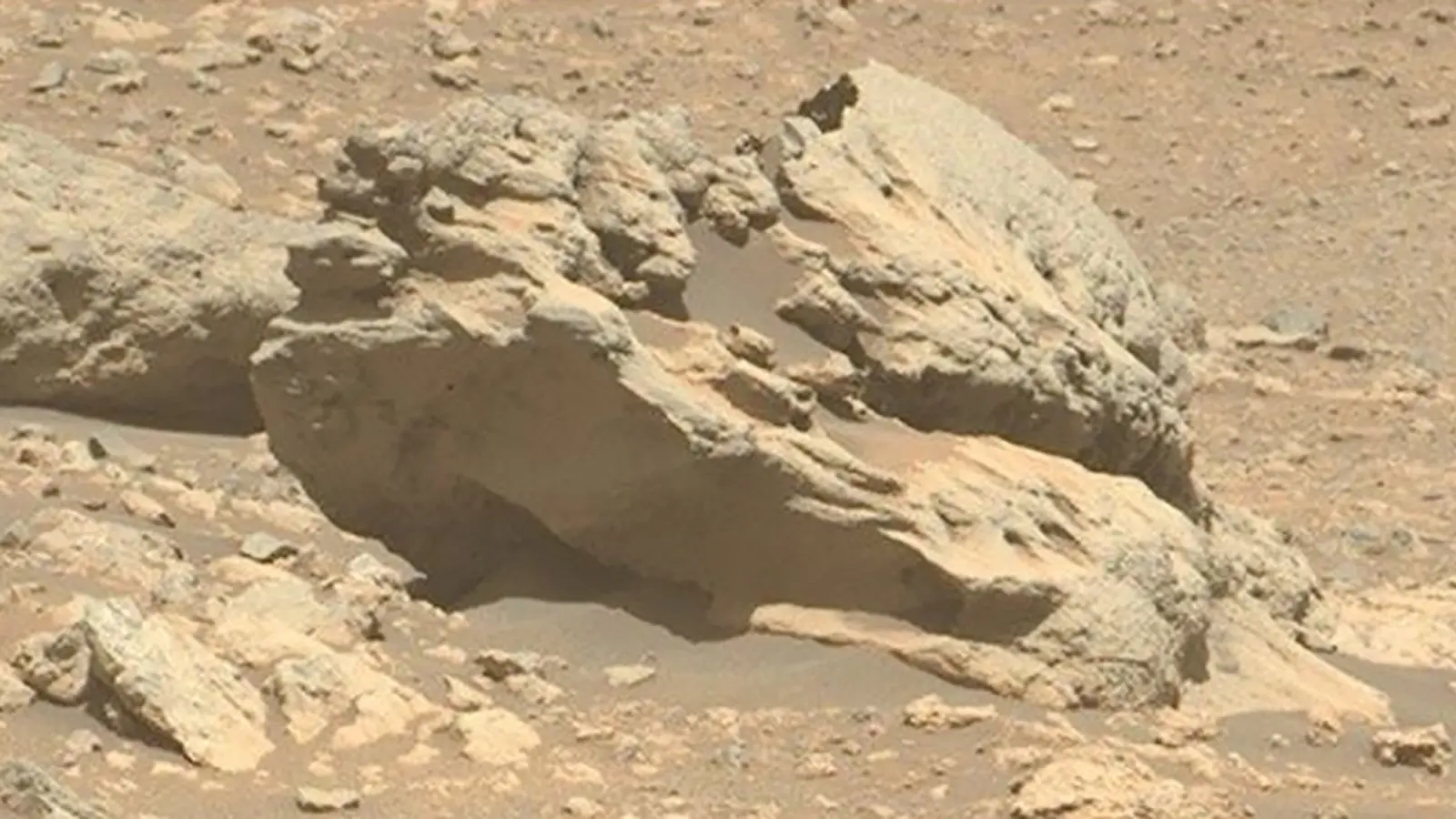
After more than five years roaming Jezero Crater, NASA’s Perseverance rover has photographed a strange, iron-rich boulder that stands out from its surroundings. The object, nicknamed Phippsaksla, may not be Martian at all — and if confirmed, it would add to the growing catalogue of meteorites on Mars.
An oddball on the Martian plain
Perseverance encountered the roughly 80-centimeter (about 31-inch) stone in the Vernodden region of Jezero Crater. Its size, unusual shape and sculpted texture immediately drew attention from mission scientists. Mastcam-Z cameras on the rover captured both close and wider-angle views, showing a rock that rises above nearby clasts and whose surface appears weathered in a different way than the local bedrock.
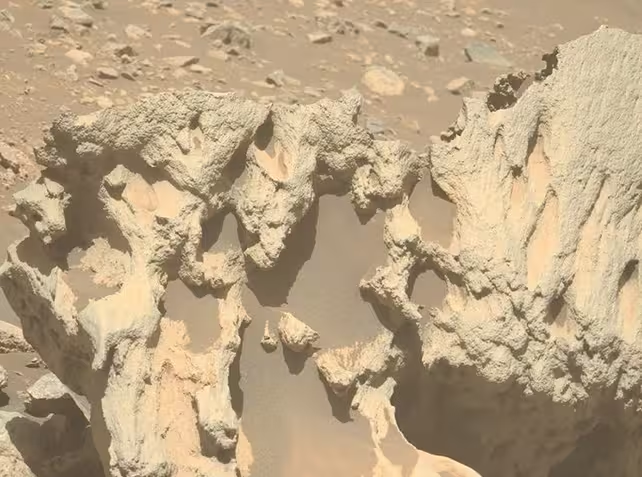
A close-up of Phippsaksla
Why scientists think it might be a meteorite
Perseverance didn’t just take pictures. The rover trained its SuperCam instrument on the rock and used laser-induced breakdown spectroscopy and other spectrometers to read its chemical fingerprint. Those measurements revealed a composition rich in iron and nickel — a hallmark of metallic meteorites.
Iron-nickel meteorites are less common than stony meteorites and generally originate from the cores of larger asteroids. In the early Solar System, heavy metals sank into the centers of melting parent bodies; when those bodies were later fractured, fragments of the metallic core were flung into space. Finding such a fragment on Mars tells a story about impacts, transport, and the diversity of material that has reached the planet.
Context: Meteorites on Mars and the Perseverance mission
Mars is already known to host iron-nickel meteorites — previous rovers and orbital surveys have identified similar finds — so Phippsaksla is not unheard of, but it is noteworthy as Perseverance’s first strong candidate of this type. The rover’s scientific toolkit makes it especially well suited to identifying and characterizing these objects in situ.
Why this matters
- Provenance: Pinpointing whether Phippsaksla formed in space or on Mars helps reconstruct the planet’s impact history.
- Composition: Metal-rich meteorites preserve conditions inside their parent asteroids and provide clues about early Solar System differentiation.
- Sampling potential: If Perseverance engineers decide Phippsaksla is a compelling target, the rover could collect and cache material for future return to Earth.
Mission tools and the path to sample return
Since landing in February 2021, Perseverance has demonstrated several firsts: it’s drilled and cached rock cores, used onboard laboratories to characterize minerals, and explored ancient lake-bed deposits for signs of past habitable environments. The rover’s drill and sealing system allow scientists to set aside samples that a future fetch mission could retrieve as part of the Mars Sample Return campaign.
Perseverance itself cannot deliver samples back to Earth; a follow-up mission will be required to collect the cached tubes and launch them off Mars for transport home. In the meantime, instruments like Mastcam-Z and SuperCam continue to expand our catalog of Martian materials and build the case for which samples are the highest scientific priority.
What Phippsaksla could tell us
Confirming Phippsaksla as an iron-nickel meteorite would strengthen evidence about the types of extraterrestrial material that land on Mars and how those objects weather in a cold, thin atmosphere. Metallic meteorites also offer a relatively uncontaminated archive of early Solar System chemistry, because their dense metal resists alteration more than many stony rocks.
Beyond pure science, such finds are also practical: metal meteorites can serve as calibration targets for instruments and as reference points for understanding Martian surface processes, erosion rates and local geology.
Expert Insight
"Every metallic meteorite we find on Mars is a direct sample of another body in the Solar System," says Dr. Elena Vargas, a planetary geologist. "Phippsaksla could help us link impactors to asteroid families and refine models of how materials are distributed across planetary surfaces. Even if it's small, its story is outsized."
Further analysis will be required to confirm the rock’s classification. For now, Phippsaksla is another intriguing data point in Perseverance’s ongoing exploration of Jezero Crater — proof that, even after years on the ground, the rover is still finding surprises.

“My work centers on sustainability, energy, and environmental science — examining how innovation can lead to a greener future.”

Discussion
Leave a Comment