
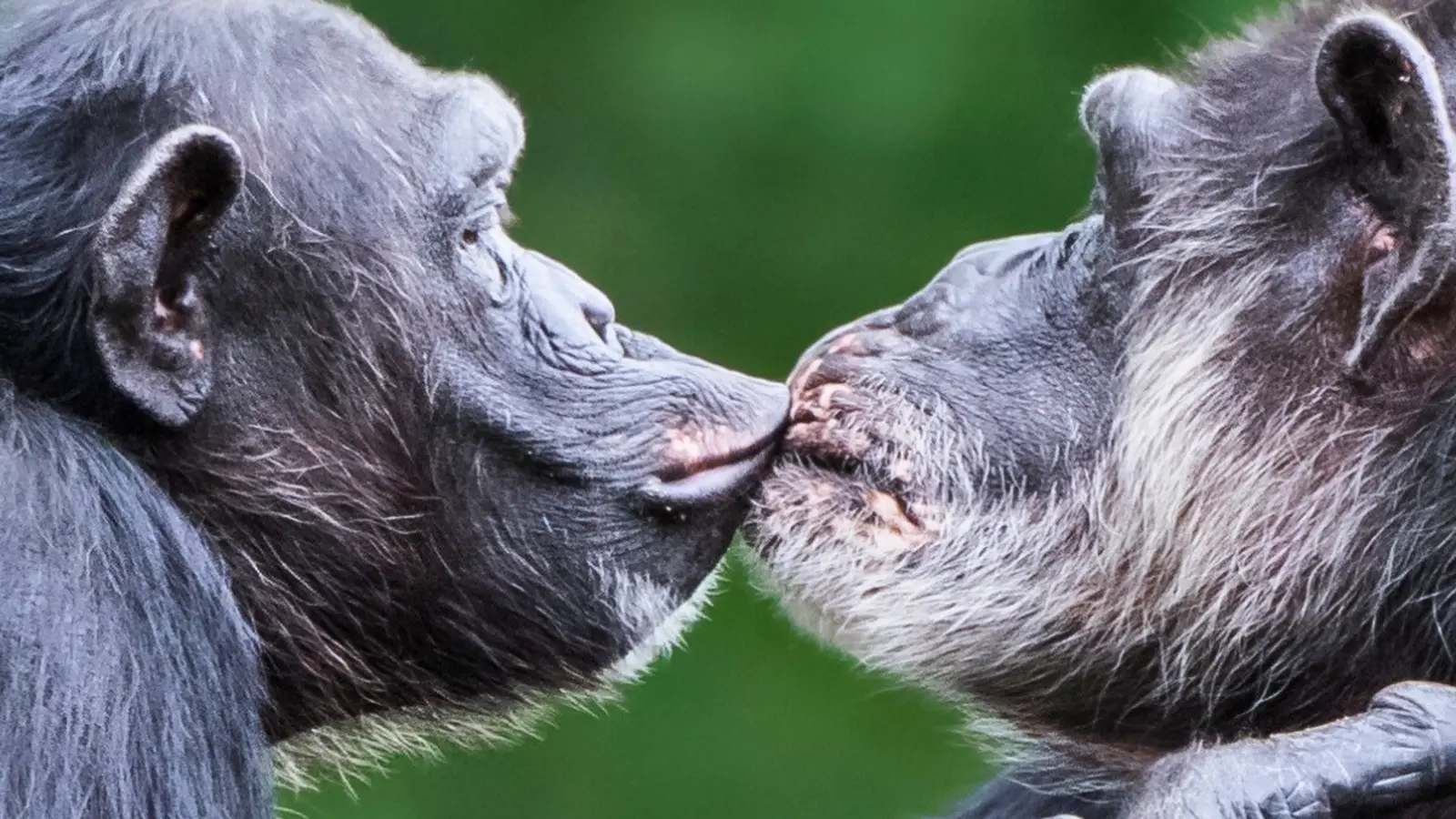
New research suggests kissing is far older than Homo sapiens — a behavior that may date back some 17–21 million years and was likely practiced by our ape ancestors and even Neanderthals.
A mouth-to-mouth behavior that predates humans
Scientists at the University of Oxford, publishing in the journal Evolution and Human Behaviour, approached kissing as an evolutionary trait rather than a purely cultural habit. For this study, researchers defined kissing narrowly as non-aggressive mouth-to-mouth contact that does not involve food exchange. That clear definition allowed them to treat kissing as an observable trait across primates and to trace its history on the primate family tree.
Observations from living great apes — including chimpanzees, bonobos and orangutans — provided the empirical foundation. The team mapped recorded instances of mouth-to-mouth contact onto a well-established primate phylogeny and ran simulations to estimate the likelihood that ancestral nodes had the same trait. Their models point to a high probability that kissing-like behaviour evolved in the common ancestor of the large apes roughly 17–21 million years ago, and that it was maintained through evolutionary time.
How the habit might have helped our ancestors
Why would kissing persist despite obvious costs such as disease transmission? The study authors and other experts propose several adaptive benefits that could explain its retention. Kissing may help reinforce social bonds, provide cues about mate health and fertility through saliva chemistry, or even aid close-group thermoregulation — a useful trait in cold climates. The Oxford team also notes that Neanderthals, whose lives overlapped with early modern humans, could plausibly have used mouth-to-mouth contact for warmth or social bonding during Ice Age conditions.
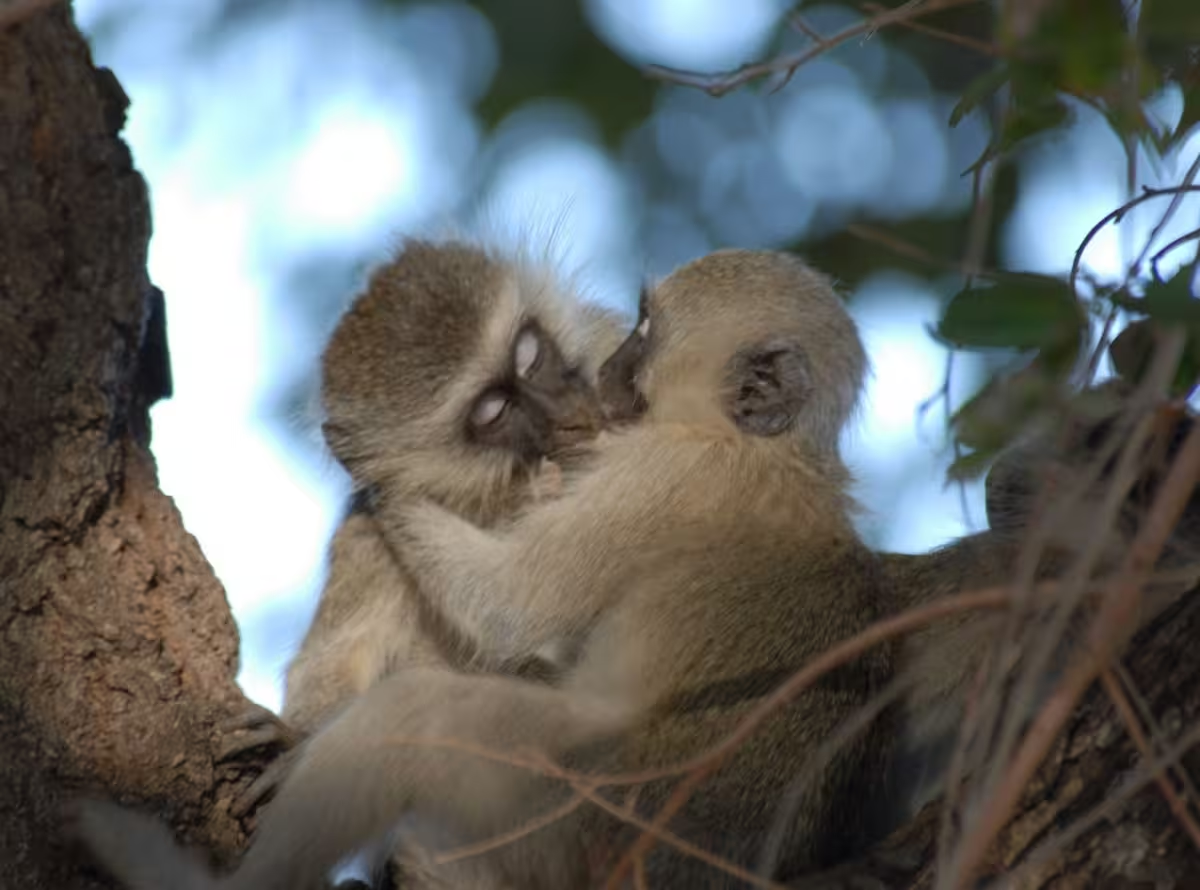
The research complements earlier work showing oral microbial overlap between humans and Neanderthals, evidence consistent with direct saliva transfer across species. That microbiome data does not prove kissing on its own, but combined with the new evolutionary reconstruction it strengthens the case that intimate mouth contact was more widespread among hominins and apes than previously assumed.
Co-author Matilda Brindle, an evolutionary biologist at Oxford, said the study brings a broad evolutionary lens to a behaviour often treated as purely cultural, and highlights the wide diversity of primate sexual and social behaviours. The findings invite follow-up studies linking behaviour, microbiomes and environmental pressures to better understand when and why kissing emerged and persisted.
Future work could expand observational datasets for lesser-studied primates, analyse saliva chemistry across species, and model trade-offs between bonding benefits and infection risks. Together, these approaches will refine our picture of a surprisingly ancient social gesture: the kiss.

“The cosmos has always fascinated me. I write about space missions, astronomy, and the technologies pushing humanity beyond Earth.”

Discussion
Leave a Comment