
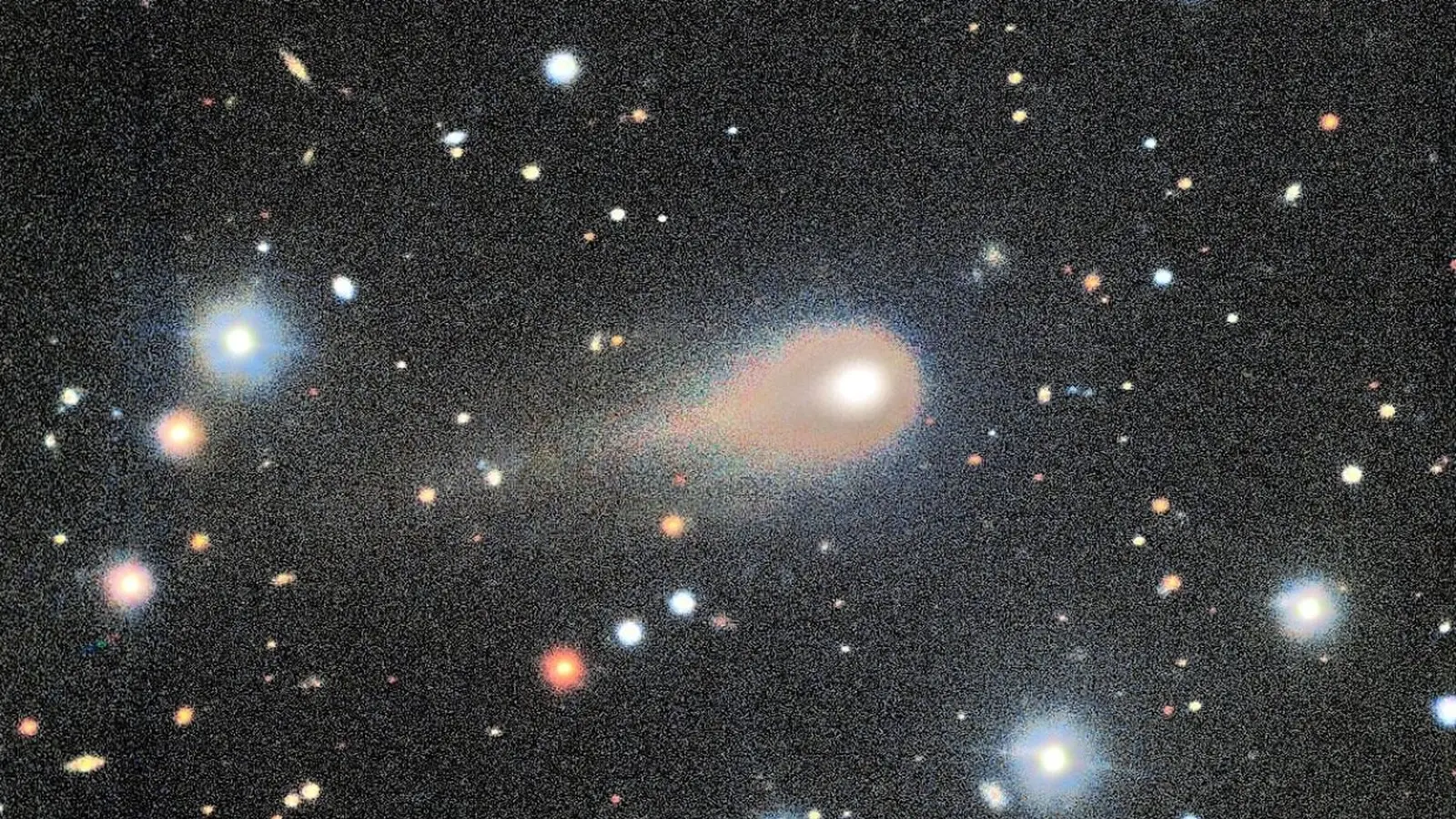
NASA has released the most detailed set of observations to date of interstellar comet 3I/ATLAS, combining views from solar observatories, Mars missions, and ground-based photographers to build a fuller picture of this rare visitor.

PUNCH’s observations of 3I/ATLAS when the comet was 231–235 million miles from Earth.
Why Mars got the best seat in the house
When 3I/ATLAS swept through the inner Solar System, its closest approach to the Sun—perihelion—occurred at a time when Earth was on the far side of the Sun and poorly placed for observations. Mars, however, sat on the favourable side of the Sun, only a whisker away in astronomical terms. That serendipity allowed Mars-orbiting and surface assets to capture the comet nearer to perihelion than any Earth-based facility could at that time.
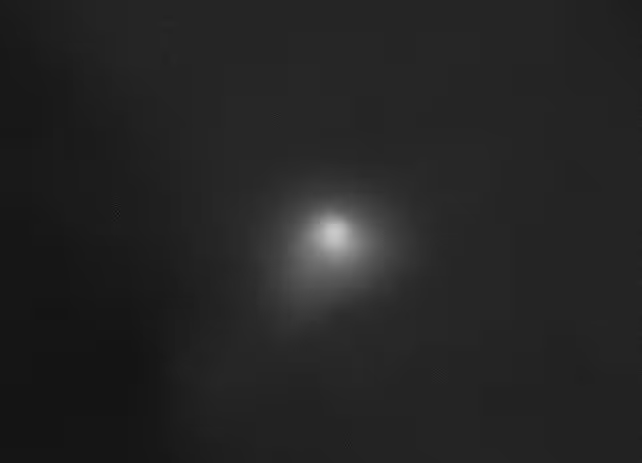
MRO's view of comet 3I/ATLAS, snapped from a distance of just 30 million kilometers, or 19 million miles, on 2 October 2025.
Tom Statler, a NASA planetary scientist, put it plainly: the comet "arrived at its closest point to the Sun when the Earth was on the wrong side for us to conveniently observe." Mars-based platforms like the Mars Reconnaissance Orbiter (MRO) and the MAVEN orbiter were on the right side, and they took advantage. Even the Perseverance rover on the Martian surface adjusted its observing schedule to watch the visitor pass.
Missions that chased a comet across the Solar System
NASA marshalled a wide array of instruments to track 3I/ATLAS. From solar-orbiting observatories to interplanetary spacecraft, the data set is unusually broad for a transient target.
- PUNCH, STEREO and SOHO—solar observatories operating in different parts of heliocentric orbit—captured the comet in white light and helped trace its path against the bright background near the Sun.
- MRO provided optical imaging from Mars orbit at distances as close as roughly 19 million miles (30 million km), offering a rare near-perihelion perspective.
- MAVEN observed in ultraviolet wavelengths, which are particularly useful for detecting hydrogen and other volatile species in a comet’s coma and tail—key diagnostics for understanding sublimation and composition.
- Deep-space science missions such as Lucy and Psyche, transiting the asteroid belt, also obtained opportunistic images, showing how flexible interplanetary platforms can be when an unusual target appears.
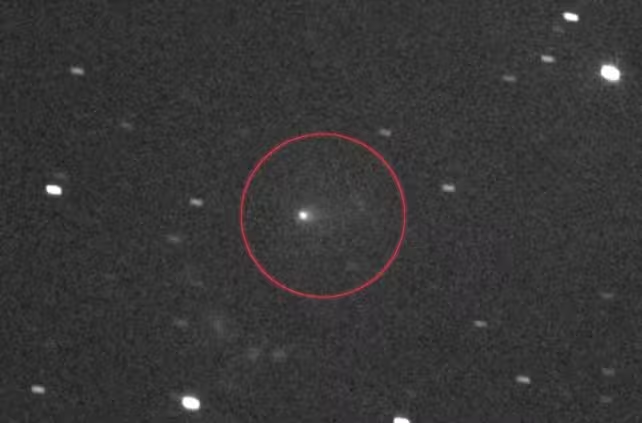
Lucy's happy snap of the interloping comet.
Despite some fuzziness in the images—an expected limitation when non-dedicated missions acquire quick-look data—the combined dataset magnifies the scientific value. Each instrument contributes different wavelength coverage, resolution and vantage point, enabling cross-calibration and complementary analyses.
What the observations reveal about 3I/ATLAS
Since its discovery by the ATLAS survey on 1 July 2025, 3I/ATLAS has defied easy categorization. Its behaviour and appearance are consistent with a natural comet: a nucleus shedding gas and dust as sunlight heats volatile ices. MAVEN’s ultraviolet spectra help confirm that hydrogen and other sublimation products are present in the coma and tail—classic cometary signatures.
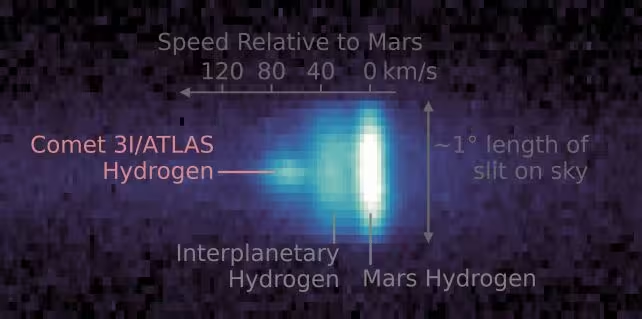
MAVEN observation of 3I/ATLAS on September 28.
NASA officials addressed public speculation directly. "This object is a comet. It looks and behaves like a comet and all evidence points to it being a comet," said an agency representative, noting that its extrasolar origin is what makes it scientifically valuable. The fact that 3I/ATLAS came from beyond our system classifies it as an interstellar object, alongside previous visitors such as ʻOumuamua and 2I/Borisov, but its activity and tail structure make it particularly interesting.
Ground-based imagery is already complementing spacecraft data. Astrophotographer Satoru Murata captured a striking view on November 16 showing long, streaming tails and a slightly green coma—visual markers of gas species like diatomic carbon (C2) and other volatiles commonly seen in comets.
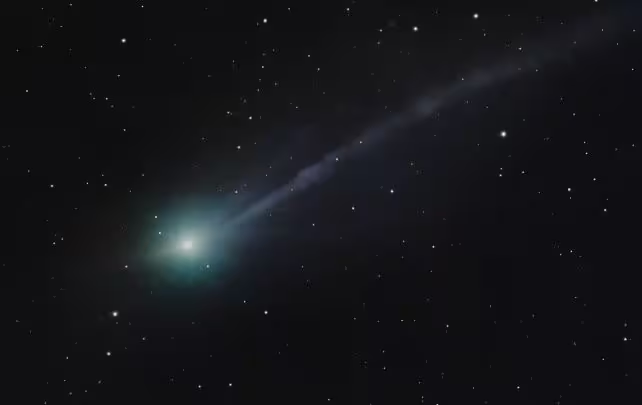
Comet 3I/ATLAS on 16 November 2025, as seen from New Mexico.
Implications for comet science and interstellar research
Each interstellar visitor offers a snapshot of material formed around another star. By combining ultraviolet, optical, and wide-field solar-observatory data, researchers can probe composition, dust-to-gas ratios, and how an interstellar nucleus responds to solar heating. Those measurements feed models of cometary activity and give clues about the chemical diversity of other stellar nurseries.
Upcoming opportunities still remain: 3I/ATLAS will make its closest approach to Earth on December 19, 2025. Although still distant by everyday standards, that flyby will provide the best chance for telescopes on Earth to image and spectroscopically characterize the comet before it fades into interstellar space again.
Expert Insight
Dr. Elena Park, an astrophysicist specializing in small bodies, commented: "Opportunistic observations like these are a reminder of how interconnected our fleet of spacecraft has become. Instruments designed for solar science or Mars exploration suddenly become comet chasers. The ultraviolet data from MAVEN and the optical images from MRO together let us separate dust scattering from gas emission—critical for understanding how this object is shedding material as it heats up near the Sun."
As 3I/ATLAS continues its outbound journey, astronomers will keep combing both archival and new observations to refine its trajectory, composition and behaviour. Each dataset — even those a little fuzzy — contributes to a richer, multi-angle portrait of an object whose origin lies beyond our Sun.

“The cosmos has always fascinated me. I write about space missions, astronomy, and the technologies pushing humanity beyond Earth.”

Discussion
Leave a Comment