
The James Webb Space Telescope has identified phosphine in the atmosphere of an ancient brown dwarf, confirming long-standing theoretical predictions and reopening questions about how phosphorus cycles through cold, hydrogen-rich worlds. The detection on Wolf 1130C—an old, metal-poor brown dwarf orbiting a compact binary—breaks a streak of surprising non-detections and gives astronomers a new laboratory for chemical models and biosignature interpretation.
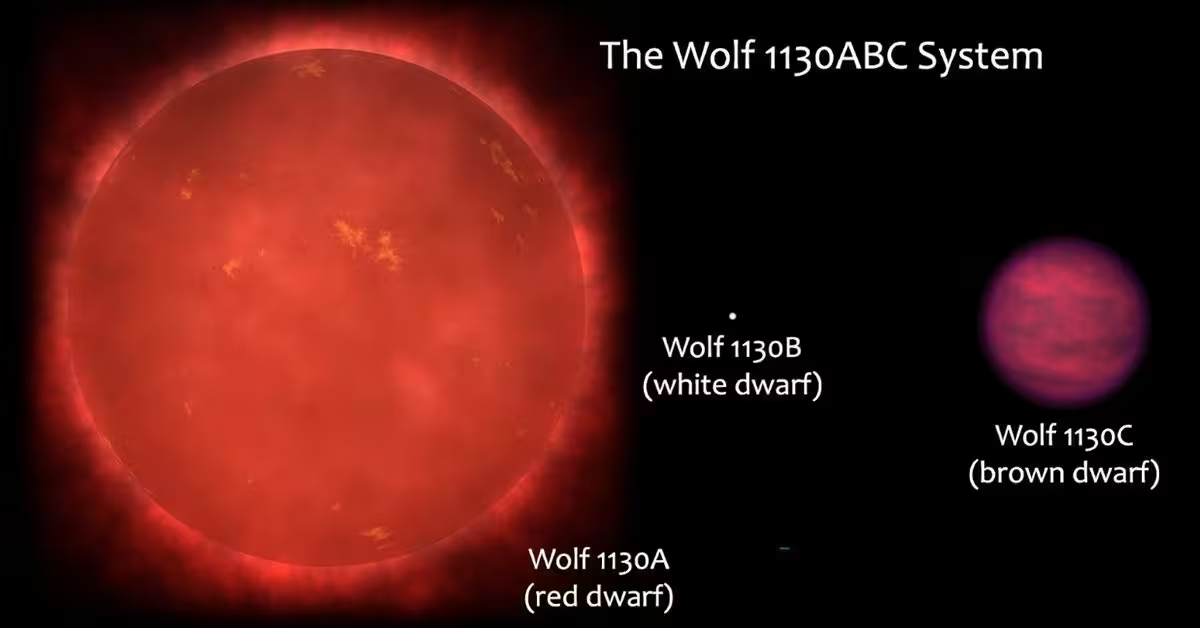
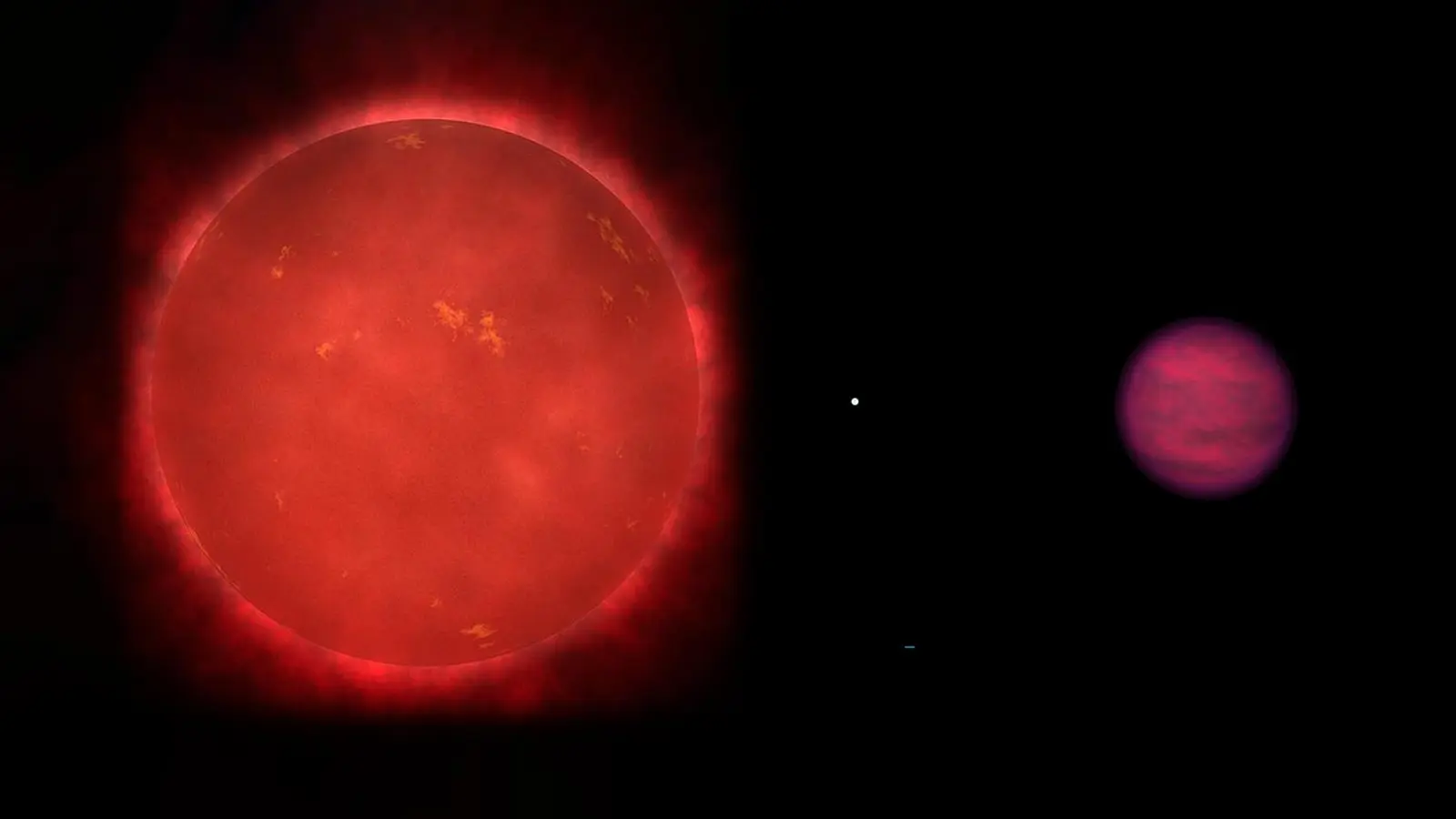
Schematic of the Wolf 1130ABC triple system, composed of the red dwarf star Wolf 1130A (l), its close and compact white dwarf companion Wolf 1130B (c), and the distant brown dwarf tertiary Wolf 1130C (r). The three components of this system are shown scaled to their relative sizes.
Why phosphine matters: chemistry, planets, and life detection
Phosphorus is a key element for life on Earth, a core component of DNA, cell membranes, and energy-carrying molecules like ATP. In reducing, hydrogen-dominated atmospheres, phosphorus can combine with hydrogen to form phosphine (PH3), a molecule that is both chemically reactive and toxic to many life forms. On Jupiter and Saturn, phosphine is a common trace gas produced in the deep, hot interior and dredged upward by turbulent mixing. Because terrestrial planets have few natural pathways to produce PH3 abiotically, phosphine has drawn attention as a potential biosignature on rocky exoplanets, though its interpretation is notoriously context-dependent.
For decades, planetary scientists expected phosphine to appear in the atmospheres of gas giants and brown dwarfs wherever the conditions resembled those of Jupiter and Saturn: abundant hydrogen, sufficient phosphorus in the gas phase, and atmospheric mixing that brings phosphorus-bearing species up from hotter layers. Yet recent observations with powerful instruments, including early JWST datasets, often failed to find the molecule where models predicted it would be abundant. That mismatch between theory and observation motivated renewed surveys of old, low-metallicity brown dwarfs to stress-test chemical models.
Wolf 1130ABC: an unusual neighborhood for an unusual detection
Located about 54 light-years away in Cygnus, the Wolf 1130ABC system is a hierarchical triple: a cool red dwarf (Wolf 1130A) tightly paired with a massive white dwarf (Wolf 1130B), and a distant, ancient brown dwarf (Wolf 1130C) orbiting the pair. Wolf 1130C is particularly attractive to chemists because it is metal-poor—meaning it has lower abundances of elements heavier than hydrogen and helium compared with the Sun. This metal depletion provides a natural testbed for how composition affects atmospheric chemistry.
Using JWST's infrared spectrographs, the team led by Professor Adam Burgasser at UC San Diego obtained high-sensitivity spectra of Wolf 1130C and identified distinctive absorption features attributable to phosphine. The signal was strong enough that the authors could quantify the molecule's abundance using atmospheric retrieval techniques—statistical methods that invert a planet's or brown dwarf's spectrum to estimate temperature structure and molecular concentrations.
Retrieval techniques and the abundance result
- Atmospheric retrievals combine radiative transfer models with optimization algorithms to match observed spectra. They return distributions of likely temperatures, pressures, and molecular mixing ratios consistent with the data.
- In the case of Wolf 1130C, the retrievals indicate phosphine at roughly 100 parts per billion by volume, a level that aligns with prior theoretical expectations for hydrogen-rich atmospheres undergoing vertical mixing.
Eileen Gonzales, an assistant professor at San Francisco State University and a co-author on the study, described the approach as reverse engineering an unknown recipe: the spectral data constrain the possible atmospheric ingredients and their proportions. In Wolf 1130C the spectral fingerprints of PH3 were clear enough to place the gas squarely within the predicted abundance range—an outcome at once satisfying and puzzling, because many similar brown dwarfs and exoplanets observed with JWST lacked comparable phosphine signatures.
Why Wolf 1130C showed phosphine where others did not
The detection raises two leading explanations, both with testable consequences. First, the metal-poor chemistry of Wolf 1130C may favor phosphine formation by limiting alternative phosphorus-bearing molecules. In more metal-rich atmospheres oxygen readily binds phosphorus into oxidized species (for example, phosphorus oxides) that suppress PH3 formation. With less oxygen available in a metal-poor environment, phosphorus may remain in reduced forms and react with abundant hydrogen to produce phosphine.
Second, the system's history could have delivered extra phosphorus to the brown dwarf's atmosphere. White dwarfs like Wolf 1130B can undergo episodic thermonuclear surface events (novae) when accreted material triggers runaway fusion on the dense stellar remnant. Those novae can synthesize and eject heavy elements—including phosphorus—into their surroundings. If Wolf 1130B experienced one or more nova events over the system's long lifetime, material enriched in phosphorus could have been dispersed and later accreted or mixed into Wolf 1130C's atmosphere. Observationally distinguishing intrinsic chemical effects from external enrichment will require targeted searches for correlated elemental anomalies and comparisons across a population of similar brown dwarfs.
Either scenario carries implications for how scientists interpret phosphine detections as potential biosignatures on rocky worlds. If atmospheric composition and system history can produce PH3 abiotically in unexpected settings, then a phosphine detection on a terrestrial exoplanet would need additional context—such as isotopic ratios, co-detection of other gases, or clear geophysical constraints—before being attributed to biology.
Implications for models, missions, and future observations
Wolf 1130C's phosphine detection provides a concrete data point for updating chemical models of phosphorus-bearing species under a range of metallicities and thermal profiles. Modelers will revisit reaction networks, include alternative sinks for phosphorus, and assess how vertical mixing efficiencies change with gravity and age. Observationally, the discovery motivates several follow-up avenues:
- Conducting a targeted JWST survey of metal-poor brown dwarfs to determine whether Wolf 1130C is unique or representative of a broader class.
- Using high-resolution spectroscopy from ground-based observatories to search for other phosphorus-bearing molecules and isotopic signatures that could reveal nucleosynthetic origins.
- Comparing the chemical inventories of brown dwarfs, gas giant exoplanets, and solar system giants to map how composition and dynamics shape phosphorus chemistry across many environments.
These efforts will also refine the observational criteria used in the search for life. By mapping non-biological pathways that produce phosphine, astronomers can better identify which combinations of gases and planetary conditions would make biogenic PH3 the most plausible explanation.
Expert Insight
Dr. Maria Chen, an atmospheric chemist at a national research laboratory, offered perspective on the finding: 'This detection is a welcome calibration point. WD 1130C shows us that PH3 can survive and be detectable in cold, metal-poor atmospheres, which changes how we weight phosphine as a biosignature. It does not rule out biological origins elsewhere, but it emphasizes the need for comprehensive context—composition, dynamics, and system history—before making claims about life.'
Conclusion
The JWST detection of phosphine in Wolf 1130C is both confirmation and provocation: confirmation that our theoretical expectations for PH3 in certain atmospheres can be correct, and provocation because many analogous worlds do not show the molecule. Solving that puzzle will sharpen our chemical models, improve the planning of future observations, and refine the rules by which we assess potential biosignatures. Whether phosphine ultimately points toward life on some worlds or instead becomes a tracer of planetary history and composition, Wolf 1130C has become an important benchmark in understanding the cosmic chemistry of phosphorus.

“The cosmos has always fascinated me. I write about space missions, astronomy, and the technologies pushing humanity beyond Earth.”

Discussion
Leave a Comment