
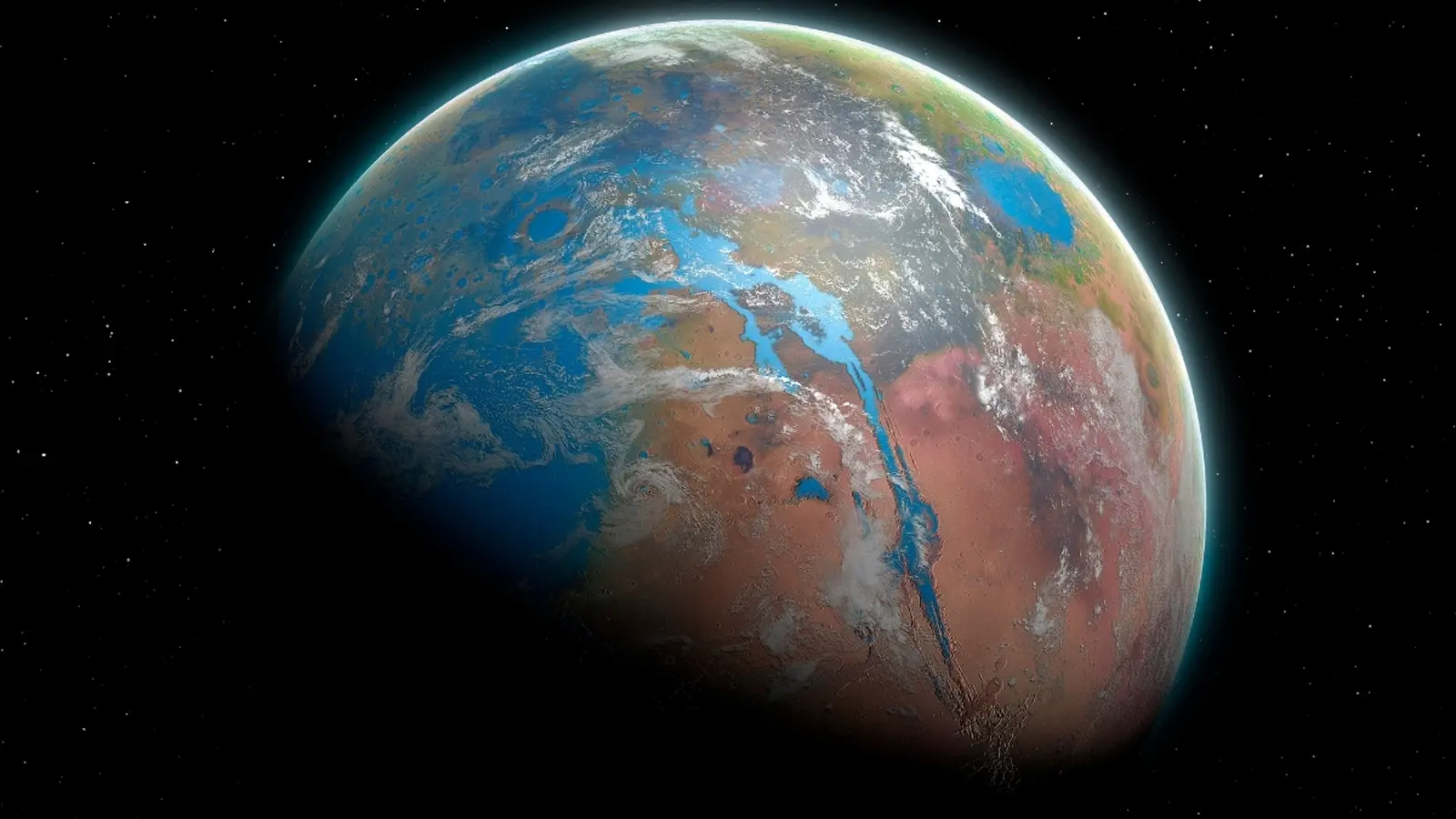
New analyses of rock layers in Gale Crater suggest that Mars held active groundwater for far longer than many scientists assumed. Researchers who re-examined Curiosity rover data found that wind-blown sand dunes were later cemented by mineral-rich water, a process that points to sustained wet conditions and potential habitats on ancient Mars.
Evidence from lithified dunes in Gale Crater
Scientists from New York University Abu Dhabi reviewed observations of the Stimson Formation, a system of lithified (hardened) dunes exposed in Gale Crater and investigated by NASA's Curiosity rover. The team identified mineral textures and chemical signatures that are best explained by interaction with groundwater — not just brief surface floods. Among the telltale signs is the presence of sulfate minerals like gypsum, which commonly precipitate from evaporating or circulating aqueous solutions.
Mastcam mosaics and other in-situ measurements show cross-bedded sandstones whose cementation patterns match late-stage aqueous alteration. In other words, dunes that were initially formed by wind were later percolated and partially reworked by subsurface water. That sequence — aeolian deposition followed by groundwater cementation — implies a climate or subsurface hydrology that could sustain liquid water intermittently for long stretches of time, possibly spanning millions to tens of millions of years.
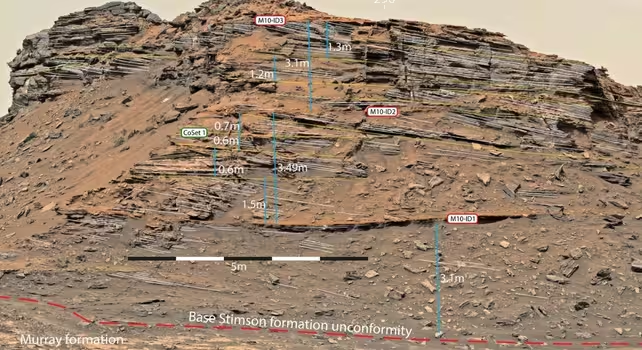
Mastcam mosaic of the Stimson Formation, which formed through interaction with underground water.
Methods, comparisons, and why the UAE desert matters
The research team combined Curiosity's instrument suite data with terrestrial field analogues. They compared Martian observations to sandstone and gypsum deposits in the deserts of the United Arab Emirates, where similar aeolian systems were later altered by groundwater flowing from nearby highlands. By matching grain-scale textures, cement types, and sedimentary structures, the scientists built a compelling case that the Stimson Formation records late-stage aqueous activity on Mars.
Field comparisons are crucial because they let researchers test hypotheses about mineral formation under known environmental conditions. On Earth, gypsum forms when sulfate-rich water evaporates or moves through sediments, leaving behind calcium sulfate dihydrate crystals that glue grains together. Finding comparable mineral assemblages in Gale Crater supports the interpretation that groundwater was involved — and not solely ephemeral surface water from short-lived floods.
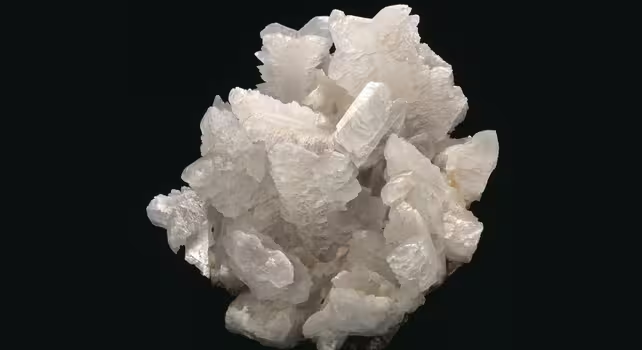
A crystal sample of gypsum
Implications for habitability and life detection
If groundwater circulated through those dune systems for extended periods, the implications for past habitability increase. On Earth, lithified sandstones often preserve microbial communities and organic matter. Microorganisms can bind sediments and induce mineral precipitation, leaving microfabrics and chemical signals that survive over geologic time. The NYUAD team argues that similar preservation could be possible in Gale Crater's lithified dunes, making these sites high-priority targets for life-detection studies.
These findings also reshape timelines for Mars' transition from a warmer, wetter world to the cold, arid planet we see today. Instead of a rapid shutdown of habitable conditions around 4 billion years ago, the record in Gale Crater hints at episodic or persistent subsurface habitability extending later into the planet's history. That opens new windows for where and when to search for biosignatures.
Expert Insight
"The combination of Curiosity's detailed fieldwork and terrestrial analog studies gives us a robust framework for interpreting Martian rocks," says Dr. Elena Soto, a planetary geologist (fictional) who studies sedimentary records on Mars. "Finding evidence that groundwater altered dune systems strengthens the case that habitable niches persisted longer than we once thought. It's a reminder to look beneath the surface — literally — when hunting for signs of past life."
Mission context and next steps
Curiosity's observations come from remote imaging, spectrometry, and chemistry experiments conducted while the rover climbed and sampled features in Gale Crater. The study used the Mars Science Laboratory's publicly available Curiosity Notebook to reanalyze those datasets and integrate them with lab and field comparisons. Future missions with drilling or return capabilities will be needed to recover samples that can test for preserved organic molecules or microscopic biosignatures definitively.
Researchers highlight the importance of targeting lithified depositional environments — such as the Stimson Formation and nearby Greenheugh Pediment — for follow-up exploration. Sandstone-hosted biosignatures are among the most durable on Earth; if similar preservation occurred on Mars, these rocks could hold some of the clearest records of past microbial activity.
Conclusion
The NYUAD-led study adds to a growing body of evidence that Mars' habitable window may have been broader and more complex than a simple early-era shutdown. By recognizing the role of groundwater in cementing dune systems, scientists gain new clues about long-lived aqueous environments and where to focus future searches for traces of life on the Red Planet.

“The cosmos has always fascinated me. I write about space missions, astronomy, and the technologies pushing humanity beyond Earth.”

Discussion
Leave a Comment