

The cosmos we inhabit began about 14 billion years ago and has been evolving ever since. Today, astronomers use observations of distant galaxies and stars to build models that project how the Universe might look far into the future. While absolute certainty is impossible, current evidence points to a slow, quiet fading rather than a sudden end.
Reading the cosmic past to predict what comes next
Our picture of cosmic history rests on one robust finding: space and time, and all the matter and energy they contain, expanded from a hot, dense state in the event we call the Big Bang. From that initial expansion, a diffuse particle gas cooled and coalesced into the first atoms. Gravity then gathered those atoms into the first stars and galaxies, and the Universe went through many dramatic transitions on its path to the present.
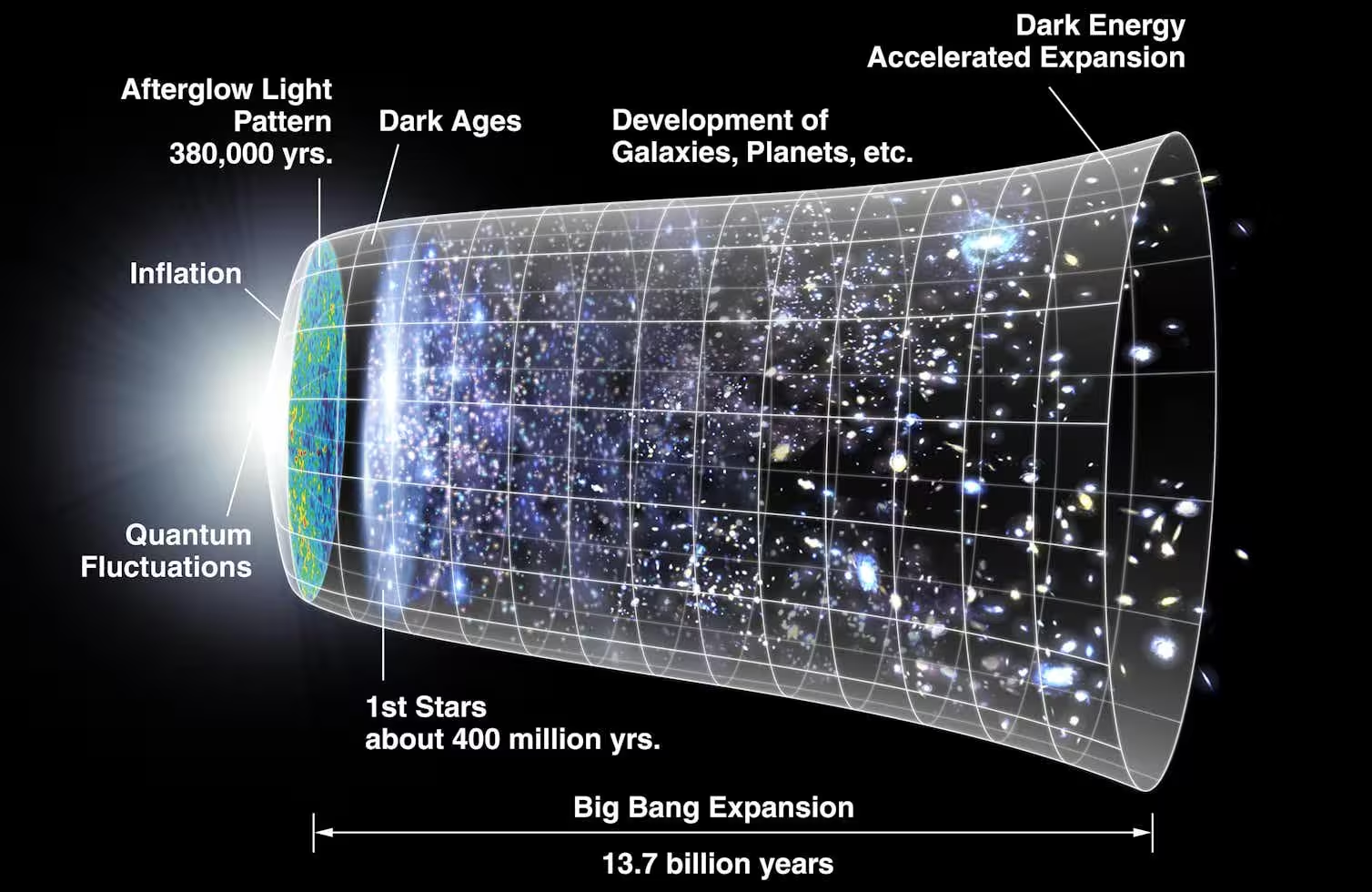
Astrophysicists infer the Universe's future by extending the patterns we see today. That extrapolation can be powerful but has limits. Like using two childhood photos to guess a person’s appearance at age six, short-term predictions are usually reliable. But project far enough into the future and unexpected phenomena — new physical processes or unknown particles — could change the outcome.
Despite those caveats, several lines of evidence converge on a plausible scenario: the Universe will continue expanding, star formation will decline and eventually cease, galaxies will merge and settle into large, red, ellipsoidal systems, and the night sky will grow dimmer and redder over trillions of years.
How stars will evolve: from blue brilliance to red ember
Stars are engines of nuclear fusion, and a star's lifetime depends primarily on its mass. Massive, hot, blue stars burn their fuel quickly and die within millions of years. Stars like the Sun live for roughly 10 billion years; our Sun is about halfway through that span. The smallest red dwarf stars, however, are extremely long-lived — they can persist for trillions to potentially quadrillions of years.
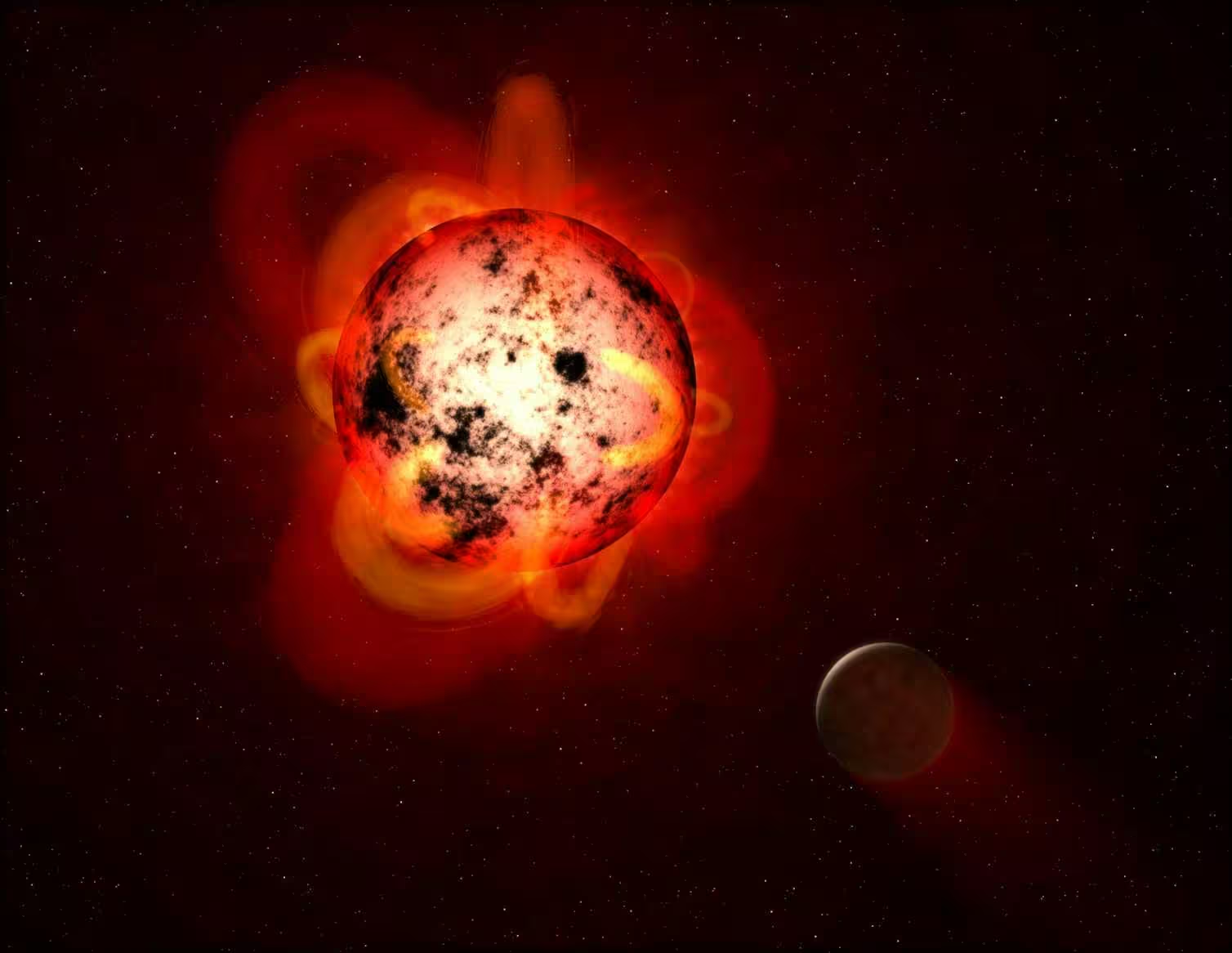
Galaxies are diverse in their star-forming activity. Some are still forming new stars from cold gas; others are essentially quiescent, having used up or lost the gas needed to make new stars. When star formation winds down in a galaxy, the short-lived blue stars vanish first, leaving behind longer-lived red and yellow stars. Over billions and then trillions of years, the overall starlight shifts to longer wavelengths and fades as even red dwarfs exhaust their fuel and cool into faint remnants.
In practical terms, the era of bright, diverse starlight is long but finite. For human timescales it is effectively eternal, but cosmologically it will give way to an epoch dominated by faint, long-lived stars and, eventually, the slow dimming of the last stellar embers.
Galaxies: collisions, cannibalism and the rise of ellipticals
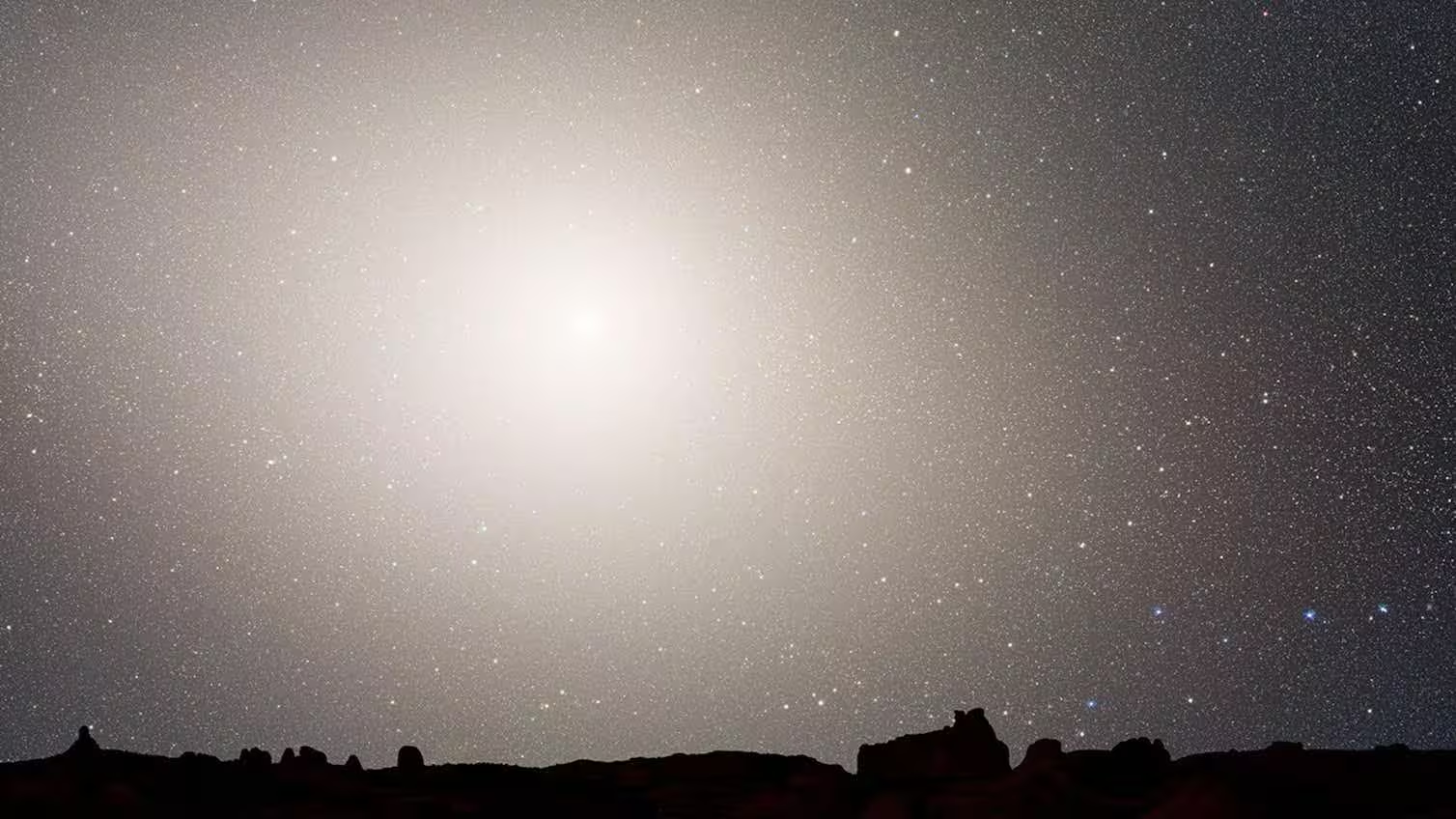
Galaxies grow primarily through mergers. Picture a sandcastle that becomes larger each time you add another bucket of sand. Over cosmic time, small galaxies collide and are assimilated into larger systems. In dense environments such as galaxy clusters, repeated collisions scramble ordered disk structures and produce massive elliptical galaxies: big, spheroidal systems with older, redder stellar populations and little new star formation.
Our own Milky Way is on a collision course with the Andromeda galaxy, a merger expected in a few billion years. Though the encounter will be visually spectacular for any hypothetical future observers — with stars sweeping past each other in complex tidal streams — individual stars very rarely collide because of the enormous distances between them. The long-term result is likely a larger, more spheroidal galaxy with a subdued rate of star formation.
As more and more galactic disks are disrupted, the Universe's morphology will shift toward a dominance of elliptical galaxies clustered in a web of dark-matter halos. These structures will slowly merge further, ultimately consolidating the visible mass in localized islands while the space between them continues to expand.
Cosmic expansion and dark energy: driving galaxies apart
One of the most consequential discoveries of modern cosmology is that the cosmic expansion is accelerating. Observations of distant Type Ia supernovae in the late 1990s provided the first clear evidence that galaxies are receding from each other at an increasing rate. The agent behind this acceleration is called dark energy, a poorly understood form of energy that acts like a repulsive force on cosmic scales.
If dark energy remains constant in density (the simplest model, called a cosmological constant), the expansion will keep accelerating. Over time, this accelerated expansion will push galaxies outside our observable horizon. Beyond a certain distance, light emitted by other galaxies will never reach observers in our region of space; they will progressively disappear from view. In this scenario, each gravitationally bound group or cluster of galaxies becomes an isolated island in an ever-expanding void.
Alternative hypotheses exist: dark energy could change with time, or new physics might cause very different fates such as a future contraction or a violent 'big rip' that tears bound systems apart. Present data favor a gentle, accelerating expansion, but refining that picture remains a central goal for observational cosmology.
Long-term timeline and the idea of a 'dark eternity'
Combining stellar evolution, galaxy dynamics and cosmic expansion gives a coherent long-term forecast. Over the next few billion years, star formation will continue in many systems, and mergers like the Milky Way-Andromeda event will reshape local structure. Over tens to hundreds of billions of years, star formation will decline as galaxies exhaust their gas. By a trillion years and beyond, only long-lived red dwarfs will remain bright, and they will eventually cool as nuclear fusion ceases.
On timescales far longer than the current age of the Universe, perhaps trillions to quadrillions of years, the cosmos could enter a phase sometimes called 'heat death' or a 'dark eternity' — an era of extremely low temperature and low radiation when stars are gone and black holes slowly evaporate through Hawking radiation. If dark energy persists, the observable Universe will shrink to the local bound structure; everything else will be unreachable and invisible.
It is important to emphasize the speculative elements: processes such as proton decay (if it occurs), unknown properties of dark energy, or new physics beyond the Standard Model could change these outcomes. But the present framework offers a conservative, data-driven projection that is consistent with what telescopes and theory currently tell us.
Expert Insight
Dr. Maya Singh, theoretical astrophysicist: 'Our best models paint a subtle but somber picture: galaxies becoming redder and dimmer, star formation tapering off, and the observable cosmos narrowing as accelerated expansion isolates local structures. Yet this 'dark eternity' unfolds over timescales so vast that for civilizations and technologies that emerge, there is still an immense window for exploration, observation and discovery.'
This commentary reflects the prevailing scientific perspective: the Universe has a long future in which observers and instruments will continue to glean insights, even if the cosmic scenery gradually fades.
Implications for observation, technology and human curiosity
What does this distant future mean for astronomy and human culture? Practically, it underscores the urgency and value of current observations. Measurements of supernovae, the cosmic microwave background, large-scale structure surveys and galaxy evolution studies all tighten constraints on dark energy and the lifetime of star-forming gas. Future space missions and ground-based telescopes — designed to probe dark energy and map faint galaxies — will refine our picture and could reveal surprises.
Technologies for detecting low-energy, long-duration signals and for preserving or transmitting knowledge across cosmic epochs acquire philosophical importance. If the Universe’s large-scale fate is one of isolation and cooling, efforts to understand and document the cosmos take on an added poignancy: a chance to record the story of a bright era before it dims.
Conclusion
Current science suggests the Universe will not end in a sudden, catastrophic event but will gradually transition into a far quieter state: fewer new stars, merged galaxies, and expanding isolation driven by dark energy. That scenario — a 'dark eternity' — is not final verdict but a forecast built from the physical laws and observations we possess today. The Universe remains an expansive laboratory, and there are many decades, centuries and millennia of discovery ahead for those committed to watching the sky.

“The cosmos has always fascinated me. I write about space missions, astronomy, and the technologies pushing humanity beyond Earth.”

Discussion
Leave a Comment