

Ethereum outlook: wedge pattern meets major protocol upgrade
Ethereum (ETH) has trended lower in recent months, trading near a key support at $3,000 after a nearly 40% decline from this year’s highs. Despite the pullback amid broader market weakness, several on-chain and protocol-level catalysts could support a recovery — most notably the Fusaka upgrade scheduled for December 3.
What Fusaka delivers and why it matters for ETH
Fusaka will introduce crucial under-the-hood improvements designed to scale the network and reduce validator overhead. The headline feature, Peer Data Availability Sampling (PDAS), enables validators to verify rollup blob data without downloading full datasets. That reduces bandwidth and storage demands while allowing much higher throughput for layer-2 rollups.
Other Fusaka changes include verkle trees for more efficient state proofs, predictable blob fees to improve fee market clarity for rollups, and history expiry tweaks to manage long-term storage. Together, these upgrades strengthen Ethereum’s competitive position for DeFi and real-world asset (RWA) tokenization use cases.
Institutional demand and large ETH accumulations
Interest from major investors has continued through this period of price weakness. Notably, Tom Lee’s BitMine Immersion — backed by prominent backers — has accumulated substantial ETH holdings this year. These large-scale purchases provide an additional support narrative for Ethereum as the protocol rolls out Fusaka and further scaling features.
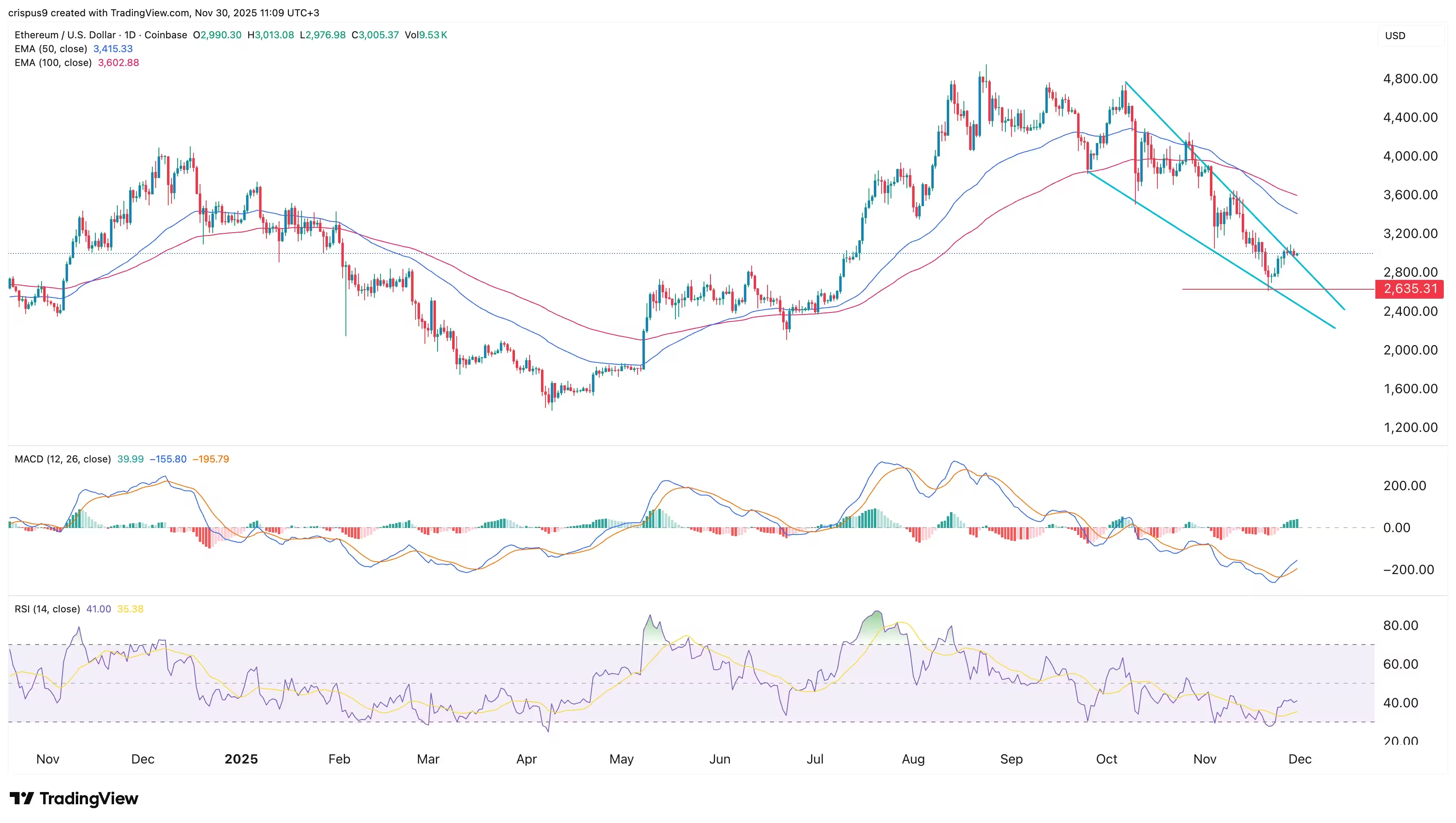
ETH price chart
Technical picture: falling wedge and indicators to watch
ETH’s daily chart shows a pronounced downtrend punctuated by a giant falling wedge, a classic bullish reversal pattern formed by two converging descending trendlines. While the price remains below the 50- and 100-day moving averages — a bearish sign reinforced by the Supertrend — momentum indicators are beginning to flash potential strength.
The MACD lines have crossed bullishly, and the Relative Strength Index (RSI) is climbing toward the neutral 50 level, suggesting selling pressure is easing. If buyers regain control, an initial rebound target sits near the $3,500 resistance zone. Conversely, a decisive break below $2,635 would invalidate the bullish wedge scenario and likely open the door for further downside.
Scenarios traders and investors should consider
- Bull case: Fusaka’s launch and improving momentum catalysts (MACD crossover, rising RSI) could trigger a relief rally to $3,500+ as rollup throughput expectations lift on-chain demand for ETH.
- Bear case: Continued macro weakness or a failed rebound under moving averages could push ETH below $2,635, negating the wedge breakout thesis.
Risk management matters: use stop-loss levels, assess on-chain flows, and follow upgrade block confirmations before assuming protocol-driven price moves.
Bottom line
Ethereum’s price action combines a rare bullish falling wedge with the timely Fusaka upgrade — a mix that could favor a rebound if buyers step in. Fundamental upgrades like PDAS and verkle trees improve throughput and validator efficiency, which supports long-term adoption. However, technical resistance and macro factors mean traders should watch key levels closely and prepare for both breakout and breakdown scenarios.

“I cover automotive innovation, electric vehicles, and the future of mobility — where technology meets sustainability.”

Discussion
Leave a Comment