

New laboratory experiments suggest Earth’s primordial atmosphere could have manufactured sulfur-containing biomolecules — including amino acids such as cysteine — from simple gases and light. That finding reframes how and where life’s raw materials might have first appeared.
A sky that cooked up complex sulfur compounds
Researchers from the University of Colorado Boulder and collaborators report in the Proceedings of the National Academy of Sciences that a simulated prebiotic atmosphere produced a surprising range of sulfur-based molecules. By illuminating a mix of methane, carbon dioxide, hydrogen sulfide and nitrogen — gases plausibly abundant on early Earth — the team generated compounds long considered products of living chemistry.
Previously, many scientists believed that organic sulfur compounds such as certain amino acids required biological pathways to form. Early laboratory simulations rarely produced those molecules in meaningful amounts unless they relied on very specific, localized conditions like hydrothermal vents or volcanic environments. The CU Boulder experiments overturn that narrower view: ordinary atmospheric chemistry, driven by light, could have been a global factory for biologically relevant sulfur species.
What the experiment showed and how it was done
In the lab, the researchers exposed a controlled gas mixture to ultraviolet-like light to mimic sunlight falling on the early atmosphere. Sulfur is notoriously tricky to study: it sticks to surfaces and typically appears at tiny concentrations compared with nitrogen and carbon dioxide. To overcome those challenges the team used a highly sensitive mass spectrometer capable of detecting trace products.
Measured reaction products included the amino acid cysteine and other sulfur-bearing biomolecules such as taurine and coenzyme M — compounds important for modern metabolism. The presence of these molecules in the simulated atmosphere implies they could have formed before life began and then rained out to oceans and land, delivering pre-made building blocks to environments where life might have taken hold.
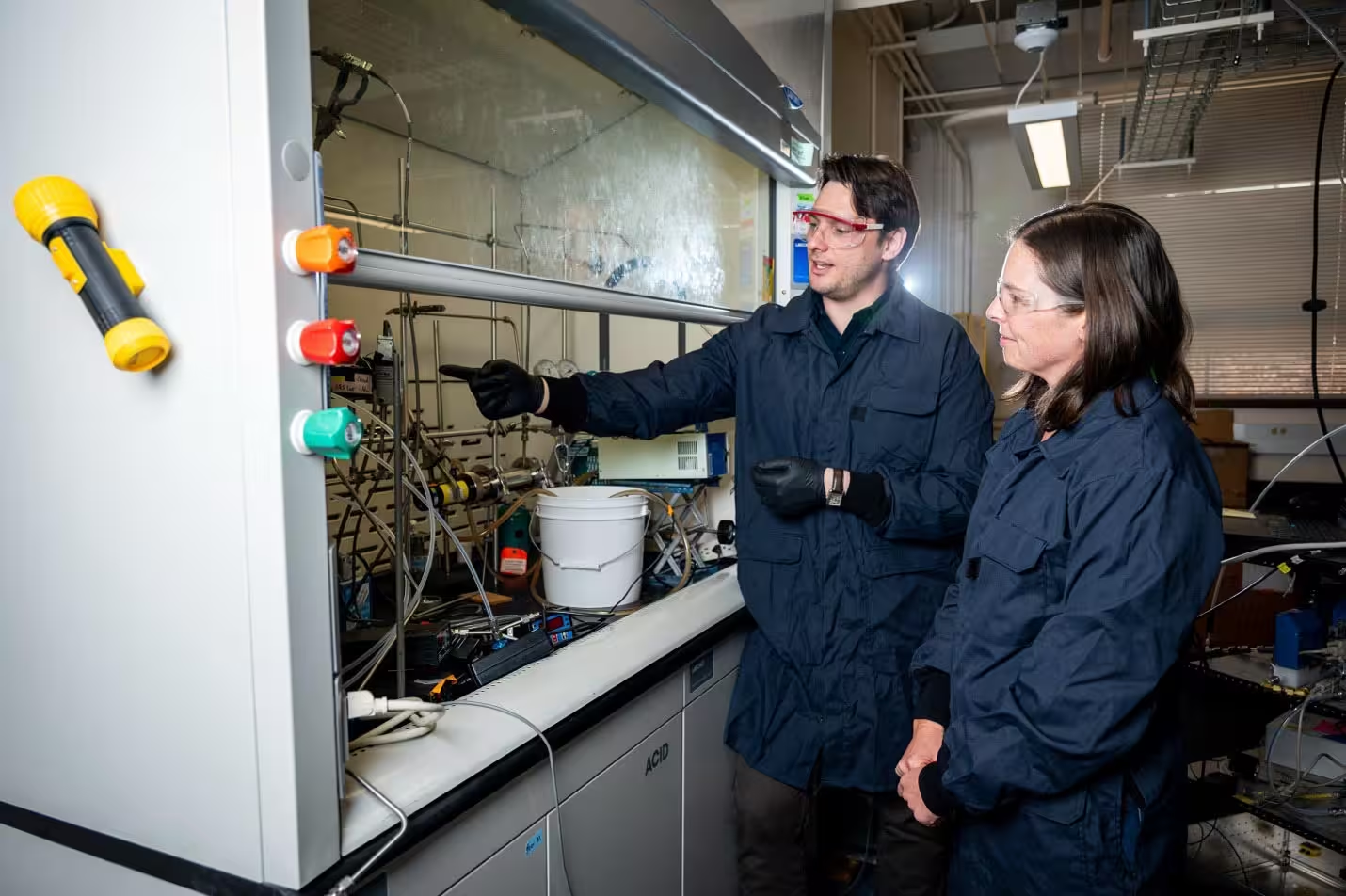
Nate Reed and Ellie Browne working in the lab.
Scaling the chemistry to a planetary context
Beyond detecting specific molecules, the team estimated how much cysteine a whole primordial atmosphere might generate. Their calculations suggested enough cysteine could have been produced to supply roughly one octillion cells (1 × 10^27), a large but still smaller amount than today’s estimated total biomass (~1 × 10^30 cells). In other words, the atmosphere alone could have delivered a global inventory of sulfur amino acids sufficient to seed nascent ecosystems.
This airborne synthesis changes the narrative about where the earliest life-relevant molecules could appear. Instead of requiring rare, chemically rich niches, at least some key organic sulfur chemistry might have been diffusely available across the planet. That widens the set of plausible scenarios for the origin of life and suggests a more permissive early environment.
Implications for origin-of-life studies and exoplanet biosignatures
The results have two immediate implications: (1) origin-of-life research must consider atmospheric production pathways as potentially important sources of complex organics; and (2) detection of specific sulfur gases on other worlds may not unambiguously signal life. For example, prior work by the same authors showed dimethyl sulfide — a sulfur gas that on modern Earth is produced by marine life — can also form abiotically from simple atmospheric chemistry and light. That finding, together with the new results, adds nuance to how scientists interpret sulfur species observed by missions such as the James Webb Space Telescope.
Detecting sulfur compounds on an exoplanet remains noteworthy, but these experiments show we must carefully evaluate whether such molecules are biogenic or the product of photochemistry. The intersection of planetary atmosphere modeling, laboratory simulation, and sensitive spectroscopic observations will be key to distinguishing the two.
Expert Insight
Dr. Mira Patel, an astrobiologist (not involved in the study), says: 'This work reminds us that planetary atmospheres are reactive chemical systems. When you expose simple gases to light, you can get surprisingly complex outcomes. That matters both for how we think life began on Earth and how we search for chemistry that might indicate life on other planets.'
The CU Boulder study also highlights the importance of precision instrumentation in prebiotic chemistry. Detecting trace sulfur species required pushing analytic sensitivity, and the techniques developed could be applied to other simulations that explore how nitrogen-, phosphorus- or sulfur-rich molecules form in planetary environments.
As researchers expand laboratory conditions to include variations in solar input, atmospheric composition and surface interactions, we’ll better understand the robustness of atmospheric pathways for producing life’s ingredients. If the atmosphere was an efficient supplier of amino acids and cofactors, then the origin of life may have depended less on rare geological settings and more on widespread planetary chemistry.

“The cosmos has always fascinated me. I write about space missions, astronomy, and the technologies pushing humanity beyond Earth.”

Discussion
Leave a Comment