
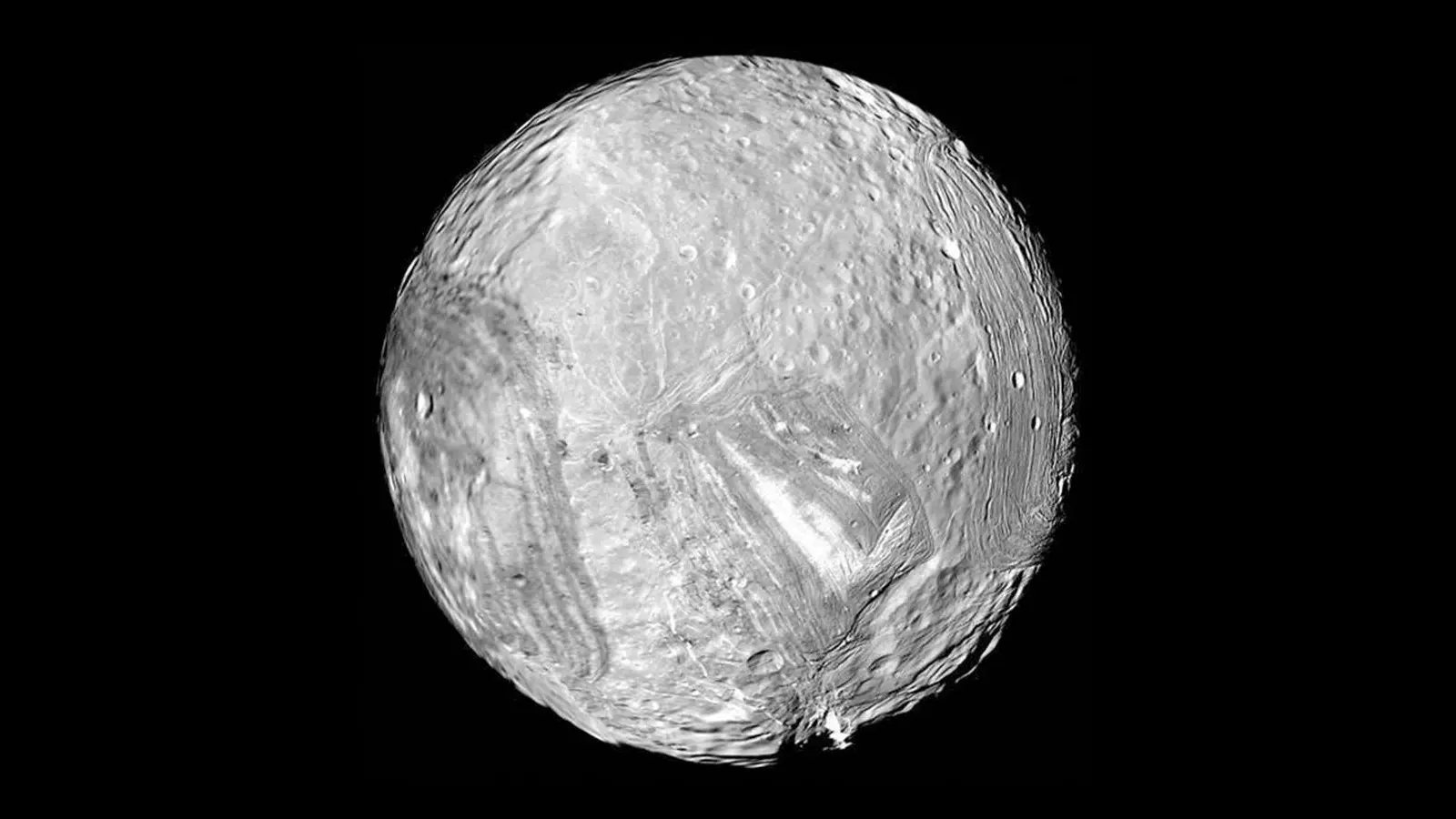
New research suggests that some small, icy moons—long thought to be geologically quiet—may host oceans that periodically boil as their ice shells thin and pressure drops. These dramatic subsurface changes could explain puzzling surface features captured by past missions.
How melting ice can lower pressure — and boil an ocean
On Earth, most geological activity springs from shifting rock and the slow motion of tectonic plates. On icy moons, however, the dominant actors are water and its frozen forms. Many of these distant satellites receive internal heat through tidal forces: gravitational tugs from their parent planet and neighboring moons flex and warm their interiors. When tidal heating strengthens, the ice shell can thin as basal melting converts solid ice into less-dense liquid water. When heating drops, the shell re-thickens.
Max Rudolph, associate professor of earth and planetary sciences at the University of California, Davis and lead author of the new study in Nature Astronomy, explains the key idea: "We're interested in the processes that shape their evolution over millions of years and this allows us to think about what the surface expression of an ocean world would be." The team modeled how phase changes in the ice-ocean system alter internal pressure on moons of different sizes.
On small moons such as Enceladus and Mimas (both orbiting Saturn) or Miranda (orbiting Uranus), the pressure above the subsurface ocean can fall enough during melting to reach the water triple point — the condition where ice, liquid water, and vapor coexist. At that threshold, pockets of the ocean can begin to boil, producing vapor, fracturing the overlying shell in localized ways, and driving material movement that leaves distinctive terrain on the surface.
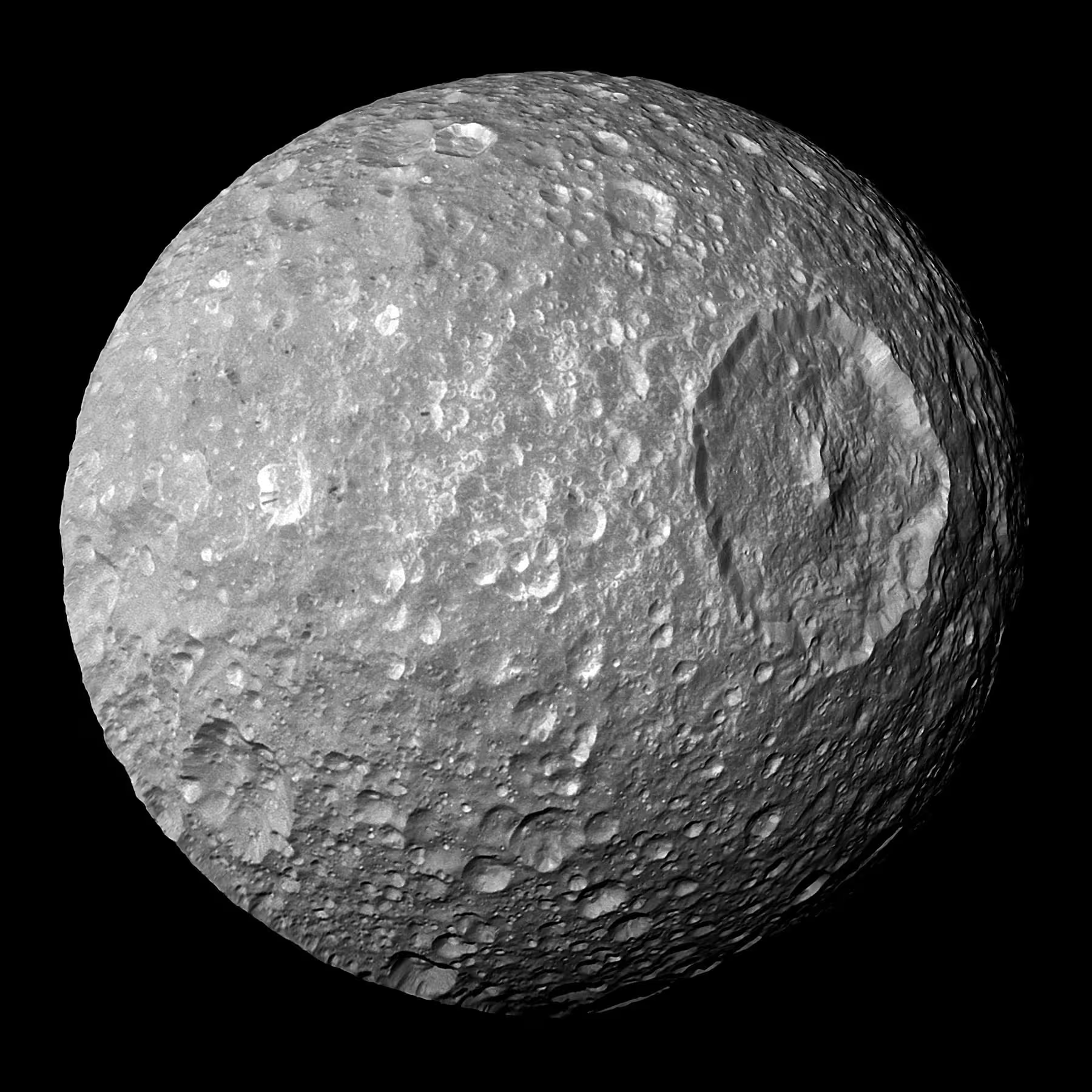
Surface fingerprints: coronae, tiger stripes, and the Death Star
Boiling oceans are not just a theoretical curiosity; they offer plausible explanations for real surface features. Voyager 2 images of Miranda show strange concentric ridges and cliffs called coronae, terrains that have puzzled scientists for decades. Rudolph's study suggests ocean boiling and the resulting pressure swings could create the stresses that formed those coronae.
Enceladus famously displays the so-called "tiger stripes" — warm, fissured regions near its south pole that spray water vapor and ice into space. Earlier work by the same group showed that ice shell thickening can pressurize the shell and produce such fractures. This new modeling completes the picture by showing how the reverse — shell thinning and melting — could lead to boiling, vapor loss, and other features.
Mimas, striking because of its large, cratered face that inspired the "Death Star" nickname, appears superficially dead. Yet Cassini's observations hint at a subtle wobble consistent with an internal ocean. Rudolph notes that Mimas’ relatively small radius means its ice shell can thin without catastrophic rupture, allowing an ocean to exist beneath a largely undeformed surface — a state where boiling could occur internally while the exterior remains heavily cratered.
Size matters: why bigger moons crack before they boil
The researchers found that moon size is a controlling factor. On larger icy satellites such as Uranus' Titania, the pressure drop caused by basal melting would tend to open cracks and fractures in the ice shell before the triple point is reached. In those cases, thinning followed by re-thickening could produce a different suite of tectonic features. In short: small moons can reach conditions for ocean boiling, while larger moons more often relieve stress by cracking.
Mission context and future prospects
These insights rely on combining physical modeling with data from spacecraft like Cassini and Voyager 2. Cassini's detailed surveys of Saturn's moons and Voyager's flybys of Uranus and its satellites provide the empirical backdrop that helps constrain thermal and mechanical models. Future missions—particularly orbital or lander investigations that can probe gravity fields, surface composition, and heat flux—would be able to test the boiling-ocean hypothesis directly.
Detecting vapor-driven deposits, altered surface chemistry, or recent resurfacing signatures would strengthen the case for episodic boiling. Instruments that measure tiny librations (wobbles) and gravity anomalies can also reveal present-day oceans, as already hinted at for Mimas and confirmed for Enceladus.
Expert Insight
"If pockets of boiling occur beneath an icy crust, they could transport heat and chemicals from the rocky core to the surface intermittently," says Dr. Lena Torres, planetary geophysicist at the Jet Propulsion Laboratory. "That has two big implications: it shapes the terrain we observe, and it affects the habitability potential by cycling nutrients and energy. Future probes targeting small ice moons could be surprisingly high-value for astrobiology."
Understanding whether oceans boil, crack, or quietly slosh beneath these frozen skins reshapes how we interpret surface geology across the outer Solar System. The new study provides a framework for linking internal dynamics to observable features — and highlights that even small moons can host complex, potentially life-relevant processes.

“My work centers on sustainability, energy, and environmental science — examining how innovation can lead to a greener future.”

Discussion
Leave a Comment