
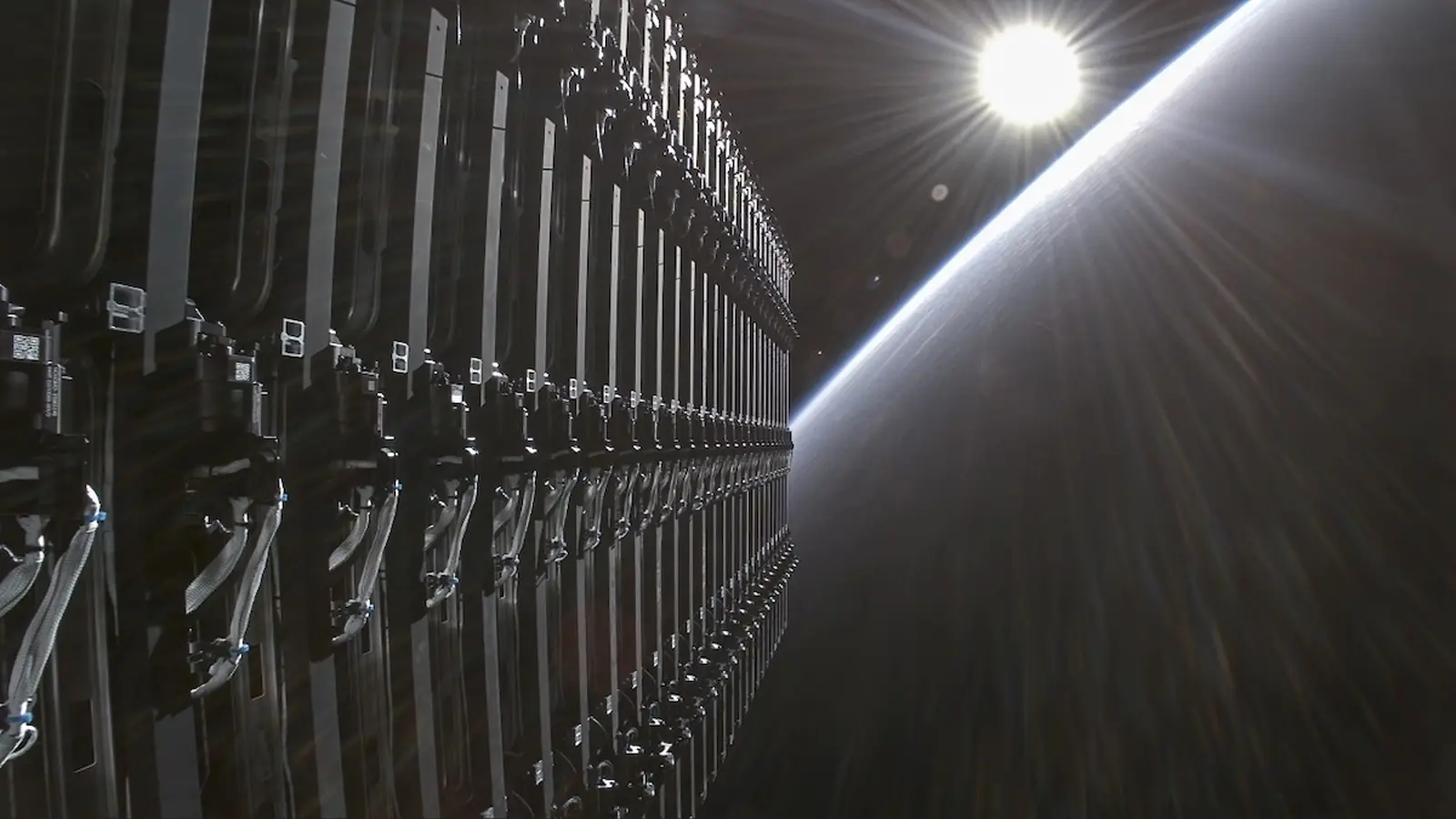
Light reflected from the growing fleets of commercial satellites could contaminate the vast majority of images taken by near-Earth space telescopes, researchers warn. A new study models how proposed megaconstellations — if launched as planned — would make astronomical observations far harder, and in some cases impossible, across a wide range of missions.
A crowded sky and the numbers behind the risk
The number of active satellites in low-Earth orbit (LEO) has jumped from roughly 2,000 in 2019 to about 15,000 today, driven largely by commercial internet constellations. But that recent rise may be the calm before a storm. The Nature study projects as many as 560,000 satellites could be in orbit by the late 2030s if all current filings to regulators proceed.
To estimate the impact, researchers simulated how those satellites would intersect observations from four different space telescopes. The result: reflected sunlight and streaks from satellites could affect an estimated 96 percent of images taken by several near-Earth instruments, including NASA s SPHEREx mission, ESA s planned ARRAKIHS, and China s planned Xuntian telescope. Hubble, with its narrower field of view, would see about one third of its images contaminated.
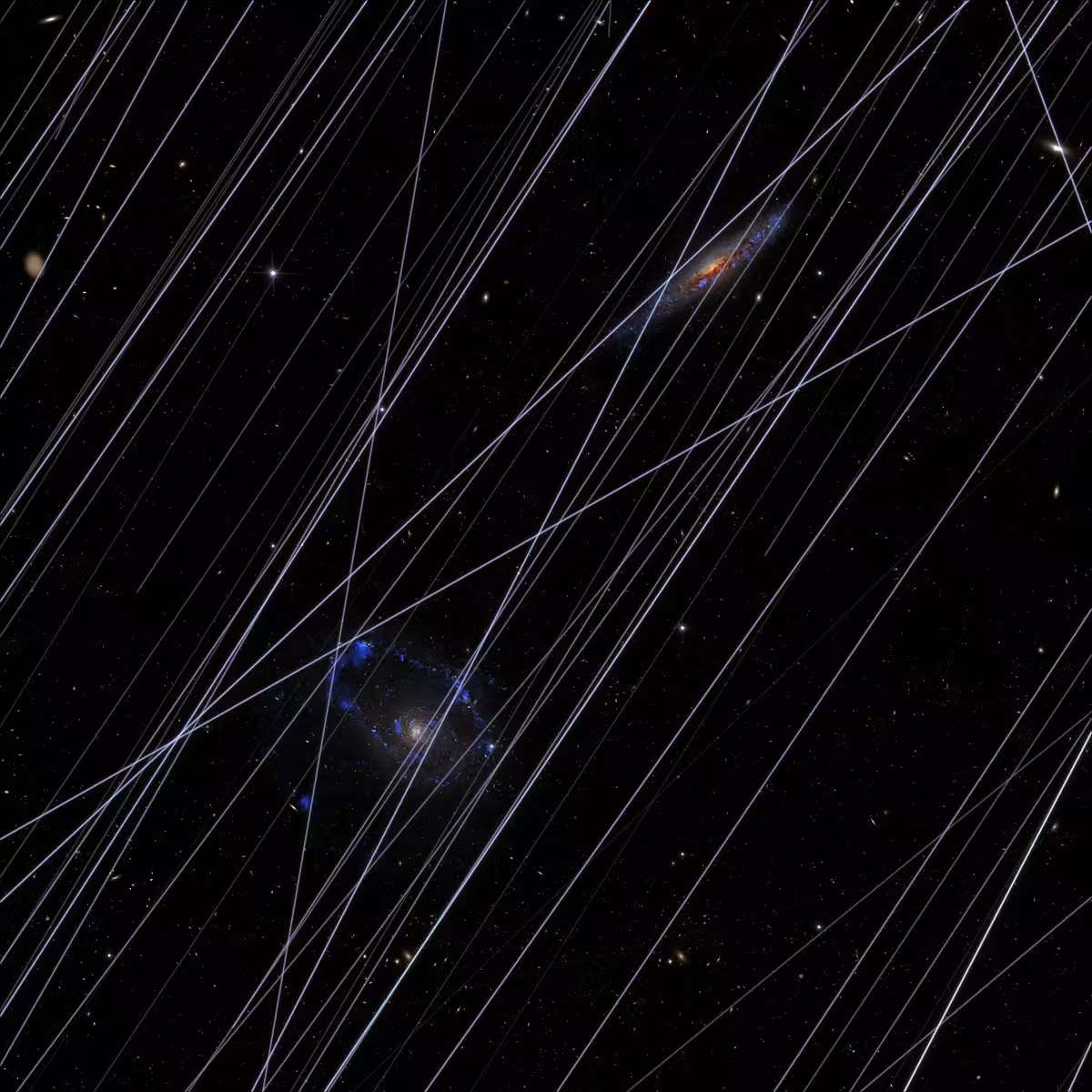
An image simulating how lights from satellites contaminate images of the universe taken by space telescopes.
Why this matters for science and planetary defence
Space-based telescopes are often the preferred platform for faint-object astronomy because they avoid atmospheric blurring and absorption. Yet satellites moving through a telescope s field of view leave linear trails or transient flashes that can masquerade as real astrophysical signals. That confusion has practical consequences: surveys searching for hazardous near-Earth objects could mistake a harmless satellite trail for a potentially dangerous asteroid, or conversely miss a real threat masked by satellite streaks.
Some missions are less exposed. Telescopes positioned at the second Sun-Earth Lagrange point (L2), roughly 1.5 million kilometres from Earth, are largely unaffected; James Webb Space Telescope, for example, operates from L2 and avoids the densest layers of LEO traffic. But many future observatories and Earth-directed instruments will sit much closer, precisely where the increasing satellite population will be most disruptive.
Technical details and possible mitigations
- Altitude choice: Putting satellites below the orbits of space telescopes would reduce conflicts, but very low altitudes can increase atmospheric drag and have environmental costs, including potential impacts on the ozone layer if massive constellations require frequent reboosting or atmospheric operations.
- Transparency and coordination: Operators could supply precise ephemerides, orientation, and surface properties to observatories, enabling software to predict and mask satellite crossings. That helps but does not eliminate loss of data or the additional processing burden.
- Design changes: Dark coatings, sunshades, and orientation strategies can reduce reflectivity. Yet the trend toward larger satellites to meet growing data needs for artificial intelligence and broadband makes brightness mitigation more challenging. Objects of 100 square metres already appear as bright as the brightest stars; plans for 3,000-square-metre platforms could reach planet-like brightness in the sky.
Competition between satellite internet providers and demand from data-intensive industries make a significant reduction in launches politically and economically unlikely. Nearly three quarters of current LEO satellites belong to one company, but projections suggest that proportion will fall as many countries and corporations enter the market.
Expert Insight
Dr. Elena Vargas, an astrophysicist specializing in observational surveys, comments: 'The problem is not just that images are degraded. It is that survey completeness and transient detection thresholds will shift unpredictably. That undermines long-term monitoring programs and could force major changes in survey strategy or instrument design. Coordinated mitigation and regulatory attention are essential now, not later.'
Conclusion
The astronomical community faces a crossroads. Rapid commercial expansion of LEO capacity promises global connectivity and new services, but it also risks degrading the very observations that expand our understanding of the Universe. Practical steps — improved sharing of satellite telemetry, design changes to reduce reflectivity, and regulatory coordination to limit uncontrolled growth — could lessen the worst impacts. Without them, near-Earth space telescopes and ground-based observatories alike may see a steady erosion of their ability to capture faint, pristine views of the cosmos.

“My work centers on sustainability, energy, and environmental science — examining how innovation can lead to a greener future.”

Discussion
Leave a Comment