
Alan Dye, a senior Apple interface design executive who played a major role in shaping the look and feel of Apple products after the Jony Ive era, has reportedly left the company to join Meta, Bloomberg says. The move underscores Meta’s intensified effort to combine hardware, software and artificial intelligence into coherent, consumer-facing products led by a high-profile design organization. Industry observers see the hire as a directional signal: Meta is investing design leadership and senior talent to make AI a visible, integrated part of future devices and experiences.
Meta builds a cross-disciplinary design studio
According to Bloomberg, Dye will report to Meta’s chief technology officer, Andrew Bosworth, and will lead a newly formed design studio charged with coordinating product strategy across hardware, software and AI. The studio is described as cross-disciplinary: it reportedly brings together user interface and interaction designers, industrial designers, product UI leads, and teams focused on metaverse art and experience. Reported participants include former Apple designers such as Billy Sorrentino, Meta UI lead Joshua Tu, an industrial design group led by Pete Bristol, and metaverse-focused design and art teams overseen by Jason Rubin.
The purpose of this studio, as outlined in public remarks and reporting, is to reduce friction between separate design silos and create cohesive product narratives from industrial form to on-device interfaces and embedded AI behaviors. For large technology platforms, aligning industrial design, UI/UX and AI engineering is increasingly central to delivering consistent, polished consumer experiences. In practice this means decisions about materials, ergonomics, screen and sensor placement, graphical language, voice and gesture interactions, and how on-device AI assists users will be coordinated by a single design leadership group.
What Meta says — and why it matters
Meta CEO Mark Zuckerberg framed the studio as an intersection of design, fashion and technology, noting that the company wants to "treat intelligence as a new design material and imagine what’s possible when that material is abundant, powerful, and human-centered." That phrasing signals a shift in how some tech companies view AI: not only as a backend service or cloud capability, but as an explicit element of product design that informs visual language, interaction patterns, and physical product form factors.
Making AI a visible, tangible part of consumer devices requires different thinking than simply adding cloud-based features. Designers must consider how generative capabilities appear in user flows, how context-aware models change system affordances, and how to communicate AI confidence, privacy safeguards and user control. Meta’s rhetoric suggests it intends to accelerate efforts to embed AI perceptibly into hardware — for example, through on-device inference, sensor fusion, more natural conversational interfaces, or real-time contextual overlays — rather than presenting AI only as a server-side enhancement.
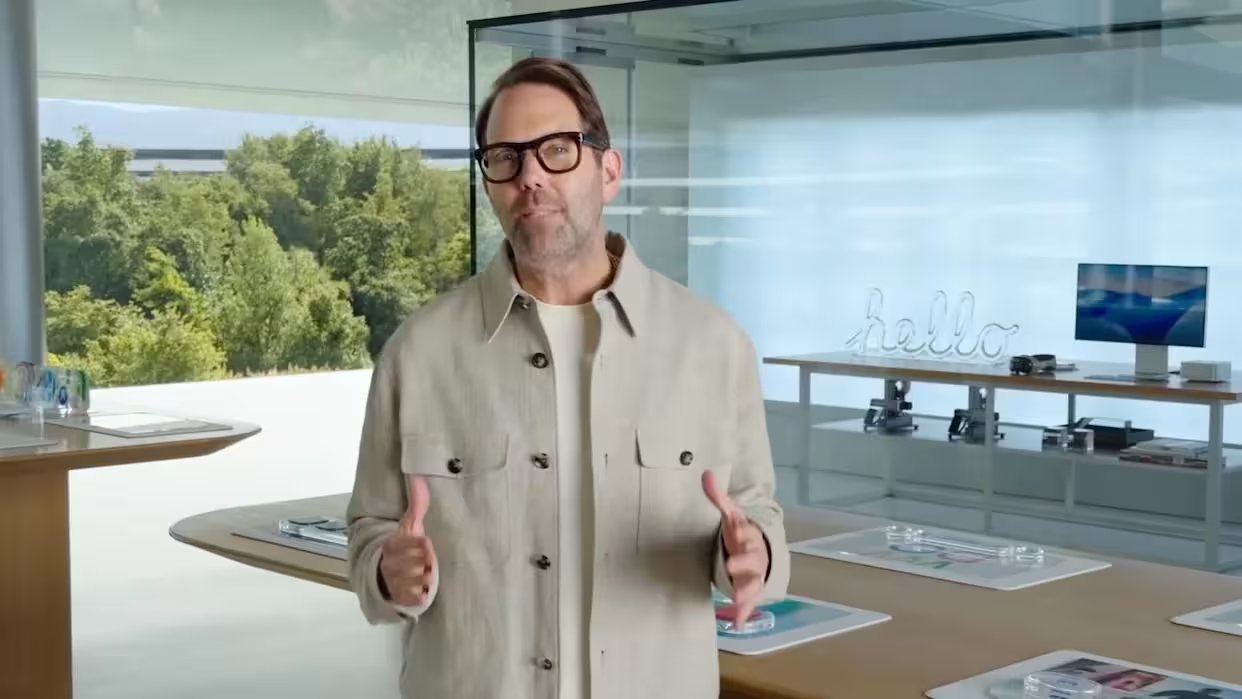
How this changes the hardware playbook
- Meta has already found market traction with Quest virtual reality headsets and smart glasses collaborations such as the Ray-Ban Display line. Bringing on senior Apple design talent like Alan Dye signals a push toward more refined hardware iterations that emphasize material quality, industrial fit, and an elevated product identity beyond early-stage prototypes.
- Products likely to be influenced by the studio include next-generation smart glasses — considered an evolution of Meta’s Ray-Ban Display efforts — as well as wearables and accessories that augment sensing and on-device AI, such as the Neural Band concept. These devices combine optical, audio, and sensing hardware with machine learning models to deliver contextual assistance, augmented reality overlays, and novel interaction models.
- The studio is positioned to better align industrial design, UI/UX and AI capabilities so product experiences feel cohesive across device families. In a design-led approach, the same design vocabulary is expected to inform physical materials, on-device graphics, interaction metaphors, system sounds, and the way AI-driven suggestions surface in context, producing a unified brand and user experience.
Concretely, this alignment may shorten design-to-production cycles by reducing iteration between groups, improve design handoffs to engineering, and ensure that AI features are considered during early hardware trade-offs (camera placement, processor selection for on-device inference, battery and thermal budgets). It also makes it more feasible to design for privacy-by-default and explainable AI behaviors when hardware and software teams share a unified brief.
Apple’s response and the wider talent flow
Bloomberg also reports Apple is recruiting a longtime UI designer named Steven Lemy to succeed Dye. Dye’s tenure at Apple included visible work on interface language and system-level design, notably contributions to visionOS and the aesthetic sometimes described as "Liquid Glass." While Apple’s famously secretive culture can obscure individual attribution for platform changes, Dye’s involvement in recent visual and interaction shifts was widely discussed within design and developer communities.
The movement of senior designers among major technology companies is not new. In recent years, several prominent Apple designers have left for companies such as Meta, OpenAI, and boutique studios working with influential design leads. For example, Evans Hankey, who formerly served as head of industrial design at Apple, departed in 2022 to collaborate with Jony Ive and later contributed design expertise to hardware efforts at OpenAI. Other senior designers linked to iPhone and other Apple hardware projects have also made lateral moves, reflecting a broader trend of design talent flowing between big tech platforms and AI-focused startups.
These shifts matter because experienced designers bring not just craft skills but institutional knowledge of platform-level trade-offs: how to balance software behavior against hardware constraints, how to craft system-wide design languages that scale across devices, and how to engineer experiences that feel premium and intuitive. When rivals recruit designers who understand the intersection of software, hardware and storytelling, they are effectively importing expertise that can accelerate product maturity and market differentiation.
What to watch next
With this leadership hire, expect to see Meta accelerate product announcements that emphasize polished, fashion-forward hardware integrated with AI-driven interaction models. That could mean shorter product cycles for refined AR/VR headsets, new generations of smart glasses with improved optics and on-device intelligence, and complementary accessories that extend sensing and contextual computing. Marketing may increasingly frame these devices as lifestyle products — not just technical prototypes — emphasizing materials, fit, and brand partnerships.
For Apple, replacing Dye is more than an organizational formality: it is a strategic need to preserve and evolve its visual language across macOS, iOS, visionOS, and new hardware categories. Apple’s response will likely focus on promoting internal design leaders, accelerating roadmap work that ties software features to hardware launches, and reinforcing the company’s approach to secrecy and integrated product design. Maintaining a coherent design language is particularly important as competitors hire seasoned designers who understand the combined demands of industrial design, interaction design, and AI system behavior.
In short, this hire is more than a personnel change. It is a strategic signal that the competition for elegant, AI-first consumer devices is entering a design-led phase. Companies will increasingly compete on the integration of AI as a tangible, human-centered feature, where how intelligence behaves, is communicated, and is physically embodied in devices will be as important as raw model capability or cloud scale.
Beyond immediate product implications, the move highlights broader industry dynamics: the maturation of AI-driven consumer hardware, the rising importance of design leadership in shaping platform strategy, and intensified hiring competition for multidisciplinary design talent. Observers should watch the studio’s early product briefs, patent filings, and recruiting patterns for clues about Meta’s priorities — whether it favors on-device ML architectures, partnerships with fashion and eyewear brands, or new interaction paradigms that blend voice, gesture, and visual augmentation.
Finally, this development raises questions about ecosystem lock-in and interoperability. As Meta and Apple shape divergent design languages around AI-enabled hardware, developers and accessory makers will need to adapt to different system constraints and interaction models. That creates opportunities for third-party accessory designers, component suppliers, and software developers who can bridge the aesthetics and technical requirements between platforms. It also suggests that standards for privacy, explainability, and device-to-device AI coordination will become increasingly important topics in product and policy discussions.
Overall, hiring Alan Dye to head a cross-disciplinary design studio reflects a shift in technology strategy: design leadership is being used deliberately to make AI not only useful, but also perceivable, desirable, and trustworthy in everyday devices. Whether Meta’s design-first approach yields measurable consumer advantage will depend on execution — from the quality of industrial materials to the subtlety of on-device AI interactions — but the strategic signal is clear: the next wave of consumer hardware competition will be fought on the grounds of integrated design, fashion sensibility, and intelligent behavior.

“I love exploring gadgets, apps, and trends that redefine how we connect, work, and play in a digital world.”

Discussion
Leave a Comment