

People often focus on what to say, but how you move your hands can significantly influence how your message is received. Recent research in communication science and cognitive psychology shows that specific hand gestures that visually match spoken ideas make speakers appear clearer, more competent, and more persuasive. Small, deliberate movements act as visual shortcuts that help listeners construct mental images, speed information processing, and improve recall. This article summarizes the evidence, explains underlying mechanisms, and offers practical guidance for applying gesture strategies in presentations, teaching, pitching, and high-stakes communication.
Why some gestures help and others don’t
Researchers label the most effective movements illustrators — gestures that directly depict or map to the concept being described. When you spread your hands to show distance, bring them together to indicate connection, or trace a curve to represent a market trend, your gestures visually mirror the information conveyed by your words. This alignment between gesture and speech increases what psychologists call processing fluency: listeners can build a coherent mental model more quickly and with less effort. The easier an idea is to process, the more credible and authoritative the speaker appears to an audience.
Illustrative gestures serve several communication functions at once: they emphasize scale (big vs. small), clarify temporal or spatial direction (upward trend, shift to the right), and reveal relationships (cause and effect, parts and wholes). They also break dense information into digestible visual chunks, which is especially helpful when explaining technical concepts, data patterns, or abstract theories in business, education, or science communication.
Not all motion is beneficial. Random waving, restless fidgeting, or gestures that are unrelated to the message can distract listeners, undermine perceived competence, and reduce persuasive impact. Excessive or culturally ambiguous gestures can create cognitive noise that competes with lexical processing. The practical rule for effective nonverbal communication is simple: prioritize clarity over choreography. Use your hands to emphasize size, direction, or relationship only when those movements genuinely mirror the content you’re communicating and align with your vocal emphasis and facial expression.
How the study reached its findings
To test the effect of gestures at scale, the research team used a two-pronged methodology combining large-scale observational analysis with controlled experimental work. First, analysts applied AI-based computer vision tools to more than 200,000 video segments from over 2,000 TED Talks to detect, classify, and quantify hand movements frame by frame. Modern pose-estimation models and gesture classifiers enabled automated tagging of movement types, amplitudes, and temporal alignment with speech. This automated approach allowed the team to identify patterns across thousands of hours of naturalistic public speaking that would be infeasible with manual coding.
Second, the researchers ran controlled laboratory experiments to isolate causality. In these experiments, 1,600 participants watched short product pitch videos in which entrepreneurs either used illustrative gestures, used non-illustrative or neutral gestures, or kept their hands largely still. Participants rated the speakers on perceived clarity, competence, and persuasiveness, and objective measures such as information retention and intention to invest or support were collected. The experimental design included counterbalancing, blind rating procedures, and statistical controls for speaker attractiveness, vocal confidence, and prior topic knowledge.
Both lines of evidence converged. In the TED Talk dataset, speakers who used more illustrative gestures received higher audience evaluations and engagement signals — patterns that were apparent regardless of topic area or speaker gender. Viewer behavior metrics included longer watch time and millions of likes aggregated across videos. In the controlled experiments, participants consistently rated speakers using illustrative gestures as clearer, more competent, and more persuasive, and they retained more factual information about the product or concept being pitched.
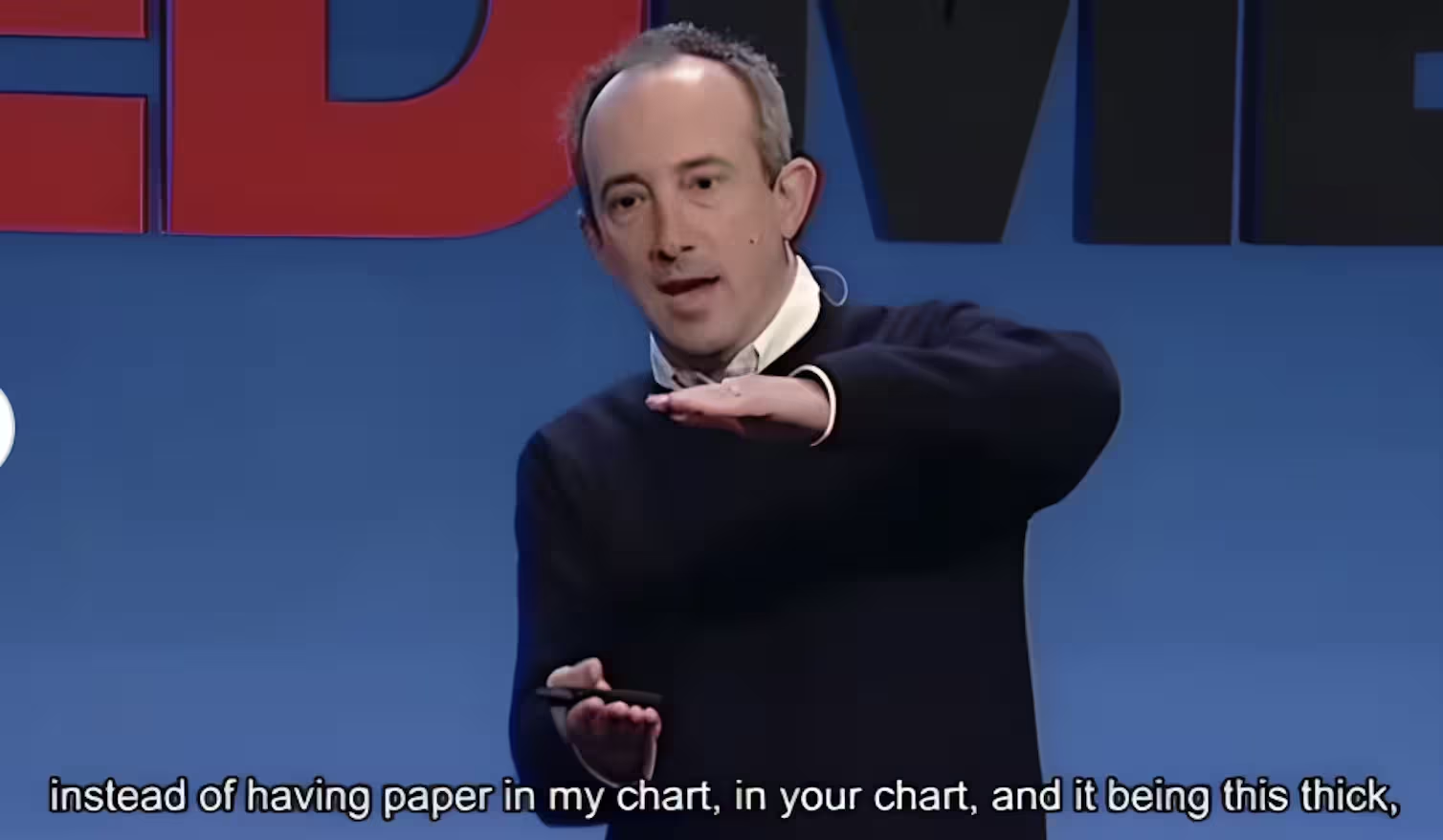
One example clip used in the analysis shows a TED speaker gesturing while explaining complex ideas (YouTube/TED – David Agus: A new strategy in the war against cancer). That visual alignment between hands and words helps make abstract concepts tangible for viewers and can increase both comprehension and emotional resonance. In practical terms, a speaker who gestures to demonstrate growth trajectories or to separate components of an argument gives the audience an extra channel of information that complements verbal content.
Scientific context and implications
The study sits at the intersection of communication science, cognitive psychology, neuroscience, and human factors engineering. Gesture research dates back decades and has documented the communicative value of hand movements across languages and cultures. What is new is the application of scalable machine-learning and computer-vision techniques that allow researchers to analyze thousands of hours of naturalistic speech automatically and to link gesture patterns with audience behavior at scale. These tools can identify sensorimotor signatures associated with effective communication, bridging lab-based insights with real-world speaking contexts.
From a neuroscience perspective, gestures likely recruit sensorimotor systems that complement classical language networks. When a speaker illustrates an idea with their hands, listeners may internally simulate the movement or spatial configuration, engaging mirror neuron systems and sensorimotor cortex in ways that support comprehension and memory encoding. This kind of neural coupling — sometimes described as interpersonal neural synchronization — strengthens the alignment between speaker and listener and is associated with improved learning outcomes in educational settings and enhanced coordination in team environments.
Understanding gesture as part of multimodal communication has practical implications for instructional design, public speaking training, and human-computer interfaces. For educators, combining spoken explanations with intentional illustrative gestures can make abstract mathematical or scientific concepts more accessible. For entrepreneurs and sales professionals, gestures that concretize product features or user journeys can increase perceived credibility and improve conversion metrics. In mission-critical or safety-critical systems — such as aviation, spaceflight briefings, or emergency response — clear nonverbal signals can reduce ambiguity when every second and instruction matters.
Real-world applications
- Business and pitching: Entrepreneurs and sales professionals can increase persuasive impact by aligning hand movements with key claims. When pitching a product roadmap, tracing a timeline with your hand can make milestones feel more concrete, and emphasizing scale with palm gestures can reinforce value propositions. These techniques can improve investor pitch performance, sales presentations, and stakeholder briefings.
- Education: Teachers and instructional designers can use illustrative gestures to clarify abstract concepts and improve learning retention in classrooms or online lectures. For example, demonstrating the phases of a process with hand motions or spatially mapping components of an argument across the stage supports multimodal encoding and helps students integrate visual and verbal information.
- Space and mission-critical communication: In high-stakes environments like mission control or astronaut briefings, consistent, unambiguous nonverbal signals can help reduce confusion. Standardized gestures paired with clear verbal commands can act as redundancy in noisy or time-pressured operations, supporting safety and coordination across team members who may be distributed or relying on remote video feeds.
Can people learn to gesture better?
Evidence from training pilots, public speakers, and educators suggests that yes, people can learn to use gestures more effectively. Short, focused interventions — sometimes as brief as five to ten minutes — can nudge speakers toward more purposeful, illustrative gestures. These micro-trainings typically include explicit instruction on gesture types (e.g., deictic pointing, iconic tracing, and representational shaping), video feedback to compare unguided and guided performance, and rehearsals tied to specific speaking content. Even brief practice with immediate feedback leads to measurable changes in audience perception.
More structured programs combine gesture training with broader nonverbal communication coaching, including vocal pacing, prosody, eye contact, and posture. Because gesture interacts with tone and facial expression, effective training aims for coherent multimodal alignment rather than isolated hand movements. For example, synchronizing a rising intonation with an upward palm motion when describing growth can reinforce the message more strongly than either cue alone.
Emerging tools use AI-driven feedback to accelerate learning. Computer vision and audio analysis can quantify gesture frequency, amplitude, and synchrony with speech, then provide objective recommendations such as "increase illustrative gestures when describing numerical trends" or "reduce repetitive baseline movements that do not add informational value." These data-driven coaching systems make it possible to scale gesture training in corporate learning programs, online courses, and coaching platforms.
Expert Insight
"Gesture is not decoration; it is part of how the brain communicates ideas," says Dr. Elena Marquez, a cognitive neuroscientist who studies multimodal communication. "When speech and movement align, they create a richer representation in the listener's mind. For complex or technical topics — including those in science and space exploration — an illustrative gesture can bridge the gap between jargon and intuition."
Researchers are also testing integrated AI tools that track voice, facial cues, and gestures simultaneously to identify the full pattern of effective communication. This multimodal approach can help trainers, educators, and mission teams understand which combinations of signals produce the best outcomes. For instance, a speaker who combines concise verbal structure with synchronized gestures and deliberate pauses may maximize both comprehension and persuasive power.
Practical takeaways from current evidence include: plan gestures as part of your core message, rehearse gestures along with the script so they feel natural and synchronized, and prioritize gestures that simplify complexity rather than obscure it. When presenting data, pair verbal descriptions with gestures that indicate direction, scale, or comparative relations. During Q&A or interactive segments, use small, confirmatory gestures to signal understanding or to invite participation.
Whether you’re leading a meeting, teaching a class, or pitching an idea, think of your hands as tools that can make abstract concepts visible. With modest practice and attention to alignment between words and motion, gestures can strengthen persuasion and clarity — turning speech into a shared, visualized idea. Incorporating gesture training into communication development programs can improve presentation skills, boost team coordination, and enhance educational outcomes across disciplines.
Finally, remember that cultural norms matter. Certain gestures may carry different meanings in different cultural contexts or may be perceived as inappropriate in formal settings. Effective communicators adapt their nonverbal repertoire to audience expectations and situational needs, combining universal illustrative gestures with culturally informed body language strategies.

“The cosmos has always fascinated me. I write about space missions, astronomy, and the technologies pushing humanity beyond Earth.”

Discussion
Leave a Comment