
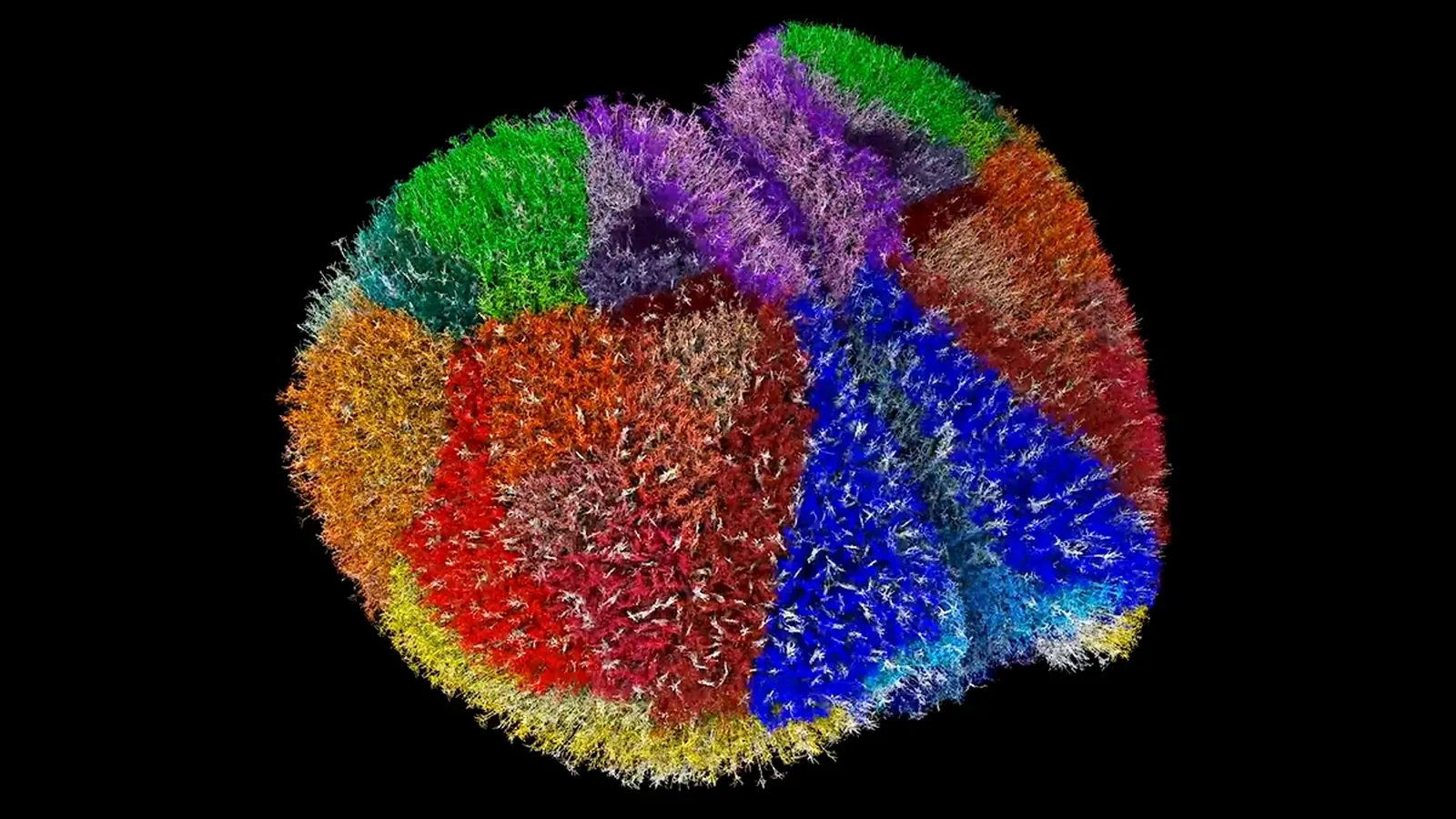
Researchers have created one of the most detailed virtual brains to date: a full mouse cortex simulation that reproduces individual neurons and their connections, enabling new experiments on brain waves, seizures and disease without invasive procedures.
How the virtual mouse cortex was built
A collaborative team from the Allen Institute (US) and the University of Electro-Communications (Japan) used cell databases, anatomical charts and new, efficiency-focused software to assemble a three-dimensional model of an entire mouse cortex. The virtual construct contains roughly 9 million neurons linked by some 26 billion synapses across 86 interconnected regions. It runs on Japan’s Fugaku supercomputer and performs calculations at quadrillions-per-second scale to simulate realistic neural activity.
By contrast, a real full mouse brain contains about 70 million neurons packed into roughly the size of an almond. The simulated cortex is therefore a subset of the full organ, but it preserves important structural and dynamical details that mirror biological circuits. The research demonstrates that with sufficient computational resources and precise biological data, large-scale, biologically grounded brain models are feasible.
What the simulation lets scientists do
The model offers researchers a dynamic, 3D map that shows individual neurons firing and forming networks in time. That level of granularity means hypotheses about cognition, the spread of seizures, interhemispheric communication and the generation of brain waves can be tested in silico before—or instead of—costly or invasive animal experiments.
.avif)
The simulation enables researchers to track the activity of individual neurons.
For example, teams can provoke a localized surge of activity in the virtual cortex to observe how abnormal rhythms propagate, or explore how synchronized oscillations between two hemispheres affect attention-like network states. Because the software is tuned to minimize unnecessary computation, long-duration experiments and many parameter sweeps become tractable on current supercomputers.
“This shows the door is open,” says computational neuroscientist Anton Arkhipov of the Allen Institute. “We can run these kinds of brain simulations effectively with enough computing power. It's a technical milestone giving us confidence that much larger models are not only possible, but achievable with precision and scale.”
Scientific context and implications
Large-scale brain simulations sit at the intersection of neuroscience, high-performance computing and data science. They rely on detailed cell-type atlases, connectomic maps (which show how neurons are wired), and electrophysiological measurements that constrain the model’s activity. When these inputs are accurate, the simulated networks can reproduce measurable properties of real tissue—such as firing rates, synchronization patterns, and wave propagation speeds.
Clinically, such models can accelerate research into neurodegenerative diseases like Alzheimer's by enabling systematic exploration of how cellular-level changes alter network dynamics over time. Simulations can also reduce the number of live-animal experiments by narrowing down the most promising interventions and predicting possible side effects of treatments on network behavior.
Tadashi Yamazaki, a computer scientist at the University of Electro-Communications, notes Fugaku’s broader role: “Fugaku is used for research in a wide range of computational science fields, such as astronomy, meteorology, and drug discovery, contributing to the resolution of many societal problems. On this occasion, we utilized Fugaku for a neural circuit simulation.”
Future prospects and challenges
The team behind the model is already using it to study brain-wave synchronization and the interactions between cortical hemispheres, but they have more ambitious plans: eventually building whole-brain models, including human-scale simulations that incorporate all available biological detail. That aim faces several substantial hurdles.
- Data completeness: Human brains are vastly more complex than a mouse cortex; obtaining the necessary, high-resolution cell-type and connectivity maps remains a major scientific effort.
- Computational cost: Human-scale simulations will require orders of magnitude more compute and optimized algorithms to remain practical.
- Validation: Models must be continually validated against experimental data to ensure that simulated dynamics reflect biology rather than artifacts of modeling choices.
Despite these challenges, the current effort is a proof of concept. By combining precise biological datasets with leading supercomputing infrastructure, researchers have advanced toward a new class of tools for studying brain function and dysfunction.
Expert Insight
Dr. Maya Fernandez, a neuroscientist and computational modeler at a university neurotechnology lab, commented on the work: “Large-scale cortical models mark a turning point for translational neuroscience. They let us probe mechanism-level questions—how cellular pathology scales to circuit dysfunction—without the confounds present in living systems. The critical next step is integrating multimodal human data so simulations can meaningfully inform clinical strategies.”
Outlook
This simulation was presented at the SC25 supercomputing conference and is available online. It represents a significant advance in biologically grounded neural modeling and highlights how supercomputers like Fugaku can accelerate discoveries, from basic neuroscience to potential clinical applications. As datasets and algorithms improve, virtual brain platforms will become ever more powerful tools for understanding thought, disease, and the emergent dynamics of neural tissue.

“My work centers on sustainability, energy, and environmental science — examining how innovation can lead to a greener future.”

Discussion
Leave a Comment