
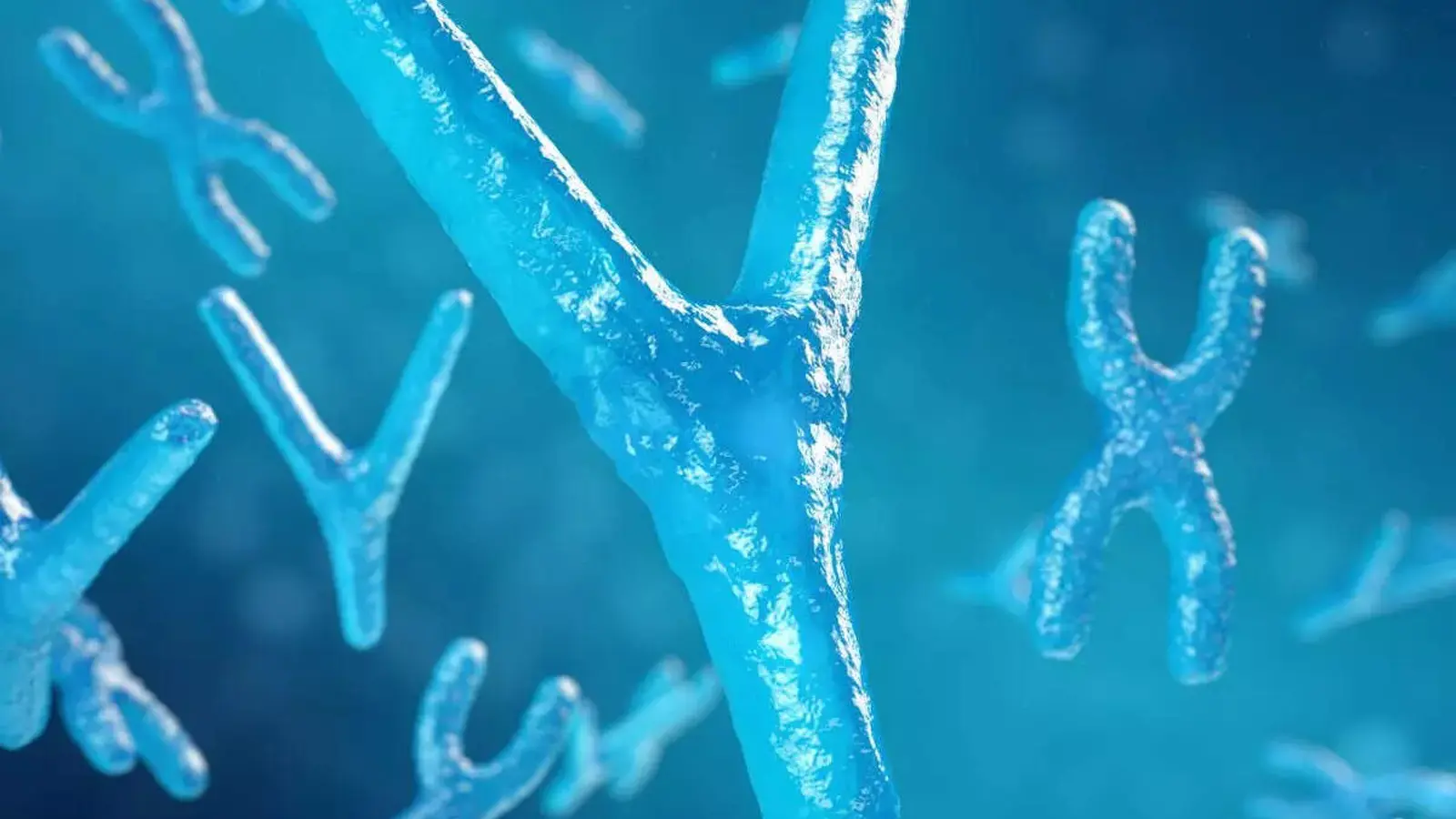
The future of the human Y chromosome has been debated fiercely for decades. Once nearly identical to the X, the Y has lost most of its ancestral gene content — and some researchers warn it could be replaced or radically reconfigured. Others argue that what remains is stable and indispensable. This article examines the scientific background, the key discoveries and the real implications for human biology.
Why the Y looked fragile in the first place
Early in mammalian evolution, the two sex chromosomes — X and Y — were essentially identical copies carrying hundreds of genes. Over roughly 200 million years the Y specialized for male sex determination and stopped recombining with the X during male meiosis. That suppression of recombination is the central evolutionary mechanism behind Y degeneration: without regular gene exchange to correct harmful mutations, genes on the Y are vulnerable to loss through drift and mutation.
Evolutionary biologists estimate that the ancestral pair had on the order of 800 genes. Today, the human Y retains only about 3 percent of that original number. But that loss was not steady. Rather than a linear decline, gene decay on the Y appears to have been rapid early on and then slowed in many lineages.
Lessons from other species: replacements and resilience
Comparative genomics shows several possible outcomes for sex chromosomes. In many fish and amphibians the Y (or Z/W systems) can deteriorate gradually and sometimes be replaced. In rodents, scientists have discovered striking natural experiments.
- Three species of mole vole — Ellobius talpinus, Ellobius tancrei and Ellobius alaicus — have no Y chromosome at all and live with only X chromosomes. In these species, male-determining functions were relocated to other parts of the genome.
- Some spiny rats (Tokudaia osimensis) appear to have replaced or heavily modified the ancestral Y, with a new genomic element assuming sex-determining duties.
These cases demonstrate that if a new, functionally superior sex-determining variant arises, it can spread rapidly through a population. From an evolutionary standpoint, the disappearance of the Y does not automatically mean the end of males or sexual reproduction — it means the mechanism that determines sex has shifted.
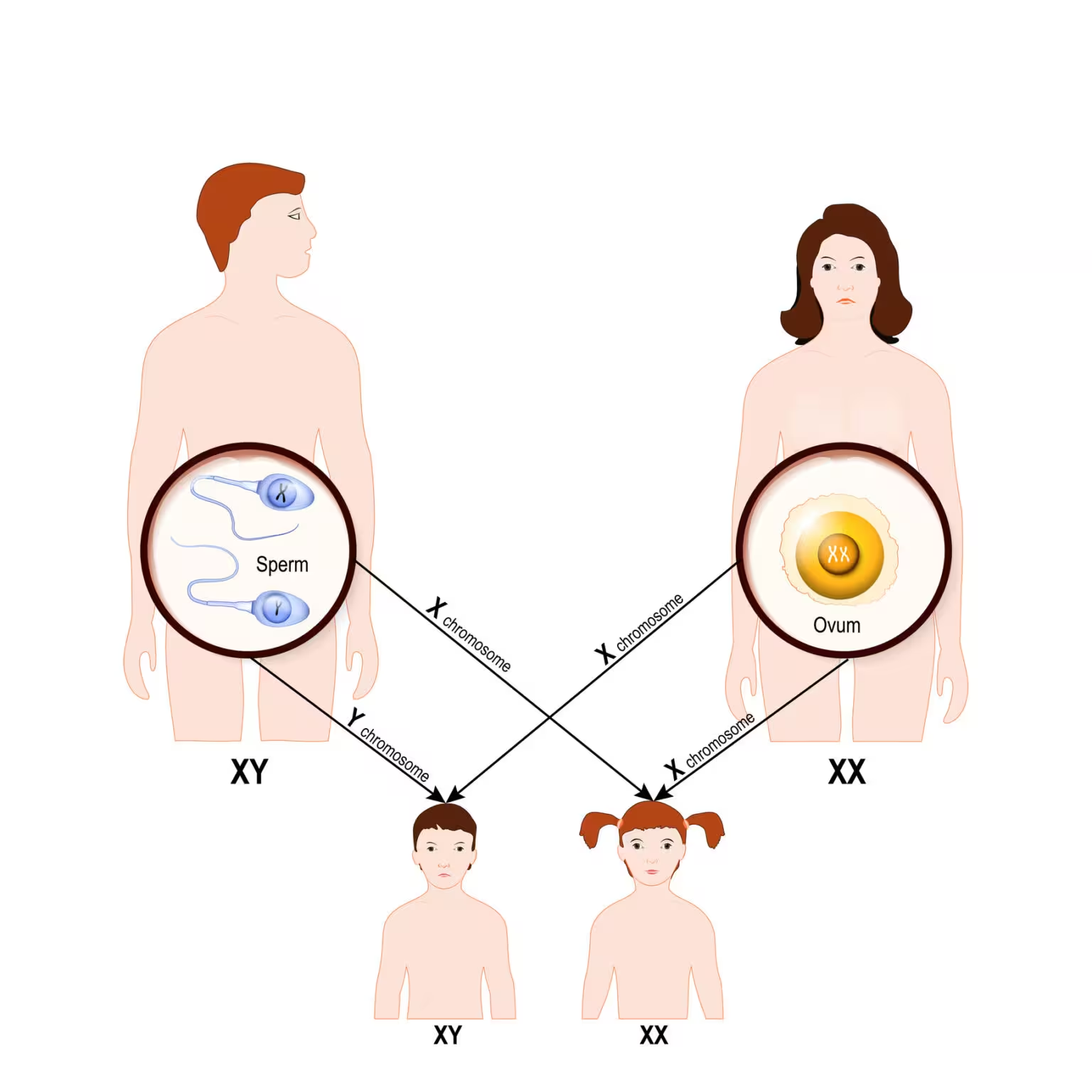
Typical genetic inheritance in humans
The debate: doomed versus durable
The discussion has often been framed as an either/or: is the Y chromosome a crumbling relic fated for extinction, or a resilient chromosome with essential genes that will persist? Two prominent voices in this debate are evolutionary biologists Jenny Graves and Jenn Hughes, each representing different interpretations of the same genomic patterns.
Graves popularized a dramatic estimate in the early 2000s suggesting the Y could vanish in a few million years if gene loss continued at the same observed rate. Her point was more nuanced than headlines suggested — she intended it as a back-of-the-envelope calculation to illustrate the trend — but the media translated it into sensational claims about the “end of men.” Graves' broader argument emphasizes that decay can continue in fits and starts and that duplicated gene copies on the Y may include many nonfunctional copies.
Hughes and colleagues, meanwhile, argue that after an initial phase of heavy loss, the Y's gene content stabilized. Work from Hughes' group showed that very few core Y genes have been lost in the primate lineage over the past ~25 million years. These retained genes are often dosage-sensitive and involved in essential functions across tissues beyond the testes, which exerts strong selective pressure to preserve them.
So which is right? Both perspectives capture parts of the truth. The Y experienced a steep early decline; what happens next depends on selective pressures, the functional importance of remaining genes, and rare genomic events that can shift sex determination elsewhere.
Mechanisms that protect or imperil Y genes
Once recombination between X and Y stopped, the Y found alternative molecular workarounds to maintain integrity. One important strategy is palindromic DNA architecture: the Y contains long inverted repeat sequences that allow it to repair some damage via intra-chromosomal gene conversion. This mechanism helps preserve essential gene copies even without an X partner.
However, gene duplication — another common Y strategy — is a double-edged sword. Making many copies of a gene raises the odds that at least one copy will remain functional, but it also increases the likelihood of accumulating nonfunctional relics. Graves has likened the Y to a "DNA junkyard" in this sense: a mixture of critical survivors and evolutionary detritus.

How a Y chromosome repairs itself without a second copy, as there are with two X chromosomes.
Detecting a shift in sex determination — a hidden challenge
If a human population ever evolved a new sex-determining system that replaced the Y, we might not notice it readily. Genome surveys rarely screen specifically for sex-determining variants, and a transferred determinant could produce the same outward outcome: two sexes, normal reproductive capability, and no obvious phenotypic differences. Only careful genomic and population-level analyses would reveal such a transition.
That raises both technical and philosophical questions for genomic surveillance. What should researchers be looking for? How would medical genetics adapt if a population carried an alternative sex-determination allele? For now, these scenarios remain largely hypothetical for humans, though they are real in other taxa.
Key discoveries and implications for human health
Understanding Y evolution is not merely an academic exercise. Loss of Y chromosomes in somatic tissues is associated with aging and increased risk of disease in men, including cancer and cardiovascular conditions. That link highlights that changes in Y biology can have direct health consequences, even if the chromosome persists at the population level.
From an evolutionary perspective, the long-term retention of certain Y genes suggests they have roles beyond male sexual development — roles that affect the whole body and thus face stronger purifying selection. That makes wholesale disappearance less likely in the short term, but does not exclude rare and rapid shifts over evolutionary timescales.
Expert Insight
"The Y chromosome’s story is one of both vulnerability and innovation," says Dr. Amelia Hart, a geneticist and science communicator. "Early gene loss highlights how genomic architecture shapes evolutionary trajectories, but the survival of core genes shows natural selection's counterbalance. In humans, the immediate risks are more about somatic loss and disease than a wholesale chromosomal extinction — that would require rare, population-level genomic turnover."
Related technologies and future prospects
Advances in long-read sequencing, single-cell genomics and comparative genomics are sharpening our picture of Y structure and function. Long-read technologies better resolve palindromic repeats and complex duplications on the Y, while population-scale datasets can reveal low-frequency sex-determining variants if they exist. Gene-editing tools offer experimental ways to test function, though ethical and safety considerations limit human applications.
Future research priorities include systematic screens for sex-determining variants across diverse populations, functional assays of conserved Y genes, and deeper investigation into how somatic Y loss contributes to age-related disease. Interdisciplinary work — bringing together evolutionary biologists, medical geneticists and bioinformaticians — will be essential.
Conclusion
The Y chromosome is neither a doomed artifact on an unavoidable march to extinction nor an immutable island of genetic permanence. It has lost most of its ancestral gene set, yet the genes that remain are often critical and conserved. Comparative genomics shows that nature can and does replace sex chromosomes in some lineages, but such events are rare and context-dependent. For humans, the immediate concerns are practical: understanding the health impacts of Y variation and somatic loss, and continuing to map the chromosome with modern sequencing tools. Over evolutionary time, surprises remain possible — and that uncertainty keeps the debate very much alive.

“The cosmos has always fascinated me. I write about space missions, astronomy, and the technologies pushing humanity beyond Earth.”

Discussion
Leave a Comment