

Researchers have uncovered that light’s magnetic component—long treated as negligible in many optical phenomena—plays a substantial role in twisting the polarization of light as it passes through magnetized materials. This finding revises a nearly two-century-old assumption about the Faraday effect and suggests new routes for controlling spin-based electronics and quantum devices.
A magnetic twist on a 180-year-old observation
Michael Faraday first described the Faraday effect in 1845: when a beam of light travels through a transparent material sitting in a magnetic field, the plane of its polarization rotates. Polarization describes the orientation of an electromagnetic wave’s oscillations; unpolarized light vibrates in many directions, while polarized light vibrates predominantly along one axis. Historically, physicists explained Faraday rotation as a result of the light’s electric field interacting with the material’s electrons and the applied magnetic field.
Until now, the magnetic component of light—the oscillating magnetic field that accompanies the electric field in any electromagnetic wave—was considered a passive participant. New work from a team at the Hebrew University of Jerusalem challenges that view, showing that the magnetic field of light makes a measurable, first-order contribution to Faraday rotation.
How experiment and theory revealed an overlooked interaction
The researchers combined refined laboratory measurements with theoretical modeling based on the Landau–Lifshitz–Gilbert equation, which governs how magnetization evolves in solids. Their calculations were keyed to physical models of Terbium-Gallium-Garnet (TGG), a magneto-optical crystal widely used in fiber optics and telecoms isolators because of its strong magneto-optical response.
Rather than attributing the entire rotation to the electric field alone, the team examined how the circularly polarized magnetic component of light can interact with electron spin—the intrinsic angular momentum of electrons—producing a torque that alters the material’s magnetic response. Their models and experimental context indicate that the magnetic part of light contributes roughly 17% of the Faraday effect at visible wavelengths and about 70% in the infrared, a far larger share than previously assumed.
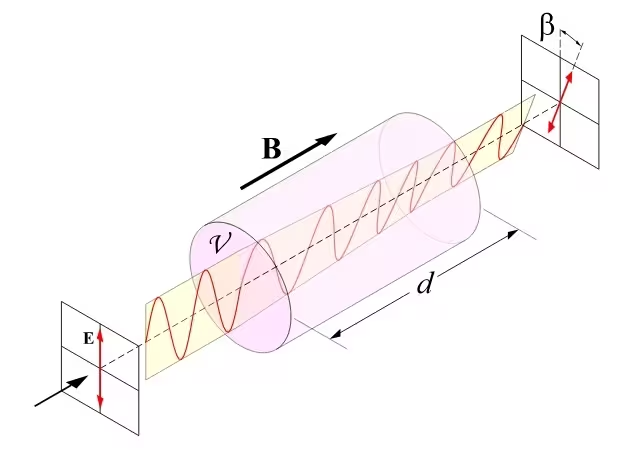
Illustration depicting the Faraday effect
Physicist Amir Capua, a member of the team, summarized the result as a rebalancing of roles: the electric field acts on electron charge in a linear way, while a spinning or circularly polarized magnetic field can exert a torque on electron spin. In simpler terms, light not only probes magnetism—it actively nudges it.
Why electron spin matters: connecting to spintronics and quantum tech
The distinction between charge and spin is central to several emerging technologies. Classical electronics primarily manipulates electron charge, but spintronics uses electron spins to store and process information—with potential advantages in speed, energy efficiency, and nonvolatility. If light’s magnetic component can directly influence spin, optical control schemes could become more powerful and precise.
Practical implications include higher-resolution magneto-optical sensors, improved optical memory elements, and novel ways to manipulate spin-based qubits in quantum computing. Electrical engineer Benjamin Assouline notes that the discovery points to a future where magnetic information is controlled optically, opening design space for devices that combine photonics and spintronics.
Beyond immediate applications, the result is a reminder that even long-established physical effects can hide subtleties. Researchers can now revisit magneto-optical phenomena in other materials and across different wavelength ranges to see where light’s magnetic field plays a role.
Experiment details and theoretical framework
The team’s approach mixed precision measurements (previously reported) with comprehensive modeling. The Landau–Lifshitz–Gilbert framework describes how magnetic moments respond to fields and damping; incorporating the oscillating magnetic component of an electromagnetic wave into that equation revealed the torque-like influence on spin dynamics. TGG served as a testbed because its strong magneto-optical coefficients amplify subtle contributions that would be harder to see in weaker materials.
Because the magnetic contribution grows with wavelength in their models, the effect becomes especially prominent in the infrared — a useful regime for telecom and many sensing technologies.
Expert Insight
"This work reframes how we think about light-matter coupling at a very basic level," says Dr. Lara Mendes, a condensed-matter physicist not involved in the study. "If the magnetic component of light can exert torque on spins directly, it gives engineers a new handle for ultrafast, low-energy spin control that is compatible with optical interconnects."
The study, published in Scientific Reports, invites experimentalists to verify the predicted percentages in different crystals and device geometries and challenges theorists to include magnetic-field coupling more routinely in magneto-optical models.
Discovering a previously underestimated channel of interaction between light and matter is also a testament to the iterative nature of science: even well-known effects can reveal fresh physics when probed with modern tools and renewed attention.

“The cosmos has always fascinated me. I write about space missions, astronomy, and the technologies pushing humanity beyond Earth.”

Discussion
Leave a Comment