
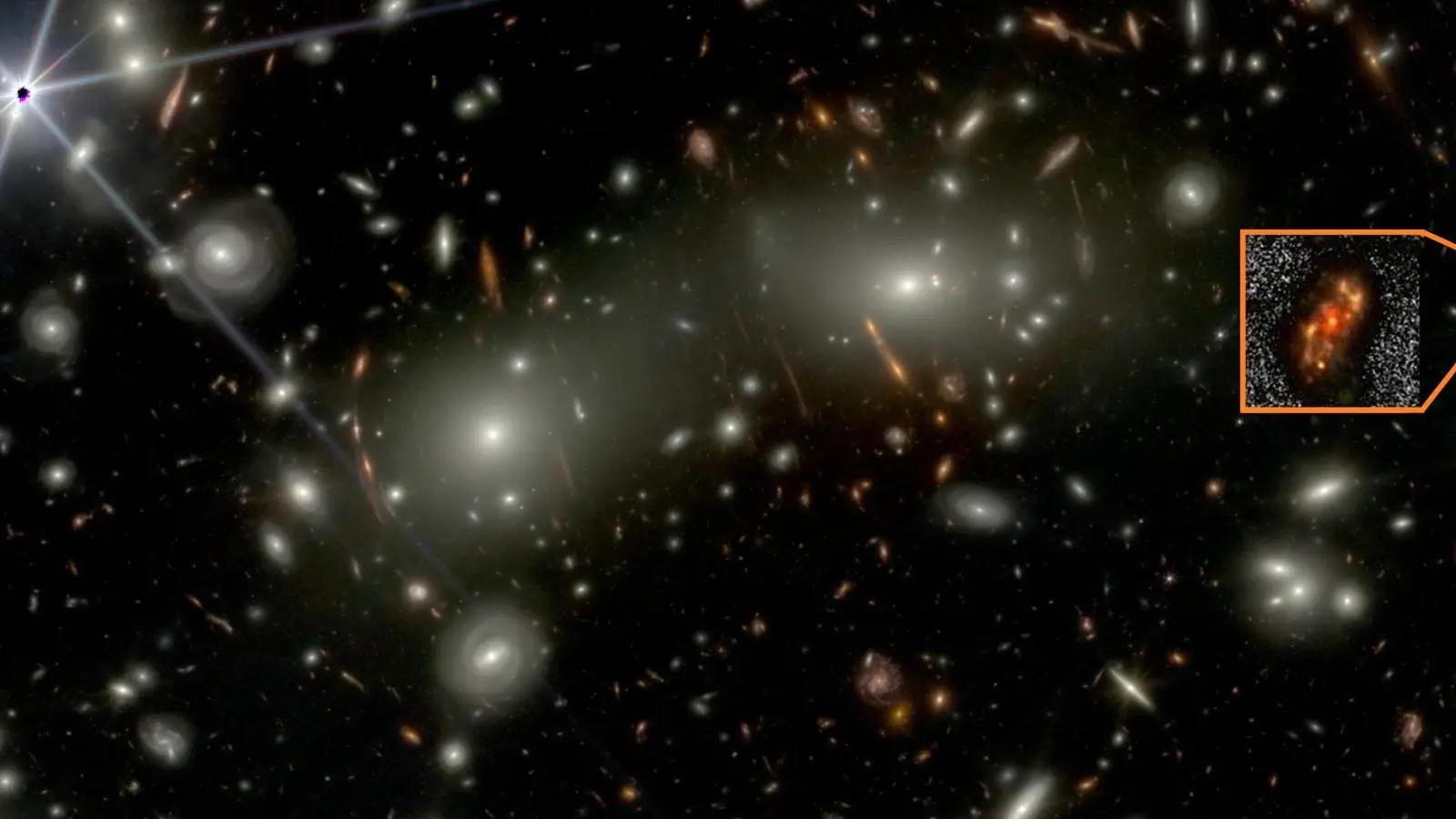
A remarkable spiral galaxy, nicknamed Alaknanda, has been identified at a cosmic epoch when astronomers expected only chaotic, immature systems. Observations with the James Webb Space Telescope (JWST) — amplified by the natural magnifying power of a massive galaxy cluster — reveal a clear grand-design spiral and intense star formation in a galaxy that formed when the Universe was roughly 1.5 billion years old.
Why Alaknanda is a surprise
Conventional models of galaxy formation predict that the first billion or two years after the Big Bang were dominated by turbulent, irregular systems. Building a textbook spiral galaxy — with a settled rotating disk, a rounded central bulge, and two symmetric, long-lived spiral arms (a so-called grand-design spiral) — requires a sequence of processes that should take much longer than a few hundred million years. Gas must flow from the cosmic web into a halo, cool and settle into a rotating disk, and then support slow-moving density waves that sculpt the spiral pattern. Major mergers at these early times would typically disrupt any ordered disk.
Alaknanda breaks that expectation. The JWST images reveal two well-defined spiral arms wrapping around a bright bulge across roughly 30,000 light-years. Photometric analysis indicates the galaxy contains about ten billion solar masses of stars and is converting gas into new stars at an extraordinary pace — roughly 60 solar masses per year, about twenty times the Milky Way’s current rate. Approximately half of its stellar mass may have formed in only ~200 million years, a blistering timescale on cosmic terms.
How astronomers saw such detail: JWST plus gravitational lensing
Alaknanda lies behind Abell 2744 (Pandora’s Cluster), a massive galaxy cluster whose gravity bends and magnifies light from more distant background objects. This gravitational lensing made the galaxy appear roughly twice as bright to JWST, providing the extra leverage needed to resolve structure in the distant system. The discovery came from deep JWST imaging that included up to 21 different filters across the near-infrared — part of the UNCOVER and MegaScience survey programs — enabling a precise measurement of distance, dust content, stellar mass, and star formation history.
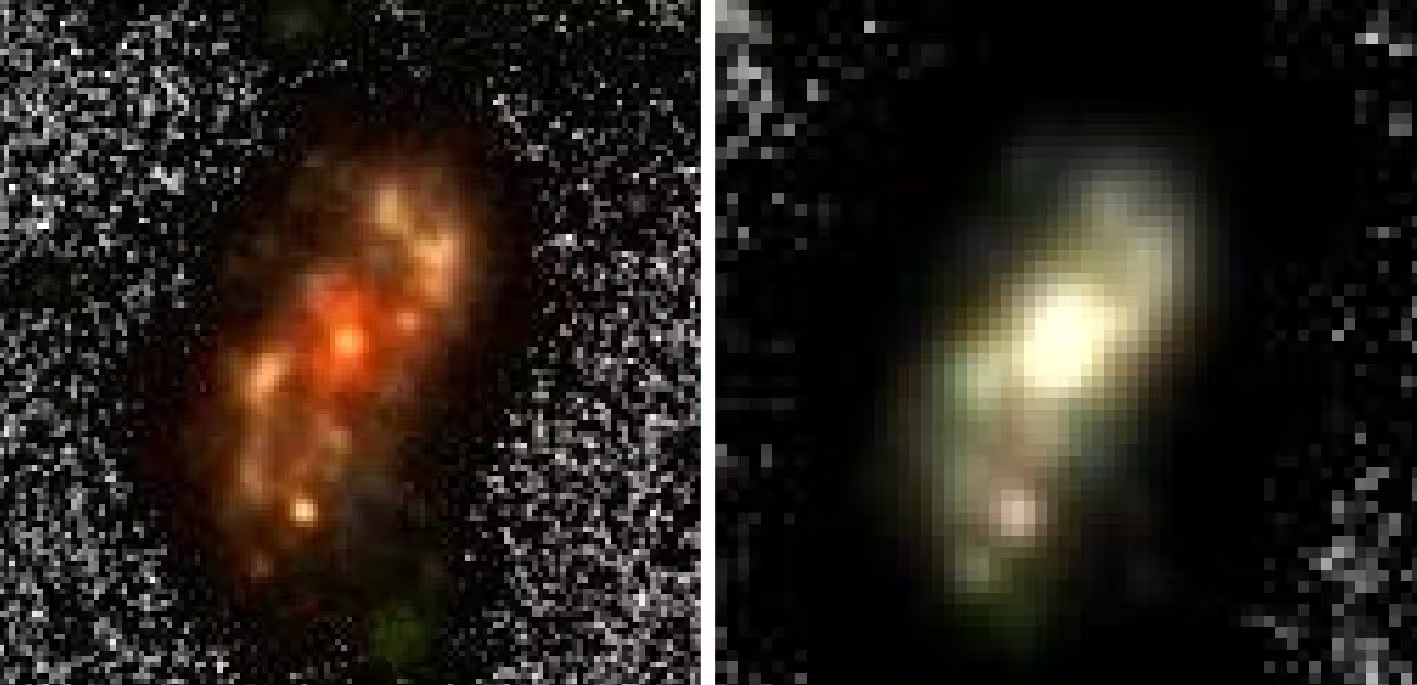
Left panel: Image of Alaknanda in rest-frame near-ultraviolet filters. The star-forming regions in the spiral arms form a beads-on-a-string pattern, characteristic of UV emission from massive stars in star-forming regions. Right panel: Alaknanda as seen in rest-frame optical filters. The spiral arms are less prominent and the underlying disk is clearly seen. Credit: © NASA/CSA/ESA, Rashi Jain (NCRA-TIFR)
Scientific context: what a grand-design spiral at z~3 means
Finding a grand-design spiral like Alaknanda at a redshift corresponding to 1.5 billion years after the Big Bang forces a re-evaluation of the pace of galaxy assembly in the early Universe. The object suggests that processes such as efficient cold gas accretion, rapid disk settling, and perhaps early spiral density wave formation can operate far faster or under different conditions than many theoretical models predict.
There are several possible formation scenarios under discussion. One is smooth, cold inflow of gas from the intergalactic medium that quickly built a rotationally supported disk, allowing density waves to amplify and form spiral arms. Another is that a gentler tidal interaction with a smaller neighbor triggered the arms, though tidally induced spirals often dissipate quickly. Distinguishing these requires kinematic data: is the disk dynamically cold (ordered rotation) or hot (turbulent motions)? Follow-up spectroscopy with JWST and observations with radio/submillimeter facilities like ALMA will be crucial to map gas motion and distribution.
Implications for galaxy formation and cosmic history
Alaknanda is not just a striking image; it’s a data point with broad implications. If the early Universe could assemble massive, well-ordered disks quickly, then the timeline for star and planet formation may also shift. Earlier formation of stable disks implies that protoplanetary environments and the ingredients for rocky planets might have become available sooner than previously estimated. The discovery dovetails with other recent JWST findings that hint at more mature, massive galaxies at high redshift than predicted by earlier models.
For theorists, this means refining simulations of gas inflow, cooling, feedback from star formation and black holes, and angular momentum transport. For observers, it prioritizes spatially resolved spectroscopy of early disks to measure rotation curves, velocity dispersion, and metallicity gradients — all diagnostics that can confirm whether Alaknanda formed quietly or via more dramatic processes.
Mission and methods: how the discovery was made
Researchers Rashi Jain and Yogesh Wadadekar at the National Centre for Radio Astrophysics (NCRA-TIFR) in Pune, India, led the analysis published in Astronomy & Astrophysics. They used JWST imaging collected by the UNCOVER and MegaScience surveys, applying multi-filter photometry to derive a robust redshift estimate, stellar mass, dust attenuation, and a time-resolved star-formation history. The gravitational magnification by Abell 2744 made it feasible to detect subtle structural details that would otherwise be below JWST’s sensitivity limits for such distant sources.
- Instrument: James Webb Space Telescope (near-infrared imaging)
- Technique: gravitational lensing magnification + multi-filter photometry
- Surveys: UNCOVER, MegaScience (deep field imaging)
- Follow-up prospects: JWST spectroscopy, ALMA mapping of cold gas
Expert Insight
"Alaknanda is a wake-up call for anyone modeling early galaxy assembly," says Dr. Mira Santoro, an observational cosmologist (fictional) who studies high-redshift disk formation. "The clear spiral pattern and rapid star-formation rate together suggest a surprisingly efficient supply of cold gas and early dynamical settling. Follow-up kinematics will tell us whether this is an exceptional case or representative of a broader, previously hidden population."
Next steps and future observations
Immediate priorities are spectroscopic confirmation of rotational support and gas dynamics. JWST’s spectrographs can measure emission-line velocities across the disk, while ALMA can map molecular gas and dust that fuel star formation. If Alaknanda shows ordered rotation with low velocity dispersion, that supports a cold-accretion, early-settling scenario. Conversely, high turbulence or asymmetric motions would point to recent interactions or rapid internal evolution.
Deeper imaging of other lensing fields and blank deep fields will reveal whether grand-design spirals at similar epochs are rare curiosities or a common, previously underappreciated phase of galaxy evolution. Each new detection will refine the statistical picture and constrain the physical ingredients needed to build spiral structure so early.
Conclusion
Alaknanda — a clear, symmetric spiral emerging from a time when the cosmos was still in its adolescence — challenges our assumptions about how quickly complexity can arise in the Universe. As JWST and other observatories continue to push observational frontiers, discoveries like this will reshape timelines for galaxy and star formation and push theoretical models to incorporate faster, more efficient pathways to disk and spiral formation.

“My work centers on sustainability, energy, and environmental science — examining how innovation can lead to a greener future.”

Discussion
Leave a Comment