
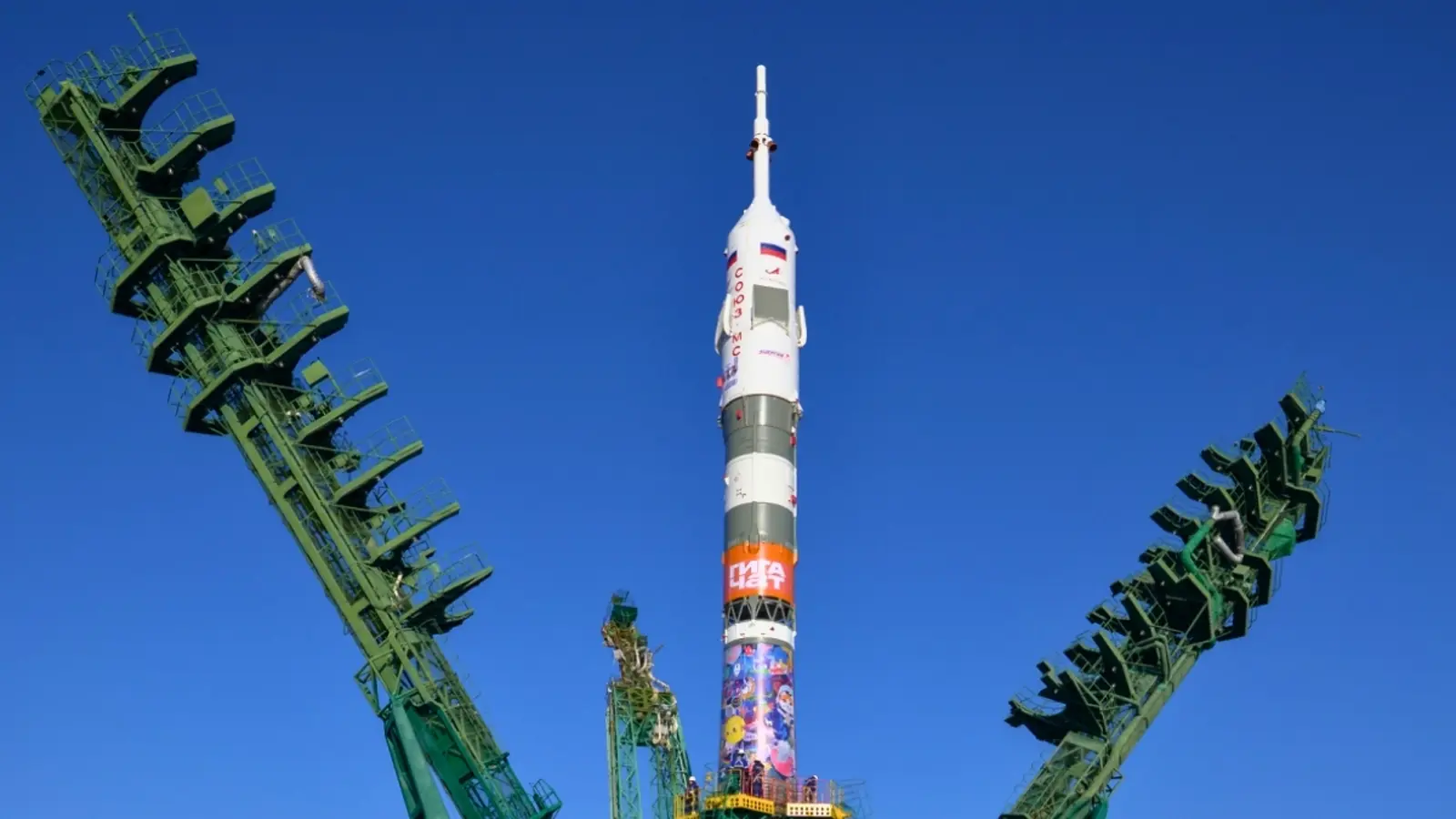
Baikonur Accident Forces Temporary Halt to Soyuz Flights
On November 27, 2025, a serious structural failure at Kazakhstan's Baikonur Cosmodrome has paused Russia's ability to conduct crewed and routine cargo flights to the International Space Station (ISS). Although the Soyuz MS-28 mission itself lifted off successfully at 09:27:57 UTC and the crew—cosmonauts Sergey Kud-Sverchkov and Sergei Mikayev, alongside NASA astronaut Christopher Williams—reached the ISS safely, post-launch drone footage revealed a critical piece of ground infrastructure had collapsed into the flame trench.
What happened at Site 31/6?

Drone footage of Site 31/6 before (above) and after (below) launch, showing the damage to the maintenance cabin.
The component that failed is the 8U216 mobile maintenance cabin: a heavy, metal service module used during final countdown operations. Weighing more than 130 metric tons, the cabin is lowered beneath the launch platform to allow technicians to inspect and service the rocket engines and install pyrotechnic safety devices. After this launch, the cabin was found inverted some 20 meters down in the flame trench.
Initial reports indicate the flight profile and vehicle behaved nominally; the Soyuz reached orbit and the crew is in good health aboard the ISS. But the damage to Site 31/6 has effectively rendered Russia’s primary crew-launch pad for Soyuz and Progress vehicles out of commission, creating an immediate operational bottleneck for Roscosmos.
Roscosmos response and damage assessment
Roscosmos confirmed the incident via official channels, stressing the success of the launch while acknowledging damage to pad hardware. According to the agency, pre-launch checks were completed and the service cabin was returned to its storage nook after fueling and countdown operations. Post-launch inspections, however, revealed that pressure differentials during ignition and plume expansion pulled the cabin from its housing and threw it into the flame trench.
Investigators are reviewing whether locking mechanisms failed or were improperly secured before liftoff. Some engineers quoted by industry outlets believe the maintenance cabin may be too badly deformed to repair on site, and may have to be rebuilt or replaced entirely—options that carry very different timetables and costs.
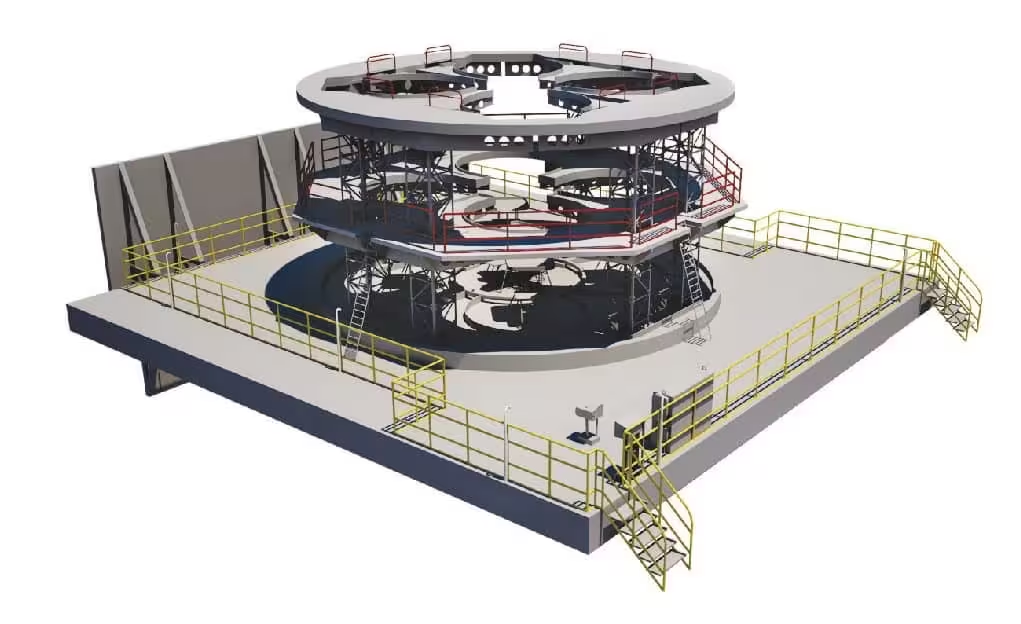
The maintenance cabin at Site 31/6
Timeline for repairs and operational impact
Roscosmos has said spare components are available within Russia, and industry sources have confirmed parts could be shipped or fabricated. One contingency under discussion is dismantling a similar cabin from Site 43 at the Plesetsk Cosmodrome and relocating it to Baikonur; Site 43 has supported R-7 family launches since the 1960s. However, moving heavy ground equipment, validating structural integrity, and requalifying the pad will take time.
Estimates for restoring Site 31/6 vary widely—from several months if the cabin can be replaced quickly, to as long as three years if extensive structural repairs are required. The scope of the repair program depends on two key unknowns: whether the cabin can be salvaged, and whether ancillary pad systems sustained heat, shock, or plumbing damage that also require replacement.
In any scenario, Roscosmos will need to carry out at least one uncrewed test launch from the repaired pad before resuming regular crewed missions to the ISS. That requirement, plus required parts fabrication and certification work, means some scheduled flights will be delayed.
Immediate operational consequences
The accident already forced slippage of the Progress MS-33 cargo mission that was due to fly on December 21, 2025, and could push back the next crew rotation, Soyuz MS-29, which had been scheduled for July 14, 2026. Because alternative Russian facilities—Plesetsk and Vostochny—either lack the launch azimuth or crew-capable infrastructure, Roscosmos cannot simply shift planned Soyuz crew missions to another domestic pad without major modifications.
Furthermore, Russia no longer operates at Europe’s Guiana Space Centre in Kourou for crew launches after the withdrawal of Roscosmos personnel, removing what might have been another workaround for certain missions.
Wider program and geopolitical implications
Baikonur's history includes several severe incidents, notably the Nedelin catastrophe in 1960. While the current mishap is not a human-casualty event, it arrives at a difficult time for the Russian space program. International sanctions since 2022 have already strained procurement, international partnerships, and commercial launch revenues. Projects such as ExoMars and planned joint missions have been canceled or suspended, and several European missions that once relied on Soyuz launches have moved to other providers.
The current disruption will likely compound revenue and scheduling pressures for Roscosmos, complicating both domestic science programs and commercial contracts that remain under the agency's purview.
What this means for the ISS and international partners
With Soyuz and Progress flights constrained, international partners will need to rely more heavily on other vehicles—commercial crew and cargo services from the U.S. and private providers—to maintain station logistics and crew rotations. NASA and its partners typically plan for contingencies, and the ISS program maintains a degree of redundancy, but extended downtime at Baikonur will tighten margins on spare parts deliveries, experiment schedules, and crew refreshment windows.
This could also accelerate negotiations or planning to use alternative commercial assets for certain services but shifting contracts or scheduling launches to meet station needs is complex and may have cost implications.
Potential impact on space-related blockchain and crypto projects
The accident also has indirect relevance to blockchain, cryptocurrency, and tokenized space ventures. Over the last several years, projects leveraging satellite constellations for blockchain nodes, secure telemetry, or orbital asset registries have begun maturing. A sustained pause in Soyuz and Progress access affects payload manifests and launch windows for smallsat and payload providers, some of whom tokenize launch slots or use smart contracts for launch insurance and escrow services.
Delays and platform risk can ripple into DeFi agreements tied to mission milestones, tokenized revenue streams for rideshare manifests, and NFT-linked mission memorabilia. Launch insurance markets—both traditional and decentralized—may see claims or re-pricing if missions are postponed. For crypto startups relying on Soyuz for low-cost rides to orbit, the Baikonur disruption will likely force scheduling changes or motivate search for alternative launch providers, affecting timelines and investor expectations.
Next steps and what to watch
Investigators will continue forensic analysis of the pad hardware and launch telemetry to determine root cause. Roscosmos has pledged to source or fabricate necessary parts and execute repairs as quickly as safety and engineering constraints allow. Key indicators to monitor over the coming weeks include assessments of secondary pad damage, decisions about replacing versus rebuilding the 8U216 cabin, and the agency’s timeline for uncrewed validation flights.
For the broader aerospace and crypto communities, follow-on items include revised launch manifests, insurance filings, and any announcements about transferring payloads to alternate launch vehicles. The intersection between space infrastructure risk and blockchain-enabled services—such as tokenized payloads, satellite-blockchain applications, and crypto-linked launch insurance—will also be an area to watch.
The Baikonur incident is a potent reminder that even successful launches can be accompanied by ground-system failures with outsized operational consequences. Restoring full Soyuz launch capability will be a priority for Roscosmos, and the outcome will shape both near-term ISS operations and longer-term international and commercial space activity.

“My work centers on sustainability, energy, and environmental science — examining how innovation can lead to a greener future.”

Discussion
Leave a Comment