
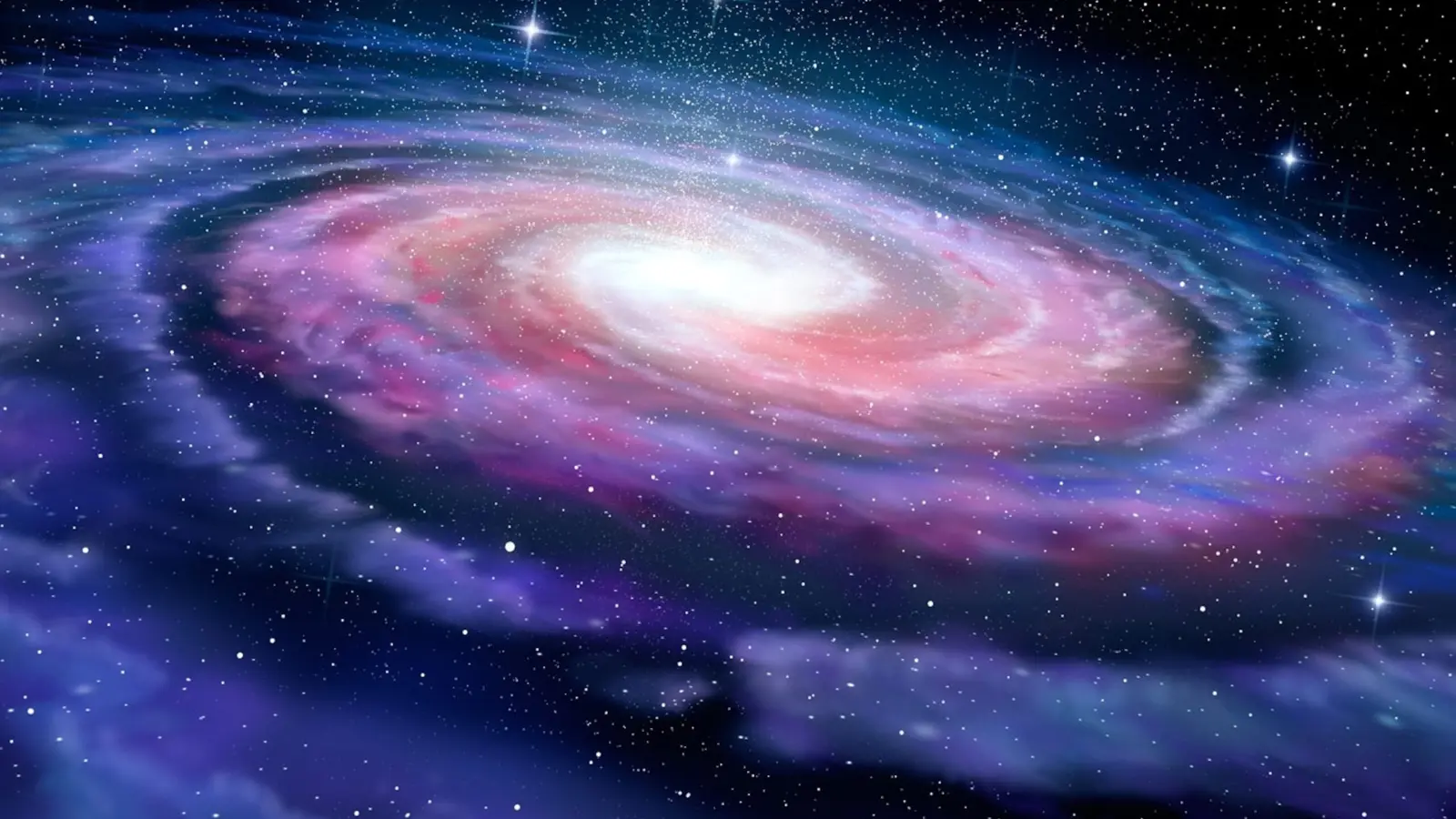
New computer models show that the Milky Way’s curious split into two chemically distinct stellar populations — long thought to be a unique signature of our galaxy’s past — can arise through multiple evolutionary routes. Rather than a single dramatic event, a combination of star-formation bursts, changing gas inflows and metal-poor circumgalactic gas can create the same two-track chemical pattern.
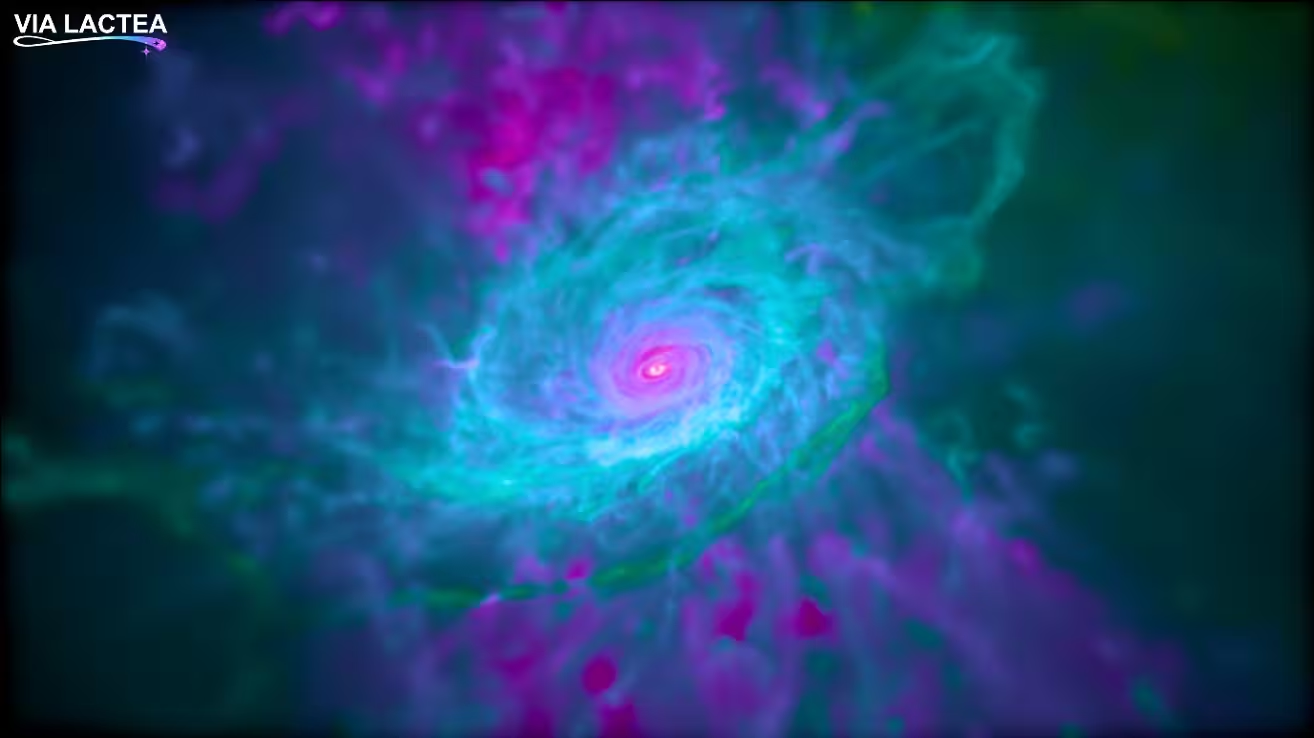
This image shows the gas disc in a computer simulation of a Milky Way-like galaxy from the Auriga suite. Colors represent the ratio of magnesium (Mg) to iron (Fe), revealing that the galactic center (pink) is poor in Mg, while the outskirts (green) are Mg-rich. These chemical patterns provide important clues about how the galaxy formed.
Unraveling the Milky Way’s chemical divide
A long-standing puzzle in Galactic astronomy is the so-called chemical bimodality: when stars near the Sun are plotted by their magnesium-to-iron ratio (Mg/Fe) versus iron abundance (Fe/H), they fall into two clear but partly overlapping sequences. Since Mg is produced mostly by short-lived massive stars (core-collapse supernovae) while Fe accumulates slower via Type Ia supernovae, the Mg/Fe ratio is a sensitive tracer of a galaxy’s star-formation history and gas supply.
Researchers at the Institute of Cosmos Sciences, University of Barcelona (ICCUB), together with colleagues at CNRS, used the Auriga suite of cosmological magneto-hydrodynamical simulations to recreate the growth of Milky Way–like galaxies inside a realistic virtual universe. By running 30 different galaxy simulations with varied merger histories, gas accretion rates and feedback physics, the team could ask whether the dual chemical sequences require a single cause — such as a major merger — or whether they are natural outcomes of galaxy evolution.
The answer: multiple pathways. In many Auriga galaxies, two distinct Mg/Fe–Fe/H sequences emerged without any single common trigger. Instead, a patchwork of processes — intense, relatively short-lived starbursts; pauses in star formation; shifts in the source and metallicity of inflowing gas — can split a galaxy’s stars into two apparent chemical tracks.
Multiple evolutionary routes: starbursts, gas flows and the CGM
One robust pattern from the simulations is that the shape and separation of the two chemical sequences closely reflect a galaxy’s star-formation timeline. A rapid, early burst of star formation elevates Mg/Fe because massive stars explode quickly and seed the interstellar medium with alpha elements like magnesium. If star formation then slows or pauses, Type Ia supernovae continue to add iron, driving down Mg/Fe in later-formed stars and creating a second, lower Mg/Fe track.
Alternatively, changes in the metallicity of gas entering the galaxy can create the bimodality. If the disc begins to draw in more metal-poor gas from the circumgalactic medium (CGM) or outer halo, new generations of stars will form with lower overall metallicity and different Mg/Fe ratios than earlier populations. The Auriga models show that a mix of internal processes and external gas accretion can therefore sculpt two chemical tracks without requiring a single dramatic collision.
This result challenges the notion that the Milky Way’s two-track chemistry uniquely records a particular merger — specifically the Gaia-Sausage-Enceladus (GSE) event, a dwarf galaxy thought to have collided with the Milky Way early on. While GSE undoubtedly affected the Galaxy’s kinematics and stellar populations, the simulations indicate that a GSE-like merger is not a necessary condition for chemical bimodality. Metal-poor inflows from the CGM or cyclical star-formation activity can produce similar signatures.
Understanding these pathways matters beyond our own galaxy. For example, Andromeda — our nearest large neighbor — does not show the same clear chemical split in current observations, suggesting diversity in galaxy evolution even among similarly sized spirals. The Auriga results predict that a range of chemical patterns should be found across external galaxies once high-resolution spectroscopy becomes routine for distant stellar populations.
Observational tests and next-generation telescopes
Predictions from the Auriga suite are timely: new and upcoming facilities will dramatically expand the chemical census of stars both inside and beyond the Milky Way. The James Webb Space Telescope (JWST) and the next generation of 30-meter-class ground telescopes will enable detailed chemical studies of stellar populations in nearby galaxies. Planned missions such as PLATO and concept studies like Chronos will add precision constraints on ages and compositions.
With these instruments, astronomers can test whether chemical bimodality correlates with a galaxy’s merger history, its CGM metallicity, or epochs of starburst activity. If simulations and observations align, we’ll gain a clearer mapping between Mg/Fe–Fe/H diagrams and specific evolutionary episodes — a valuable tool for reconstructing the pasts of distant galaxies.
Expert Insight
"The Auriga simulations emphasize that galaxies are not bound to a single evolutionary script,” says Dr. Aisha Rahman, an astrophysicist specializing in chemical evolution. "Two-track chemical patterns are like fingerprints: useful, but not unique. By combining stellar chemistry with age dating and kinematics, we can start to read the sequence of events that shaped a galaxy."
Conclusion
Instead of a single textbook explanation, the Milky Way’s chemical bimodality appears to be a natural outcome of diverse evolutionary processes. The Auriga simulations make clear that star-formation history, gas inflow metallicity and the circumgalactic environment can all carve two distinct chemical tracks. Upcoming telescopes and surveys will be crucial to test these predictions and to resolve how common — or rare — our Galaxy’s chemical pattern truly is across the cosmos.

“The cosmos has always fascinated me. I write about space missions, astronomy, and the technologies pushing humanity beyond Earth.”

Discussion
Leave a Comment