
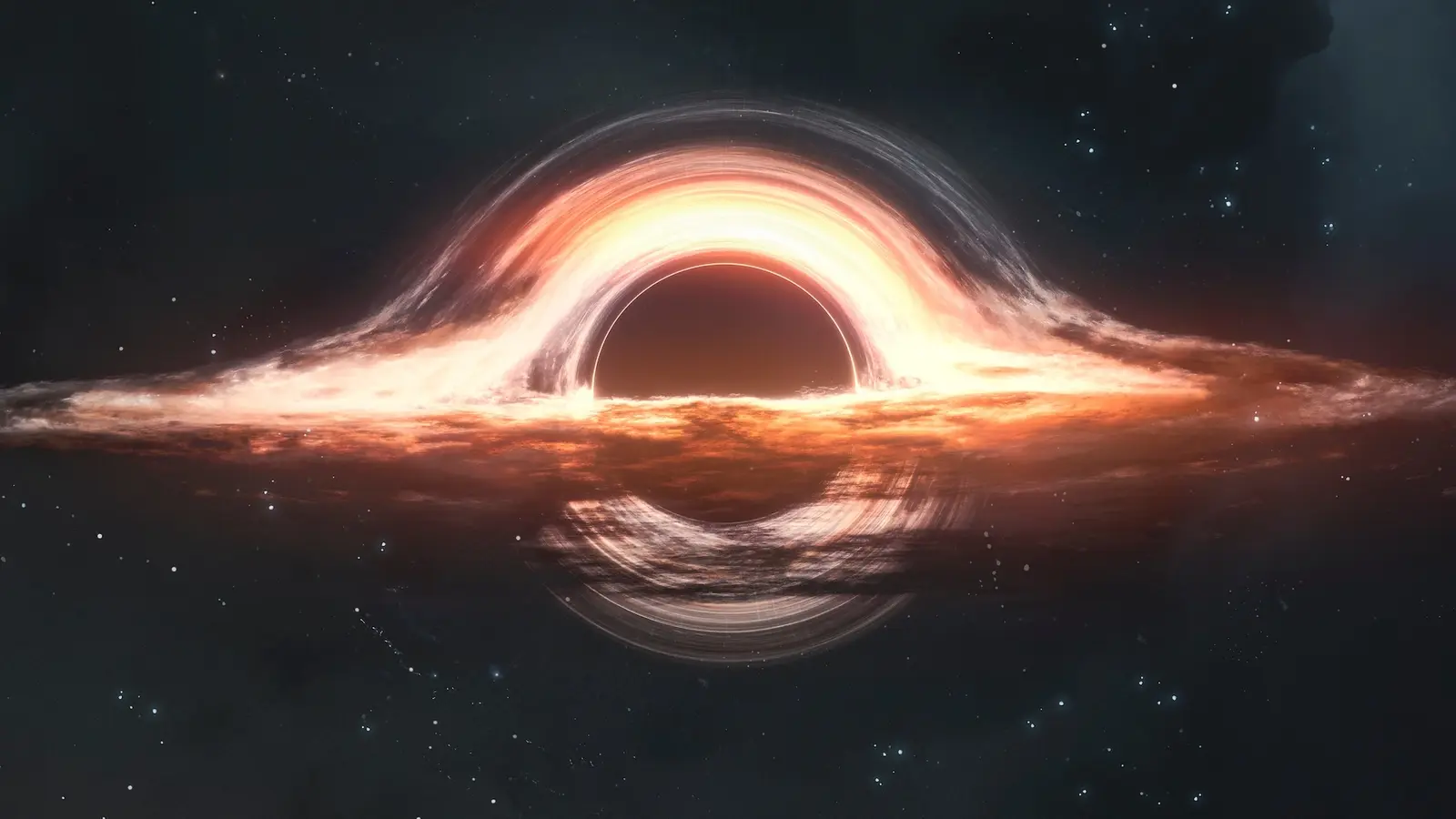
Researchers have produced the most comprehensive computer models to date of matter falling into black holes, combining full general relativity with detailed radiation physics on exascale supercomputers. These new simulations reproduce behaviors seen in telescopes and spectra that previous simplified models missed, opening a clearer window into how disks, winds and jets form around luminous black holes.
Using cutting-edge algorithms and the world’s fastest machines, a team from the Institute for Advanced Study and the Flatiron Institute’s Center for Computational Astrophysics has created a computational framework capable of treating radiation exactly within curved spacetime. The effort focuses on stellar-mass black holes—objects roughly ten times the Sun’s mass—that evolve on human-observable timescales and whose high-energy light provides the best clues to accretion physics.

Using next-generation supercomputers, the team uncovered patterns that closely resemble what astronomers observe in real systems
A new level of realism: combining relativity and radiation
Modeling gas near a black hole means contending with two intertwined challenges. First, the black hole’s gravity is so strong that only Einstein’s general relativity correctly describes how spacetime is curved and how matter and light move. Second, when large amounts of gas fall inward, the energy release is enormous: radiation (photons) carries momentum and energy, influences temperature and pressure, and exchanges heat with the gas. Historically, computational limitations forced researchers to simplify one or both problems—treating radiation as a crude fluid or ignoring relativistic corrections in parts of the domain.
What this new work delivers is a direct numerical solution that treats radiation transport consistently within general relativity, without those simplifying approximations. That matters because black hole accretion flows are highly nonlinear: small changes in radiative coupling or in the way photons escape can radically alter the disk structure, turbulence, and the launching of winds or jets. By solving the full equations, the simulations reveal stable patterns and spectral signatures that match observations of ultraluminous X-ray sources and X-ray binaries more closely than previous models.
How the simulations were built and run
To reach this milestone the team developed new applied mathematics and software and scaled them to run on exascale hardware. Key elements included a radiation transport algorithm that directly integrates the photon field in curved spacetime, and an implementation optimized for modern massively parallel architectures. Christopher White led the radiation transport design, while Patrick Mullen implemented the algorithm in the AthenaK code, tailored for exascale performance.
Access to Oak Ridge and Argonne National Laboratories’ Frontier and Aurora supercomputers—machines that can perform on the order of 10^18 operations per second—was crucial. These resources let the group resolve both the small-scale turbulence inside the disk and the large-scale outflows and jets over sufficiently long runs to compare with observational timescales. The project builds on decades of theory and on computational legacies stretching back to early numerical pioneers in fluid dynamics and astrophysics.

This image shows the gas density in a two-dimensional cross-section of an accreting black hole. Brighter areas represent regions of higher density. Near the black hole, the accretion flow forms a dense, thin thermal disk embedded within a magnetically dominated envelope that helps stabilize the system. Although the flow is radiation-dominated and highly turbulent, the thermal disk structure remains remarkably stable. Credit: Zhang et al. (2025)
Key scientific results and observational links
The simulations focus on stellar-mass black holes because their fast variability (minutes to hours) lets researchers map dynamic processes to observable changes in X-ray light. When gas spirals inward it often forms a radiation-dominated, turbulent disk. The new models show that even in the presence of strong radiation pressure and turbulence, a thin thermal disk can persist close to the black hole if a magnetically dominated envelope helps stabilize the flow. This structure affects the emitted spectrum and the timing properties of the source.
Beyond the disk itself, the simulations reproduce powerful, radiation-driven winds and, in some regimes, relativistic jets guided by organized magnetic fields that thread the inner flow. The modeled spectra—computed from the simulated photon field—match observed X-ray spectra from several types of accreting systems better than earlier approximate models. That spectral agreement strengthens confidence in interpreting telescope data and in extracting physical parameters such as accretion rate, magnetic field strength, and black hole spin.

This image shows how gas and magnetic fields behave around a fast-spinning black hole that is capturing matter at an extremely high rate. The thick, donut-shaped disk of gas around the black hole gets denser toward its middle. In this image, brighter purple areas indicate that the gas is denser, while darker purple areas have less gas. Near the black hole, a powerful jet shoots outward, guided by spiral-shaped magnetic fields. The colorful lines in the image trace the jet’s magnetic fields, and their colors reveal the field strength: red and orange show stronger magnetic fields, while yellow and green show weaker ones. Credit: Zhang et al. (2025)
Implications for black hole science and astrophysics
Having a reliable, high-fidelity simulation tool changes how scientists can test physical ideas. For example: why do some accreting black holes launch strong jets while others only produce winds? How does radiation pressure alter the inner-disk geometry and the observable high-energy emission? With a model that treats radiation properly in curved spacetime, researchers can probe these questions quantitatively and link model outputs to spectra, light curves, and polarization signals.
Another implication affects multiwavelength astrophysics. Supermassive black holes in galactic centers evolve on long, often inaccessible timescales; stellar-mass systems provide a complementary laboratory because they evolve rapidly. The new models make it easier to translate time-dependent simulation results into predictions for X-ray, UV and even optical variability, helping observers plan campaigns and interpret transient events such as state transitions or sudden flares.
Expert Insight
"Bringing full radiation transport together with general relativity is what we needed to close the loop between theory and observation," says an astrophysicist familiar with the project. "These simulations allow us to watch how photons and plasma talk to each other in the most extreme environments in the universe. That connection is essential if we want to read spectral features and use them to measure black hole properties with confidence."
Another computational scientist notes: "This is as much a software and algorithmic achievement as it is an astrophysical one. Running these codes efficiently at exascale required rethinking data movement and parallelism, and that work will benefit other fields that need large-scale radiation hydrodynamics."
Future directions and challenges
The research team plans a sequence of follow-up studies. Immediate goals include extending the framework to a wider range of black hole masses (including supermassive black holes), exploring different accretion regimes from sub-Eddington to highly super-Eddington flows, and improving microphysics such as frequency-dependent radiation transport and more detailed radiation–matter coupling across a broader temperature and density range.
There are also technical challenges ahead. Exascale simulations are expensive in compute hours and storage, and post-processing to generate synthetic observations is also intensive. The team will need continued access to leadership-class facilities and community support to run parameter surveys and to share tools and datasets with observers and theorists worldwide.
Conclusion
By solving radiation transport in curved spacetime without resorting to simplifying approximations, the new simulations represent a major step toward physically faithful models of luminous black hole accretion. They offer testable predictions for disk structure, winds, jets and spectra, and they provide a platform to interpret increasingly precise observational data. As exascale computing matures and algorithms improve, expect a rapid acceleration in our ability to model and understand black holes in both stellar and galactic contexts.

“The cosmos has always fascinated me. I write about space missions, astronomy, and the technologies pushing humanity beyond Earth.”

Discussion
Leave a Comment