
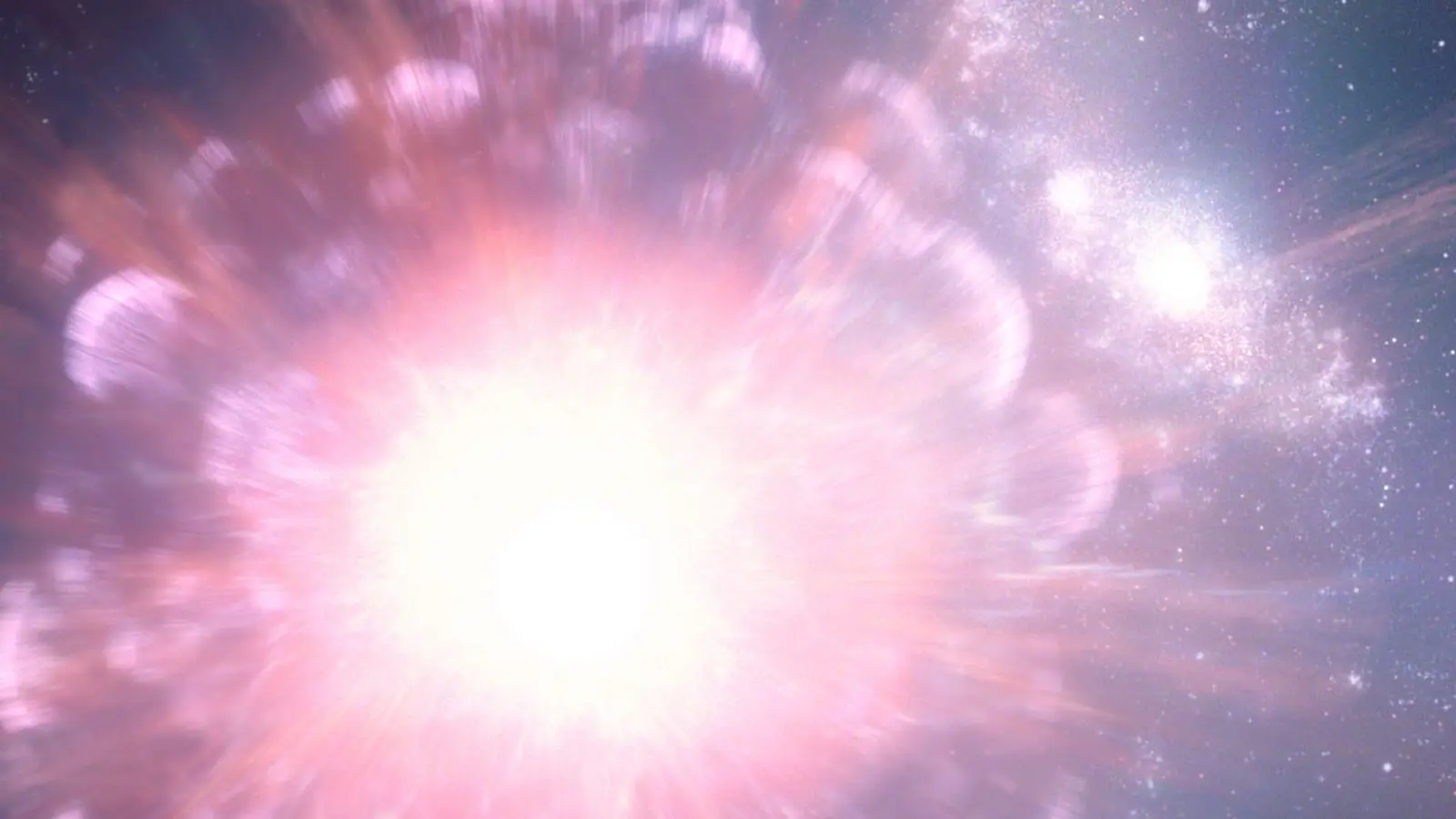
A tiny red flash from the Universe’s infancy — seen by multiple observatories and confirmed by the James Webb Space Telescope — has set a new record as the earliest supernova ever observed. The event erupted when the cosmos was only 720 million years old, during the critical Epoch of Reionization.
A faint flash at the edge of time
On 14 March 2025, the joint French-Chinese satellite SVOM (Space Variable Objects Monitor) flagged a bright, distant gamma-ray burst. The signal, cataloged as GRB 250314A, initially looked like the brightest peak of a long-duration burst whose lower-intensity emission dipped below the satellite’s detection threshold. Follow-up observations with NASA’s Neil Gehrels Swift Observatory, the Nordic Optical Telescope, and ESO’s Very Large Telescope measured the burst’s distance: a redshift of 7.3. That places the explosion roughly 720 million years after the Big Bang — well within the Epoch of Reionization, when the first generations of stars and galaxies were clearing the fog of neutral hydrogen that filled the cosmos.

The gamma-ray burst that started it all, GRB 250314A
Long-duration gamma-ray bursts are closely linked to the catastrophic deaths of massive stars. When such a star’s core collapses, it can launch narrow, relativistic jets that produce intense gamma radiation for seconds to minutes. In many cases, weeks later observers can see a distinct supernova brighten as the debris from the collapsed star interacts with surrounding material.
JWST confirmation: a surprisingly ordinary supernova
Astronomers scheduled observations with the James Webb Space Telescope timed to catch the expected rise of a supernova following the GRB. Cosmic expansion stretches and slows observed time, so the supernova peak appears later to Earth-bound observers than it would locally at the burst. Webb’s infrared sensitivity made it uniquely capable of disentangling the supernova light from the distant background.
To many researchers’ surprise, the JWST spectra and photometry revealed no exotic features. The explosion’s light curve and spectral signatures matched those of familiar core-collapse supernovae seen in the recent Universe. Crucially, the observed brightness did not rely on gravitational lensing — no massive foreground galaxy cluster was magnifying the signal. This means the supernova itself was intrinsically similar in luminosity and composition to modern counterparts, despite occurring during a formative period of cosmic history.

An artist's impression of the initial gamma-ray burst (left) and the supernova explosion that followed (right)
What this implies about early stars and reionization
The Epoch of Reionization marks when the first stars and galaxies emitted enough ionizing ultraviolet light to convert the Universe’s hydrogen from neutral to ionized, allowing light to travel freely. Understanding the nature of those early ionizing sources is a major goal of observational cosmology. A supernova tied to a gamma-ray burst at redshift 7.3 suggests that at least some massive stars then had structures and end-of-life behavior similar to stars in the more recent Universe.
If gamma-ray-burst supernovae in the early Universe are not systematically brighter or unusually different than nearby examples, it reshapes expectations for how many such events telescopes might find. Because many searches have relied on gravitational lensing or unusual intrinsic brightness to detect the most distant explosions, finding a normal-brightness supernova this far back hints that numerous comparable events may be hiding below previous detection thresholds. JWST’s sensitivity in the infrared and targeted follow-ups of GRBs can now open a new window on ordinary stellar deaths in the first billion years.
Beyond population statistics, the chemical fingerprints imprinted in the supernova spectrum will help constrain nucleosynthesis in early massive stars — an important piece in the puzzle of how the first heavy elements seeded later generations of stars and planets.
Observations and collaborative effort
This discovery underscores the value of rapid-response multi-observatory campaigns. SVOM identified the initial high-energy flash, other ground- and space-based facilities provided localization and distance, and Webb supplied the decisive infrared follow-up needed to confirm a supernova at extreme redshift. The result adds to a small but growing sample of gamma-ray bursts and supernovae located within the first billion years of cosmic time — only a handful have been found in five decades of GRB hunting.
As astronomers continue to comb GRB catalogs and schedule JWST observations timed to capture supernova peaks (accounting for cosmological time dilation), the sample of well-characterized high-redshift explosions should grow. Each new detection refines models of early stellar evolution, feedback on the intergalactic medium, and the timeline of reionization.
Expert Insight
"Detecting a supernova this far back with no lensing boost is a breakthrough for observational cosmology," says Dr. Maya R. Singh, an astrophysicist at the Institute for Extragalactic Studies. "It tells us that at least some early massive stars evolved and died in ways we can recognize today. That continuity simplifies certain cosmological models and makes JWST an even more powerful tool for studying the first billion years."
Conclusion
GRB 250314A and its associated supernova push the observational frontier deeper into the Cosmic Dawn. The finding — a normal core-collapse supernova seen 720 million years after the Big Bang — implies that some of the earliest massive stars resembled their modern counterparts and that many faint explosions may still await discovery. With coordinated high-energy alerts and JWST’s infrared capabilities, astronomers are poised to chart how ordinary stellar processes shaped the early Universe.

“The cosmos has always fascinated me. I write about space missions, astronomy, and the technologies pushing humanity beyond Earth.”

Discussion
Leave a Comment