
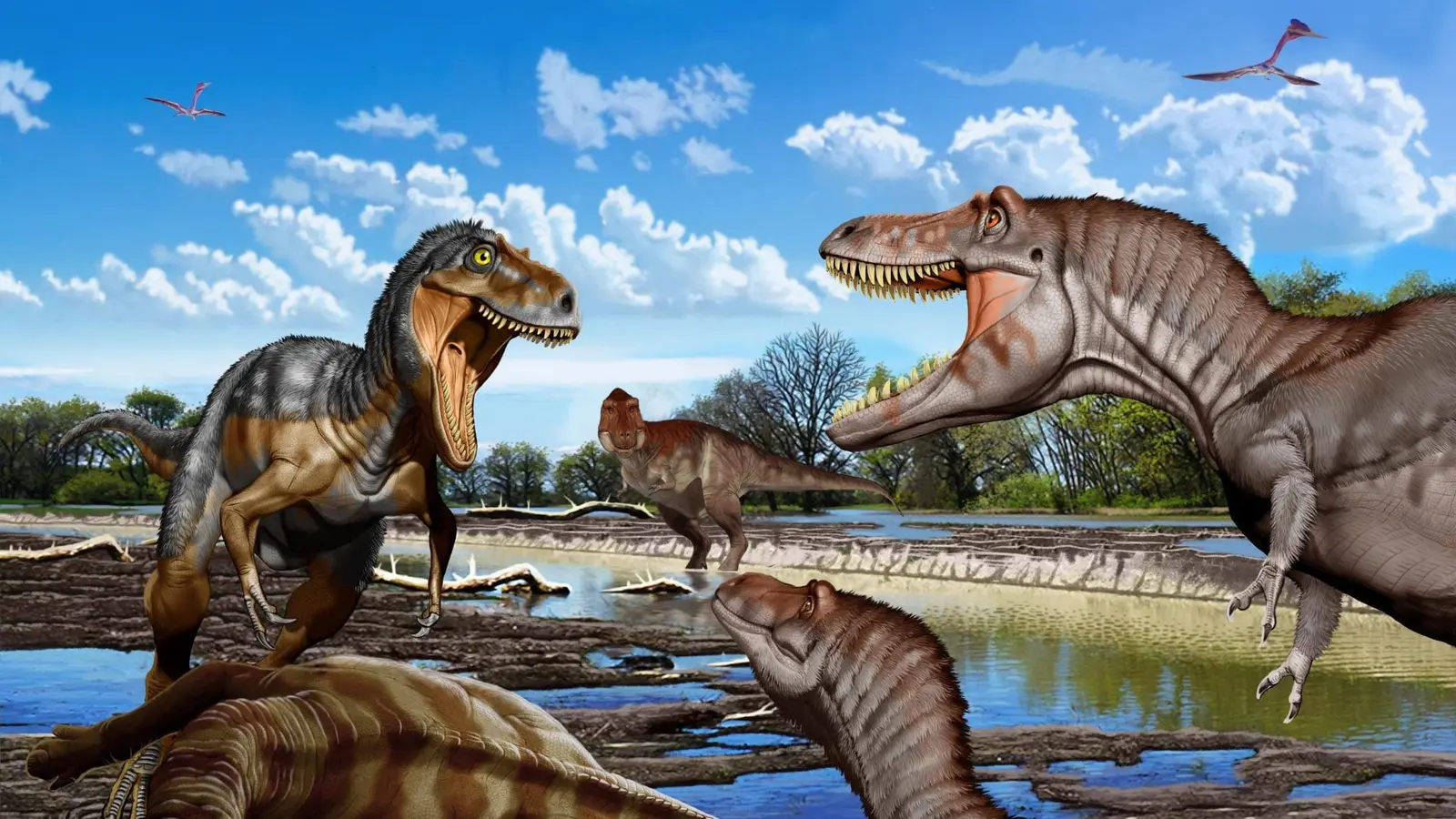
New histological evidence overturns a long-standing debate: the controversial skull known as Nanotyrannus is not a juvenile Tyrannosaurus rex but a mature, smaller tyrannosaur that occupied its own ecological niche during the Late Cretaceous.
A small skull, a big paleontological question
For decades, paleontologists argued over whether a single, relatively small tyrannosaur skull—used to name Nanotyrannus—represented a distinct species or merely a juvenile stage of Tyrannosaurus rex. That question has major consequences: if the skull was simply a young T. rex, then apparent anatomical differences would reflect growth stages rather than separate species. If it was a distinct taxon, North American Late Cretaceous ecosystems were more diverse than traditionally thought.
That debate has now been decisively reframed. A multi-institutional team, publishing new results in Science, used microscopic bone analysis to assess the age and growth history of the Nanotyrannus holotype. Their conclusion: the specimen was approaching full maturity, not a rapidly growing juvenile of T. rex. The result re-establishes Nanotyrannus as a legitimate, smaller-bodied tyrannosaur and alters how scientists reconstruct predator communities before the end-Cretaceous extinction.
.avif)
The T. rex growth series at the Natural History Museum of Los Angeles County’s Jane G. Pisano Dinosaur Hall is the only display of its kind on Earth. Courtesy of the Natural History Museum of Los Angeles County. Credit: Stephanie Abramowicz
Reading the throat bone: how histology revealed maturity
Many paleontologists determine dinosaur age by cutting and examining thin sections of long bones—ribs, femora, humeri—looking for patterns in bone deposition analogous to tree rings. But the Nanotyrannus holotype is primarily a skull with many delicate, air-filled elements, leaving few conventional bones for histological sampling. The research team found an unusual opportunity in the hyoid, a small throat bone that supports the tongue and associated soft tissues.
Hyoids are rarely used for growth studies; their potential to retain reliable age signals had not been established. To validate the method, the authors compiled a comparative dataset spanning living reptiles (lizards, crocodilians, birds), fossil dinosaurs, and an exceptional growth series of T. rex skeletons curated at the Natural History Museum of Los Angeles County (NHMLAC). That T. rex series—juvenile, teenage, and subadult individuals—served as internal benchmarks to test whether the hyoid’s microstructure tracks growth consistently with long bones.
Under the microscope, bone microstructure records growth rate and pauses in deposition. The Nanotyrannus hyoid showed more numerous and closely spaced growth rings—indicating a history of periodic slowdowns and long-term slowing of growth—compared with clearly immature T. rex individuals. Simply put: the Nanotyrannus holotype carries a histological signature of a near-adult, not a rapidly growing youngster.
“The identity of the holotype specimen was the key piece in this debate. Discovering that this small skull was actually fully grown shows definitively that it is different from Tyrannosaurus rex,” said Dr. Christopher Griffin, lead author and Assistant Professor of Geosciences at Princeton University.

Dr. Morris studying the hyoid, or throat bone, of “Thomas” in the Dinosaur Institute collections. Credit: Stephanie Abramowicz
Validating a new toolkit: why the hyoid matters
Adopting the hyoid as a reliable histological proxy required careful validation. The researchers first demonstrated that hyoid histology in modern taxa reflects known ages and growth patterns. Then, by comparing hyoid histology to long-bone histology in the NHMLAC T. rex growth series, they confirmed consistent signals: immature T. rex show growing bone textures both in limbs and in the hyoid, while more mature individuals display features indicating slowed or ceased growth.
Dr. Zach Morris, Dinosaur Institute Postdoctoral Fellow and a central figure in the project, led sampling of the NHM growth-series specimens. His work showed that even in giant predators—animals that grew extremely fast compared with most living vertebrates—the hyoid preserves a record of developmental stage. That allowed direct, apples-to-apples comparisons between the Nanotyrannus holotype and juvenile/subadult T. rex specimens.
“Our teenage Tyrannosaurus looks immature in both its limbs and its hyoid, while Thomas looks like a more mature, but still not quite adult animal. Amusingly enough, Thomas is not nearly as mature as the Nanotyrannus holotype, despite being much larger,” Morris explained, highlighting how size and maturity do not always covary in tyrannosaurs.
.avif)
A size comparison of the hyoid in juvenile and subadult T. rex with Nanotyrannus (above). While Nanotyrannus would have been slightly smaller than the NHM’s juvenile T. rex, the signs of maturity are clear under the microscope (below). The greater number and more closely spaced growth rings (8 vs. ~2 in the teenage T. rex!) reveal the holotype of Nanotyrannus was both fully mature and a distinct species. Credit: Dr. Zach Morris
Implications for tyrannosaur diversity and Late Cretaceous ecosystems
Recognizing Nanotyrannus as an adult taxon does more than settle a taxonomy argument: it reshapes ecological reconstructions. If multiple tyrannosaur species coexisted, they likely partitioned prey resources by body size, hunting strategy, or habitat preference. The new study aligns with other independent datasets toward the same conclusion—multiple tyrannosaur species roamed Late Cretaceous North America.
Such diversity suggests ecosystems were more complex, with several apex and meso-predators interacting, competing, and occupying distinct ecological roles. For example, a smaller, fully grown Nanotyrannus might have competed directly with juvenile T. rex for similar prey, or specialized on different prey items that matched its body size and feeding mechanics. Reconstructing these interactions improves our understanding of food webs, predator-prey dynamics, and how these communities responded to environmental stressors leading up to the end-Cretaceous extinction.

NHM Dinosaur Institute Postdoctoral Fellow Dr. Zach Morris compares a cast of the Nanotyrannus skull to the juvenile (left) and teenage (right) skeletons featured in the Dinosaur Hall’s iconic T. rex growth series. Credit: Stephanie Abramowicz
Balancing conservation and discovery
Histological sampling often requires destructive analysis, which museums must weigh carefully against the scientific value of new knowledge. The team minimized loss by 3D scanning, molding, and casting the hyoid before sampling—preserving anatomical data for future study while extracting the histological evidence needed to test the hypothesis.
“So many techniques in modern paleontology require some degree of destructive analysis, and as a Curator, I’m always trying to strike a balance between conservation and discovery,” said Dr. Caitlin Colleary of the Cleveland Museum of Natural History. The authors report that the scientific gains here justified the careful sampling approach.
Expert Insight
“This study is a great example of how museum collections enable new science decades after specimens were first cataloged,” says Dr. Laura Benton, Paleobiologist at the University of Edinburgh. “By validating an unconventional bone—the hyoid—as a growth indicator, the team expanded our toolkit for aging fossil vertebrates. That matters because accurate age estimates change species assignments, ecological models, and ultimately our picture of ancient biodiversity.”
What the study means for future research
The confirmation of Nanotyrannus as a mature species will prompt reexamination of other fragmentary tyrannosaur fossils and reinterpretation of community structure in the latest Cretaceous. It also opens the door to more targeted histological surveys using non-traditional elements—potentially unlocking age data from skulls and other skeletons previously thought unsuitable for growth studies.
Moreover, the approach underscores the value of collaborative, cross-disciplinary datasets that combine comparative anatomy, modern analogs, museum growth series, and advanced imaging. When multiple lines of evidence converge—morphology, bone microstructure, and broader statistical analyses—the resulting taxonomic and ecological inferences are far more robust.
Conclusion
By demonstrating that the Nanotyrannus holotype was nearly fully mature, the new histological study resolves a contentious debate and restores the specimen’s status as a distinct, smaller-bodied tyrannosaur. Beyond taxonomy, the research reshapes our view of Late Cretaceous predator communities and highlights how careful museum-based science and innovative methods can refine big-picture questions about dinosaur diversity and evolution.

“My work centers on sustainability, energy, and environmental science — examining how innovation can lead to a greener future.”

Discussion
Leave a Comment