
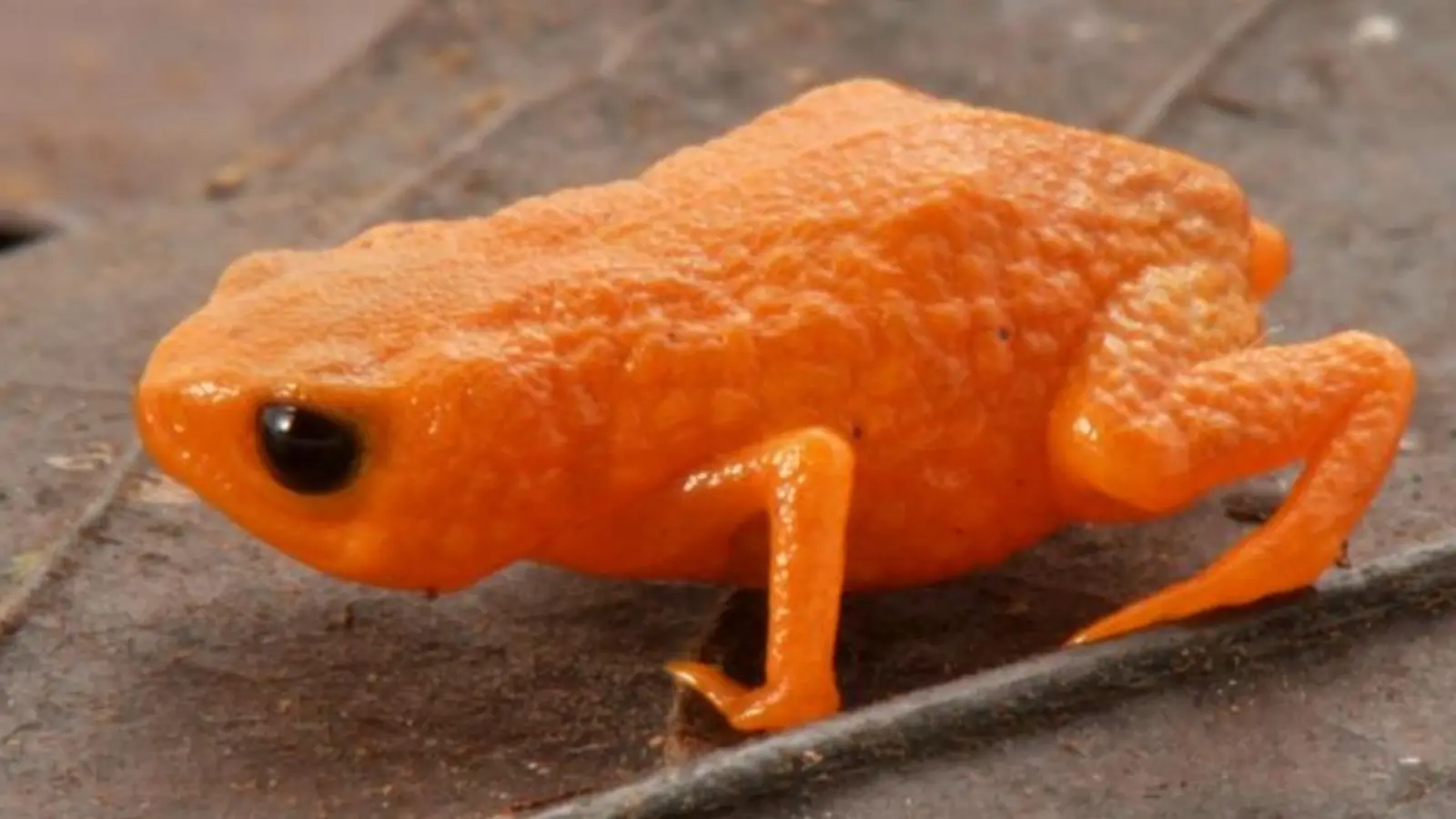
Deep in the misty Serra do Quiriri mountains of southern Brazil, researchers have identified a strikingly orange frog no bigger than a thumbnail. This newly described species of miniature toadlet adds to the region's extraordinary roster of endemic amphibians and underscores the urgent need to conserve high-altitude Atlantic Forest fragments.
Discovery in the leaf litter
Over seven years of fieldwork aimed at cataloguing Brachycephalus populations in Santa Catarina led scientists to stumble on an unmistakable new species. At first glance the bright orange color made the animals hard to miss, but it was the males' mating call that revealed their distinct identity. Researchers located calling males by ear while quieter females were collected more randomly during leaf-litter searches.
The team combined careful morphological comparison with genetic sequencing back in the laboratory to confirm the toadlet was not a known species. They published their findings in PLOS One and named the new species Brachycephalus lulai. The epithet honors Brazil's president, Luiz Inácio Lula da Silva, a dedication the authors say is intended to promote broader conservation efforts for the Atlantic Forest and its tiny, endemic frogs.

The miniature orange frog, perched on the tip of a pencil
Where it lives and why it matters
B. lulai inhabits a very narrow elevational band above roughly 750 meters in the Serra do Quiriri, a chain of cloud forests in Santa Catarina. Like other members of the family Brachycephalidae, these toadlets are extreme miniatures that spend much of their lives within leaf litter and rely on microhabitat stability—cool, humid conditions typical of montane cloud forest.
Although the study reports that the specific site where B. lulai was found appears relatively pristine, many amphibian relatives in Santa Catarina are already critically endangered. Amphibians are, globally, the most threatened class of vertebrates. Small range size combined with local threats makes even apparently secure populations vulnerable to rapid decline.

The cloud forests of Serra do Quiriri
Threats and conservation steps
Researchers highlight several human pressures that jeopardize montane amphibians: recurrent grassland burning, cattle grazing that alters forest edges, invasive plant species that change understory structure, tourism impacts, mining and deforestation. To reduce such risks, there is an ongoing formal discussion about establishing a federal conservation unit in Santa Catarina that would protect critical forest tracts without requiring the government to purchase private lands.
Marcos Bornschein, a herpetologist at São Paulo State University and lead author on the paper, emphasized that naming the species 'lulai' is intended as a call to action: to expand conservation initiatives across the Atlantic Forest and safeguard Brazil’s highly endemic miniaturized frogs. The authors also note that more sampling is needed to refine species boundaries and better understand intraspecific variation across montane fragments.
Study context and field challenges
The researchers point out two recurring obstacles for montane biodiversity studies: limited funding and the logistical difficulty of reaching remote sites. In some cases, teams must clear many kilometers of trail through dense forest to sample populations. Despite the effort, such fieldwork is essential: it reveals cryptic diversity and informs protection priorities for species that may exist nowhere else on Earth.
By combining bioacoustics, morphology and genetic data, the team produced a robust species description that strengthens our understanding of Brachycephalidae diversity and highlights the fragile uniqueness of Brazil's cloud forests.

“The cosmos has always fascinated me. I write about space missions, astronomy, and the technologies pushing humanity beyond Earth.”

Discussion
Leave a Comment