
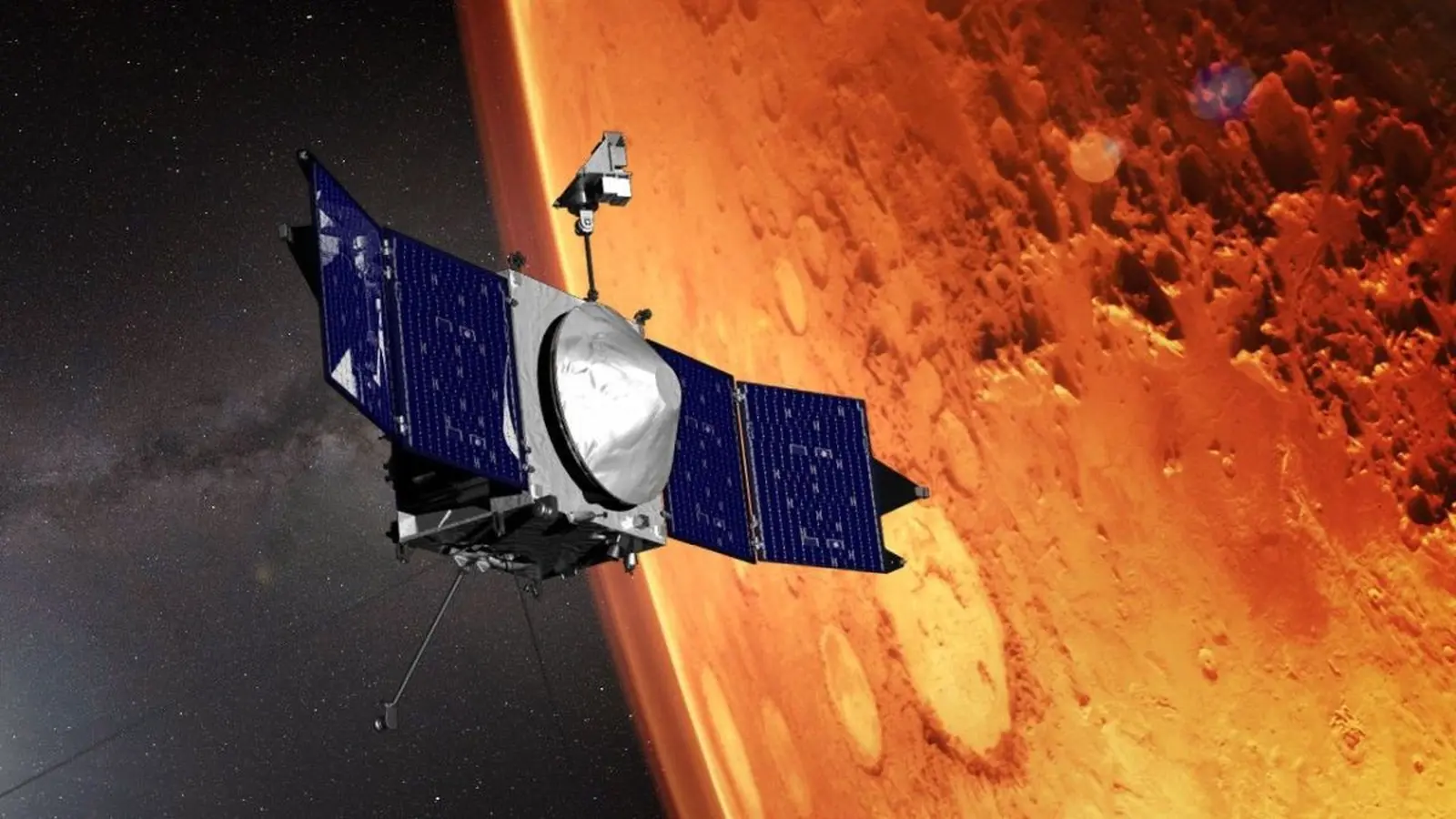
NASA has reported an unexpected loss of communication with MAVEN, a long-serving Mars orbiter that has studied the planet's upper atmosphere since 2014. Engineers are searching for a signal and investigating what caused the spacecraft to fall silent after a routine orbital pass.
What happened: the silence behind Mars
On 6 December 2025, MAVEN (Mars Atmosphere and Volatile Evolution) went behind Mars as part of its regular orbit and failed to reestablish contact after emerging on the far side. Ground teams report that the spacecraft had been functioning normally before the loss of signal, and by 9 December NASA announced an active investigation to locate any beacon or telemetry. "The spacecraft and operations teams are investigating the anomaly to address the situation," the agency said, adding that further information will be released as it becomes available.
Why MAVEN matters to Mars science and exploration
Launched in 2013 and arriving at Mars in September 2014, MAVEN’s primary mission is to study the upper atmosphere and ionosphere and how those layers interact with the solar wind. By measuring how atmospheric particles escape to space, MAVEN has helped explain how Mars transformed from a wetter, potentially habitable world into the thin, cold planet we see today.

An image of Mars in ultraviolet light obtained by MAVEN in 2023. The purple patch is the north pole.
The spacecraft’s instruments revealed several key processes: how dust storms loft water and other volatiles high into the atmosphere where solar wind can sweep them away; the existence of Mars’s extended magnetic tail; the sputtering process that accelerates atmospheric loss; and even a newly identified type of proton aurora. These findings are central to comparative planetology—understanding how Earth and Mars, born from similar materials, diverged in climate and habitability.
Operational role and implications for surface missions
MAVEN also plays a practical role: it carries a UHF radio that acts as a data-relay node for surface rovers, including Curiosity and Perseverance. Losing the orbiter reduces redundancy in communications and complicates data return for current missions, though other orbiters remain active and can pick up some of the workload. Investigators will prioritize restoring contact not only to recover scientific data, but to maintain communications infrastructure around Mars.
Engineers will analyze recent telemetry, flight logs, and orbital geometry to determine whether the event was caused by a hardware failure, a software fault, radiation effects, or a transient communications blackout. Identifying the cause could safeguard other spacecraft by informing operational and design changes.
As NASA continues the search for MAVEN’s signal, the mission’s scientific legacy remains significant: years of atmospheric measurements that underpin planning for future exploration and deepen our understanding of planetary evolution.

“The cosmos has always fascinated me. I write about space missions, astronomy, and the technologies pushing humanity beyond Earth.”

Discussion
Leave a Comment