

Overview: The rise of prediction markets and emerging risks
Prediction markets such as Polymarket and Kalshi have grown rapidly, turning collective opinions into tradable contracts tied to political outcomes, corporate events, and even military developments. These platforms and their growing volumes have attracted mainstream attention — from partnerships with major media outlets to regulatory scrutiny from the CFTC and multiple state agencies. While prediction markets can produce fast-moving crowd forecasts, they also introduce new vectors for market manipulation, insider trading, wash trading, and potential credit risk exposure for lenders and consumers.
Why prediction markets matter for crypto and finance audiences
For blockchain and crypto-savvy readers, prediction markets represent an important intersection between decentralized trading models and traditional financial regulation. Many platforms use crypto rails or tokenized incentives to facilitate bets, while others operate under regulated frameworks. The accuracy of prediction markets — often touted as a real-time "truth signal" — can be undermined if trading activity is distorted or if insiders exploit privileged information to resolve markets.
Trading volumes and public attention

Weekly volumes on Polymarket are frequently over $1 billion
Polymarket has reported weeks with notional volumes exceeding $1 billion, while Kalshi has secured notable partnerships with media companies to surface prediction data in broadcasts and digital feeds. Founders have even speculated that the market for converting opinions into tradable assets could rival larger financial markets if adoption continues. That prospect is driving both investor interest and regulatory attention.
Case studies: alleged manipulation and insider exploitation
Prediction markets enable wagers on granular outcomes — from the result of a sports match to territorial control in an active conflict. That granularity creates opportunities for bad actors with privileged access to data or the ability to influence public records.
ISW map edit and a resolved battlefield bet
The Institute for the Study of War (ISW) publishes frontline maps used by media and analysts. In November, an unauthorized edit to the ISW map depicting an intersection in Myrnohrad coincided with the resolution of a Polymarket contract — "Will Russia capture Myrnohrad by…" — which required confirmation that Russian forces controlled a specific intersection between Vatutina Vulytsya and Puhachova Vulytsya. The map was briefly altered to show Russian control and then reverted minutes after the market resolved.

The updated Nov. 17 ISW map did not show that Russian forces controlled the intersection
If accurate, this episode suggests a troubling overlap between information manipulation and real-world conflict reporting, where changes to publicly trusted data sources can have direct financial consequences on prediction markets.
High-profile insider wins
Other incidents point to more conventional insider advantages. A pseudonymous trader known as AlphaRaccoon reportedly netted over $1 million by trading on Google search ranking outcomes and correctly predicting the launch date of a major AI model, actions many observers labeled as exploiting insider knowledge. Public statements from engineers and researchers describing such wins have intensified concerns that employees at major tech firms can monetize inside information via prediction markets.
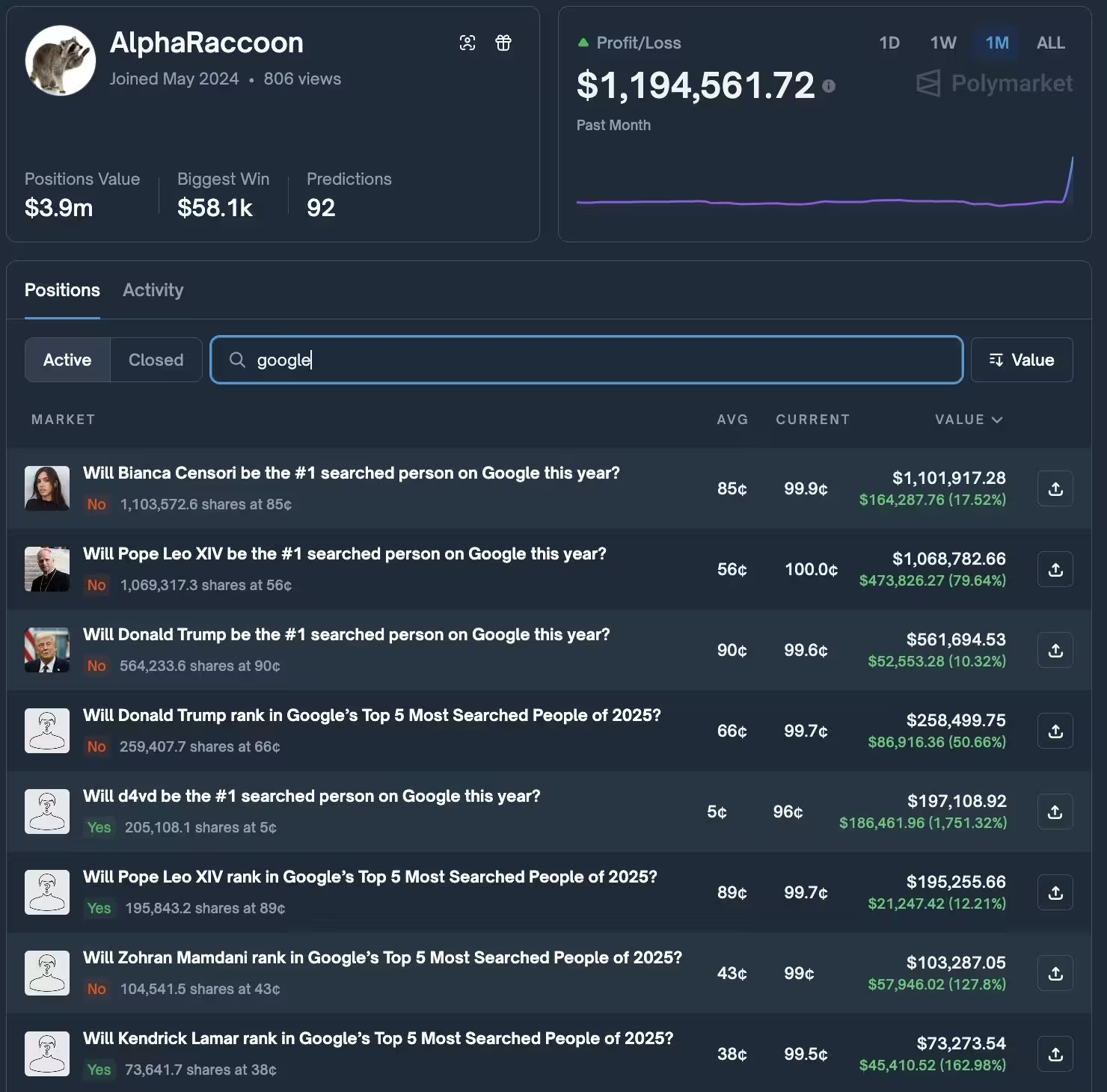
AlphaRaccoon’s betting history
Wash trading: inflating volume, eroding trust
Academic research has raised alarms about artificial volume. A Columbia Business School report found that wash trading — buying and selling to create the appearance of activity without taking net exposure — made up roughly 60% of Polymarket’s volume in December 2024. While that share subsequently fell, researchers estimated average wash trading around 25% of total activity through 2025.
Wash trading does not meaningfully enhance liquidity or market information. Instead, it can mislead users, investors, and regulators about platform engagement and the predictive power of the market. For platforms that tout their ability to produce rapid, accurate forecasts, inflated volumes undermine credibility and obstruct meaningful price discovery.
Regulatory responses and legal battles
Prediction markets now sit at the center of a complex regulatory landscape. Polymarket secured approval from the U.S. Commodity Futures Trading Commission (CFTC) to operate an intermediated trading platform, and Kalshi also operates under CFTC oversight. On paper, CFTC permissions offer a pathway to operate in all 50 states, but state-level regulators have pushed back.
Several states, including Nevada, New Jersey, New York, Massachusetts, Maryland and Ohio, have questioned whether Kalshi’s model amounts to gambling and have opened enforcement actions. Connecticut’s Department of Consumer Protection has issued cease-and-desist orders to multiple platforms, citing a lack of appropriate gambling licenses and consumer protection concerns.
How federal and state positions diverge
The split between federal approvals and state-level gambling statutes highlights legal ambiguities that prediction markets must navigate. Platforms that rely on crypto infrastructure face additional uncertainty, since digital-asset regulation and consumer protections vary widely across jurisdictions.
Credit risk, consumer protection, and market behavior
Banking analysts have warned that gamified interfaces and easy access to prediction markets could amplify speculative behavior, potentially pressuring consumer credit. Bank of America analysts noted that frequent and impulsive wagers may lead to overextension of credit, increasing delinquencies among borrowers and raising underwriting challenges for lenders.
This convergence of entertainment and speculative finance adds behavioral risk to portfolios, which could feed through to credit quality for issuers and subprime lenders. Regulators and consumer protection agencies are increasingly concerned that users may not understand the risk profiles of these contracts or that traditional protections do not apply to certain prediction market platforms.
What platforms and regulators must address
To preserve their predictive utility and protect users, prediction markets should pursue stronger safeguards. Key recommendations include:
- Enhanced identity verification and trade surveillance to detect insider-driven trades.
- Transparent audits and third-party reviews to identify wash trading and artificial activity.
- Clear consumer disclosures about the legal status of markets in specific states and the protections (or lack thereof) for funds.
- Collaboration with regulators to design rules that preserve market benefits while limiting abuse.
Technical and governance fixes
Market operators can deploy blockchain-based audit trails, implement position limits, and use machine learning surveillance systems to flag anomalous trades. Governance frameworks that include independent oversight bodies may improve trust and make it easier for regulators to assess compliance.
Looking ahead: balancing innovation with integrity
The idea of converting collective opinion into tradable assets is compelling and could unlock new forms of market intelligence for politics, economics, and technology. But the rapid growth of prediction markets brings real risks: insider exploitation, wash trading, consumer harm, and systemic credit effects. As platforms expand, they must adopt rigorous controls and engage proactively with regulators to protect users and preserve the integrity of market signals. For crypto and blockchain communities, these developments will inform broader debates about how decentralized or hybrid marketplaces should be governed and regulated.
Kalshi co-founder Tarek Mansour’s vision of making "a tradable asset out of any difference in opinion" may be aspirational, but the path forward requires careful regulatory navigation, stronger anti-abuse mechanisms, and transparent consumer protections before prediction markets can realize their full potential.

Discussion
Leave a Comment