
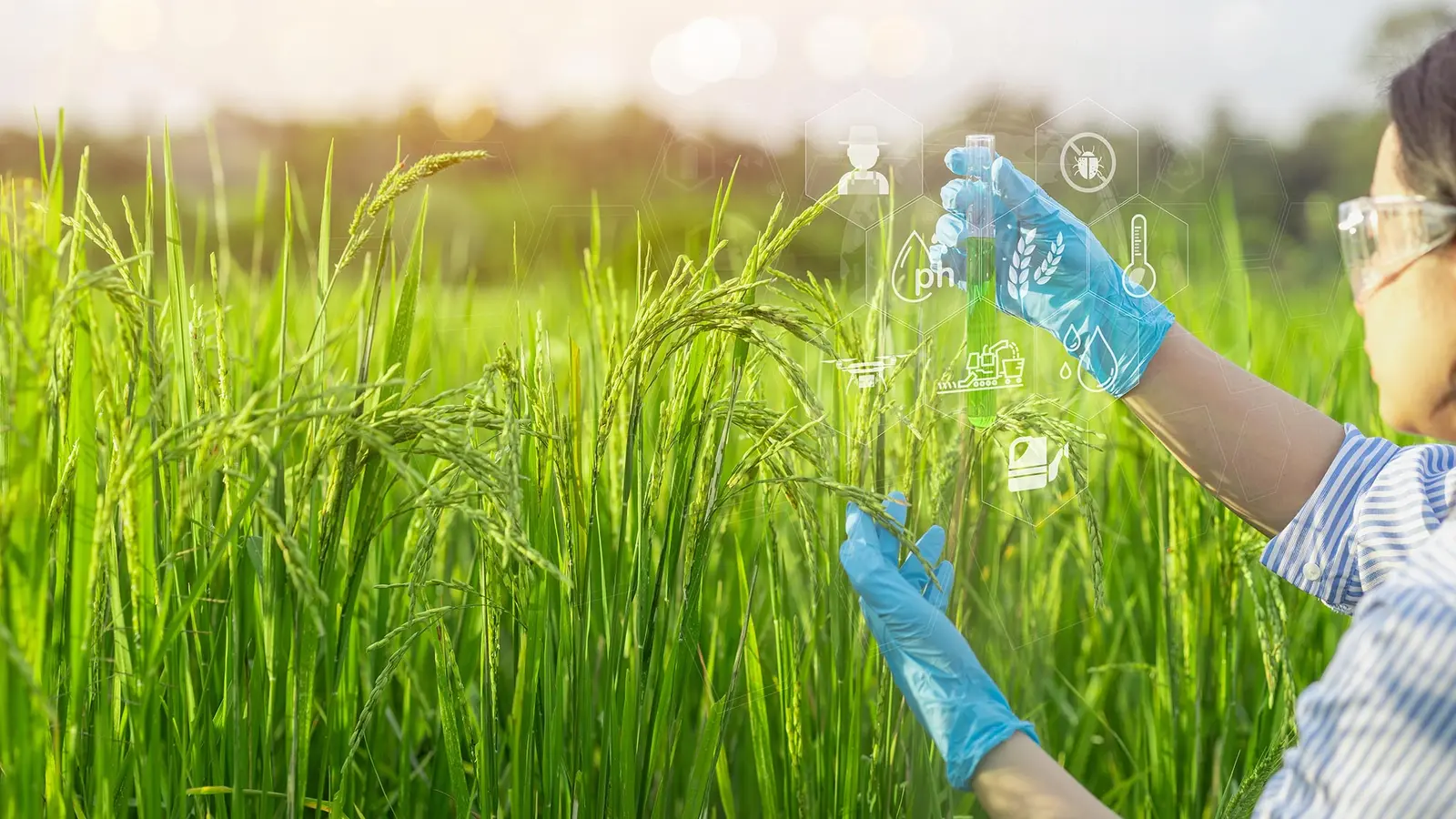
Researchers from the University of Massachusetts Amherst and Jiangnan University report a field-tested technique that could let farmers use far less nitrogen fertilizer on rice without sacrificing yield — and simultaneously improve grain nutrition, soil health, and climate outcomes. The innovation: a nanoscale selenium spray applied to rice plants that enhances photosynthesis and nitrogen uptake while reducing greenhouse gas emissions in real-world paddy trials.
Researchers have discovered that nanoscale selenium sprays can dramatically reduce fertilizer needs in rice while sustaining yields and enriching soil health. The approach boosts photosynthesis, improves nitrogen use efficiency, and sharply cuts greenhouse gas emissions in real-world field trials.
Why fertilizer efficiency matters for global rice production
The Green Revolution dramatically increased global food production largely through synthetic nitrogen fertilizers. But those gains carry costs. Producing nitrogen fertilizer consumes a lot of energy and emits CO2, and once applied to fields a large share of that nitrogen doesn’t end up in crops. Typical nitrogen use efficiency (NUE) for many cereals ranges from 40–60%; for rice, it can be as low as ~30%, meaning up to 70% of applied fertilizer is lost to runoff or gas emissions. That waste translates into economic losses for farmers and fuels environmental problems like eutrophication and greenhouse gas release.
“We know NUE has to improve,” says Baoshan Xing, University Distinguished Professor of Environmental and Soil Chemistry and co-senior author of the study. The new multi-institutional work, co-led by UMass Amherst and Jiangnan University, addresses this challenge with an agricultural nanotechnology approach that was tested in actual paddy fields rather than just in the lab.

Baoshan Xing, University Distinguished Professor of Environmental and Soil Chemistry, director of UMass’ Stockbridge School of Agriculture. Credit: University of Massachusetts Amherst
Field trial findings: less fertilizer, similar — or better — yields
In field experiments, lightly spraying rice plants with a suspension of selenium nanoparticles allowed researchers to reduce nitrogen applications by 30% while maintaining — and in some measures improving — crop performance. The team used aerial drones to apply the nano-selenium to foliage and stems, which enhances direct uptake compared with soil application.

(a) Rice receiving selenium and 30% less fertilizer (RF+ Se ENMs) is far bulkier than rice receiving less fertilizer (RF) and comparable to conventionally grown rice (CK). (b) Field experiment testing the greenhouse gas emissions of rice with nano-treatments of selenium.
Key empirical results included:
- An increase in photosynthetic activity of more than 40% after nano-selenium treatment — meaning plants fixed more atmospheric CO2 into sugars.
- An improvement in nitrogen use efficiency from ~30% to roughly 48.3%, reducing the need for synthetic fertilizer inputs.
- A reduction in emissions of nitrous oxide and ammonia by 18.8–45.6%, cutting significant contributors to agricultural greenhouse gases.
- Higher grain protein, elevated levels of several essential amino acids, and increased selenium content — a potential nutritional benefit for populations with selenium-deficient diets.

(a) One of the experimental fields in Kunshan City, China; (b) and (c) comparing yield and grain weight of conventionally grown rice (CK), rice treated with 30% less fertilizer (RF), and rice treated with 30% less fertilizer and nano-selenium (RF+Se ENMs).
How nano-selenium works: plant physiology and soil microbiology
The researchers propose a linked plant–microbe mechanism. Selenium at the nanoscale appears to stimulate the rice plant’s photosynthetic machinery, so leaves produce more carbohydrates. Those extra sugars are transported to roots, encouraging root growth and exudation of organic compounds. Robust root exudates nourish beneficial soil microbes, which in turn enhance the plant’s ability to acquire nitrogen and ammonium from the soil.
That symbiosis improves nitrogen assimilation into plant tissues (higher NUE), reduces nitrogen losses to water and air, and shifts soil microbial communities toward greater diversity and function. The cascading effect is both agronomic and environmental: farmers spend less on fertilizer while fields emit less climate-warming gases.
Implications for sustainable agriculture and climate goals
Rice uses roughly 15–20% of the world’s synthetic nitrogen fertilizer. A scalable technology that cuts fertilizer demand by 30% in rice systems could therefore deliver substantial reductions in fertilizer production emissions as well as field-level greenhouse gases. For smallholder farmers, the economic improvements were tangible in the trials: the study reported a per-ton economic benefit increase of about 38.2% compared with conventional practices when factoring input savings and maintained yields.
Beyond economics, there are public-health angles: selenium is an essential micronutrient for humans, and biofortifying rice grain with safe levels of selenium can address dietary deficiencies in some regions. However, any large-scale selenium application programs would need to be tightly managed to avoid oversupply; selenium has a narrow range between dietary requirement and toxicity.
Expert Insight
“The study is compelling because it moves beyond controlled greenhouse tests into real paddies,” says Dr. Anna Lopez, a soil ecologist with two decades of experience in rice agroecosystems. “Seeing improved photosynthesis, better root growth, and measurable drops in nitrous oxide from field trials suggests this could be a practical tool for farmers. The next step is multi-year, multi-climate trials and careful monitoring of soil and grain selenium concentrations.”
Future prospects, risks, and next steps
Field validation is a major strength of the work, but scaling up will require attention to several factors: cost and logistics of producing stable selenium nanoparticles, safe application protocols (drones offer precision but require investment), and regulatory frameworks that govern nanoparticle use and micronutrient fortification. Long-term monitoring of soil microbial communities and selenium cycling is essential to avoid unintended ecological impacts.
Related technologies such as targeted foliar sprays, precision-fertilizer management, and integrated pest and nutrient approaches could combine with nano-selenium treatments to further enhance sustainable rice farming. If broadly tested and adopted, the approach could contribute to climate mitigation, lower production costs for farmers, and improved nutritional quality of a staple food for billions.
Conclusion
Nano-selenium foliar treatment is a promising, field-tested strategy to reduce nitrogen fertilizer dependency in rice while maintaining yields, boosting nutritional value, and cutting greenhouse gas emissions. Moving from controlled trials to widescale adoption will require careful assessment of long-term environmental safety, production logistics, and local agronomic conditions — but the evidence so far suggests a practical route toward more sustainable rice production.

“The cosmos has always fascinated me. I write about space missions, astronomy, and the technologies pushing humanity beyond Earth.”

Discussion
Leave a Comment