
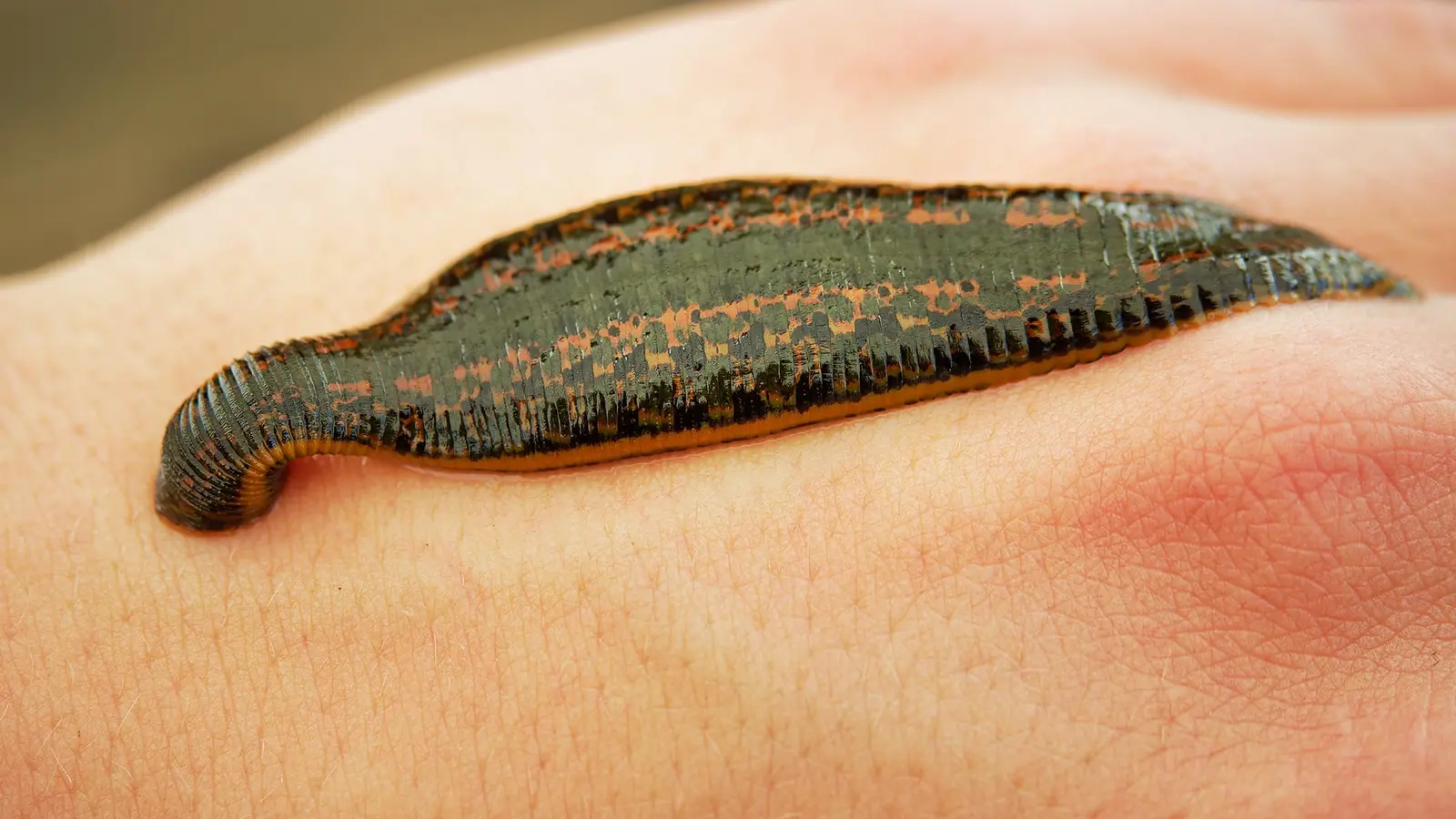
A remarkably preserved fossil from Wisconsin has pushed the origin of leeches deep into the Paleozoic and overturned long-standing assumptions about their early ecology. Rather than emerging as blood-feeding parasites on land or in freshwater, the earliest members of the leech lineage appear to have been marine hunters that fed on soft-bodied prey.
The fossil leech compared with a modern leech. Double arrows indicate the large caudal sucker used for attachment, single arrows indicate body annulations.
A surprise from the Waukesha biota
Found in the exceptional Waukesha biota of Wisconsin, the specimen dates to roughly 430 million years ago. That age predates previous estimates for the origin of the leech clade (Hirudinida) by at least 200 million years. Waukesha is a sedimentary deposit renowned for its rare preservation of soft-bodied organisms—conditions that allow creatures without bones, shells, or exoskeletons to enter the fossil record.
The fossil itself preserves a teardrop-shaped, annulated body and a pronounced tail, including a large caudal sucker. That combination of features is a diagnostic hallmark of leeches, and it allowed the research team to identify the specimen as a member of the broader leech group despite the absence of hard parts.
Anatomy and lifestyle clues
Crucially, this ancient leech lacks the anterior sucker that modern hematophagous (blood-feeding) leeches use to latch on and pierce skin. The missing forward sucker, together with the specimen’s marine context, suggests a lifestyle very different from the iconic parasitic leeches many people imagine.
Modern leeches display a wide variety of feeding strategies—some are predators that swallow prey whole, others scavenge, and a subset feed on vertebrate blood. Blood feeding requires complex biochemical and anatomical specializations, including anticoagulants, specialized mouthparts, and digestive adaptations. The new fossil lacks the obvious structural evidence of those innovations, implying that early leeches likely fed on soft-bodied invertebrates or consumed their internal fluids rather than sucking blood from larger vertebrates.
Why this fossil matters to evolutionary timelines
Prior to this discovery, molecular and fossil estimates tended to place the origin of leeches in the Mesozoic, roughly 150–200 million years ago. This new body fossil from the Ordovician–Silurian boundary pushes that origin much deeper into the Paleozoic, indicating that the leech lineage had a much longer and more complex history than previously recognized.
Because soft-bodied animals are rarely fossilized, each such specimen carries outsized weight for reconstructing evolutionary history. The Waukesha specimen therefore not only identifies an earlier origin for Hirudinida but also broadens our view of the ecological roles early annelids played in ancient marine ecosystems.
How researchers identified the specimen
The fossil emerged during a wider survey of the Waukesha site led by teams including scientists at Ohio State University. Its significance wasn’t immediately obvious; the specimen’s unique combination of a caudal sucker and segmented body drew attention during a later review, when paleontologists sought specialists to verify the identification.
Collaboration was key. Researchers from the University of California, Riverside, the University of Toronto, the University of São Paulo, and Ohio State University contributed to the formal description published in PeerJ. Lead author Danielle de Carle and colleagues compared the fossil’s morphology with living leeches and related annelids, concluding that the combination of annulations and a distinct posterior sucker is diagnostic of leeches and not found together in other wormlike taxa.
Scientific context and implications
This find does more than add an ancient date to a family tree: it reshapes hypotheses about how blood-feeding behaviors evolved. If ancestral leeches were marine predators, then parasitism and blood feeding must have evolved later, independently, and perhaps multiple times within the group as leeches colonized new habitats such as freshwater and terrestrial niches.
It also underscores how gaps in the fossil record—especially for soft-bodied animals—can bias our interpretations. Exceptional deposits like Waukesha act as windows into otherwise invisible branches of life, revealing anatomies and ecologies that molecular clocks alone cannot resolve.
Expert Insight
“This fossil is a rare and convincing example of how early annelid lifestyles differed from their modern descendants,” says Dr. Lena Morales, a paleobiologist at the Natural History Museum (fictional). “Finding a caudal sucker without an anterior attachment organ shows us that the evolutionary pathway to parasitism involved a series of ecological shifts, not a sudden jump to blood feeding. It invites new questions about when and why leeches moved from marine predation toward parasitic niches.”
Conclusion
The 430-million-year-old leech from Wisconsin rewrites an important chapter in annelid evolution. By placing leeches in a marine predator role far earlier than expected, the fossil compels researchers to rethink the timing and sequence of adaptations leading to parasitism. More broadly, the discovery highlights the value of exceptional fossil sites for filling major gaps in our understanding of life’s deep history—and the need for continued fieldwork and interdisciplinary analysis to map the full shape of the tree of life.

“My work centers on sustainability, energy, and environmental science — examining how innovation can lead to a greener future.”

Discussion
Leave a Comment