
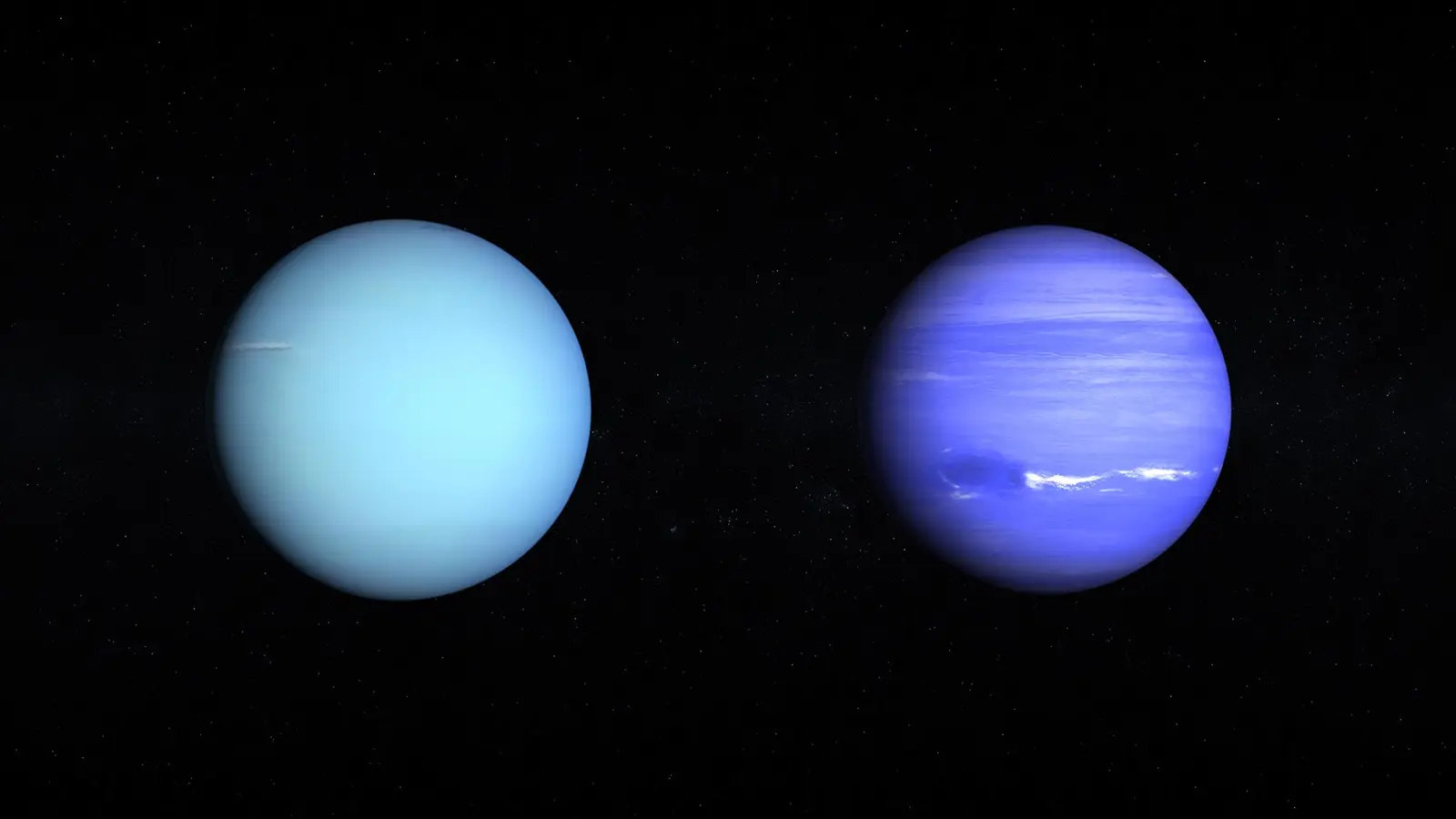
New modeling from the University of Zurich challenges the long-held idea that Uranus and Neptune are predominantly icy worlds. By combining unbiased statistical sampling with physics-based constraints, researchers show that both planets might contain far more rock than previously thought — and that our picture of the outer Solar System remains incomplete until spacecraft return fresh measurements.
Rethinking the ice giant label
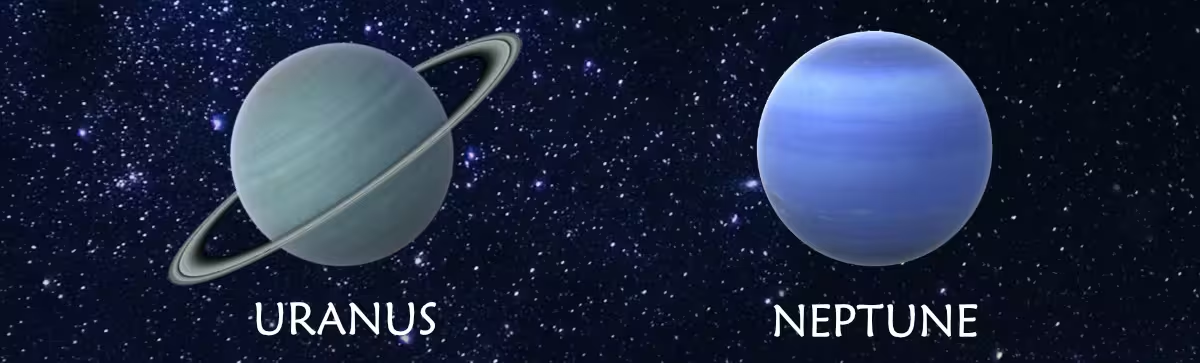
For decades the Solar System has been taught as three families of planets: four rocky terrestrials, two gas giants and a pair of ice giants. Uranus and Neptune sit in that last group, usually assumed to be dominated by ices such as water, ammonia and methane under high pressure. The new study from the University of Zurich argues this classification might be an oversimplification. Using a novel, more agnostic modeling technique, the authors find interior solutions in which the two planets are either water-rich or rock-rich depending on reasonable physical assumptions.
The implication is that Uranus and Neptune could span a broader range of internal compositions than the textbook 'ice giant' label implies. The team also points to independent evidence that the small distant world Pluto is largely rock, underscoring how diverse outer Solar System bodies can be.
How the new models work
Traditional interior models often fall into two camps: empirical fits that lack physical depth, or physics-first calculations that require many assumptions about material behavior at extreme pressures. The Zurich team bridged that gap by generating large ensembles of random density profiles, then testing which profiles produce gravitational fields consistent with observations. Each candidate is vetted against known gravitational moments, mass and radius, and only physically plausible runs are kept. Repeating this process thousands of times builds a family of allowed internal structures without forcing a single assumed composition.
Why an 'agnostic' framework matters
This approach reduces built-in bias toward any one composition and highlights degeneracies — different internal recipes that match the same external measurements. That degeneracy is exactly why current data can support both rock-dominant and ice-dominant interiors for Uranus and Neptune. The models are not claiming a definitive answer, but they expand the range of realistic possibilities planetary scientists must consider.
Magnetic mysteries and interior clues
The study offers fresh explanations for the puzzling magnetic fields of these planets. Unlike Earth, which has a largely dipolar field aligned near its rotation axis, Uranus and Neptune exhibit multi-polar, tilted fields. The Zurich models naturally produce 'ionic water' layers — regimes where water dissociates and conducts electricity — at depths that can sustain dynamos producing non-dipolar geometry. Moreover, the models indicate Uranus' dynamo region may lie deeper than Neptune's, a detail that helps account for observed differences in their magnetic signatures.
Understanding where dynamos operate is essential, because magnetic field morphology provides an independent constraint on interior structure. If future missions can map magnetic fields at higher resolution, those data will help narrow down which interior solutions are realistic.
What we still don’t know and why missions matter
Despite this advance, major uncertainties remain. Material physics under the extreme pressures and temperatures inside ice or rock-rich giants is still poorly constrained. Laboratory experiments and advanced theory are improving the picture, but in situ measurements are the gold standard. As Luca Morf, the study's lead PhD student, notes, the behavior of materials at planetary core conditions could materially change model outcomes. Professor Ravit Helled, who initiated the project, emphasizes that both rock-dominant and ice-dominant scenarios fit current data, so dedicated spacecraft missions are needed to break the tie.
Planned mission concepts that would orbit or fly past Uranus and Neptune could deliver precise gravity, magnetic and acoustic measurements, plus atmospheric composition data. Those observations would tighten interior models and answer whether the outer pair are truly unusual ice factories or surprisingly rocky cousins of the inner worlds.
Until then, this work serves as a reminder that planetary categories are useful shorthand but often mask complex realities. The outer planets keep surprising us, and modern modeling tools are now ready to explore that complexity in ways not possible a decade ago.

“The cosmos has always fascinated me. I write about space missions, astronomy, and the technologies pushing humanity beyond Earth.”

Discussion
Leave a Comment