
Long before colorful petals or fragrant bouquets, some of Earth’s oldest seed plants used another sense to recruit partners: heat. New research shows that cycads—primitive, cone-bearing plants—produce rhythmic thermal signals that guide nocturnal beetles between male and female cones, ensuring pollination across generations..
An infrared signal older than petals
Cycads are living relics of the Jurassic: slow-evolving, palm‑like plants with cylindrical trunks, stiff pinnate leaves, and conspicuous cones. Unlike most flowering plants that rely on color and scent, many cycads generate measurable heat in their reproductive organs. Researchers led by Wendy Valencia‑Montoya at Harvard show that this thermogenesis is not incidental—it’s a timed, active strategy that lures a single species of beetle and likely predates the evolution of showy flowers.
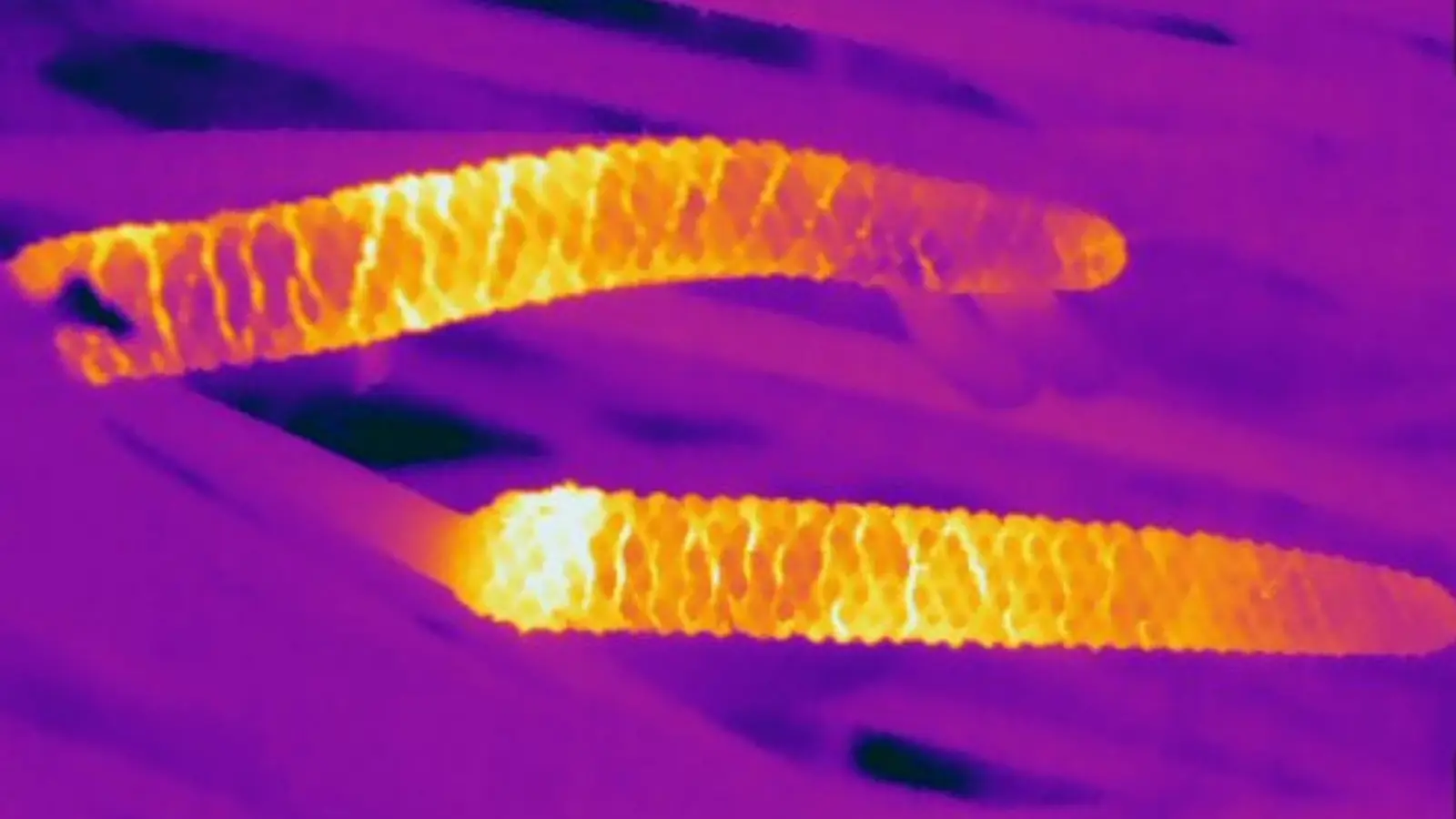
The study focused on Zamia furfuracea, a cycad native to Mexico that depends on the beetle Rhopalotria furfuracea for pollination. Using thermal imaging in the field, the team found that male cones warm on a precise daily schedule, rising in temperature around mid‑afternoon and peaking before cooling again. Female cones follow the same pattern but with a roughly three‑hour lag, creating a predictable thermal sequence that beetles track to carry pollen from male to female cones.

Thermal imaging of Zamia furfuracea in the wild. The dotted lines indicate cones at levels of development either too early or too late for pollination purposes. (Valencia-Montoya et al., Science, 2025)
How plants and beetles make heat-based matchmaking work
The mechanism is elegantly simple and surprisingly molecular. On the plant side, cycads turn on a gene called AOX1 (an alternative oxidase) in cone tissues. AOX1 redirects mitochondrial metabolism away from efficient ATP production and toward heat release—fuel is consumed and energy is dissipated as warmth rather than stored. This creates steady, sustained temperature elevations in cones during the pollination window.
On the insect side, the pollinating beetles are equipped to detect that warmth. At the tips of their antennae sit coeloconic sensilla—specialized sensory structures tuned to thermal infrared. Those sensors use a TRPA1 ion channel to transduce radiant heat into neural signals. The researchers demonstrated the causality: when environmental cues other than heat were removed, beetles still navigated to warmed cones; when the TRPA1 channel was disabled experimentally, the beetles no longer responded. This is the first direct evidence linking TRPA1-based heat sensing to pollination behavior.

Beetles of the species Rhopalotria furfuracea on a male cone of the cycad Zamia furfuracea, whose cones produce heat during pollination.
Scientific context and experimental approach
Thermogenesis in plants is not new—skunk cabbage and some aroids are known to warm their inflorescences—but demonstrating a reproductive advantage for sustained cone heating required careful field work and cross-disciplinary techniques. The team combined circadian monitoring, thermal imaging, genetic expression assays, and behavioral experiments on live beetles. Showing a 24‑hour repeatable cycle pointed to an internal clock rather than a passive response to ambient temperature or light, and gene expression profiles highlighted AOX1 as a major player during heating phases.
Behavioral assays isolated thermal radiation as the critical attractant. By masking or disabling other cues (scent, visual contrasts) and selectively impairing the TRPA1 channel in beetles, the researchers could separate correlation from causation. The beetle movements followed the thermal wave from male cones to female cones, and pollen transfer occurred as a direct result of that movement.
Implications for evolution, ecology and conservation
These findings rewrite a part of the story about how plants and insect pollinators first connected. Infrared signaling offers a single, intensity‑based channel of information—less complex than color but robust in low‑light or nocturnal environments. This might have been an effective early strategy when insect vision was simpler and before the explosion of angiosperm diversity and insect color vision during the Cretaceous.
Today there are roughly 300 cycad species, many endangered. The rise of flowering plants (angiosperms) roughly 112–93 million years ago introduced a vastly expanded palette of visual and olfactory signals that favored pollinators with color vision and complex scent processing. As a result, thermal signaling may have become an evolutionary cul‑de‑sac for many cycads—specialized and effective in certain ecological niches, but less competitive in others.
Beyond evolutionary history, the discovery raises practical conservation questions. Specialized pollination systems are fragile: loss of a single beetle species or disruption of daily thermal cycles through climate change could imperil reproduction in these cycads. Protecting nocturnal microhabitats and preserving the insect partners will be essential if these living fossils are to survive.
Expert Insight
“This study expands our understanding of plant–animal communication,” says Dr. Laura Mendel, a plant ecophysiologist not involved in the work. “By showing a direct genetic and sensory pathway—AOX1 in plants and TRPA1 in beetles—researchers provide a clear mechanism for how thermal cues can structure pollination. It also highlights how much more there is to learn about non‑visual signals in ecological networks.”
Conclusion
The discovery that cycads use circadian‑timed heat to attract specialist beetles bridges paleobotany, molecular biology, and sensory ecology. It suggests that infrared signaling was a viable pollination strategy long before petals and pigments dominated the floral world—and it underscores the vulnerability of co‑dependent systems in a rapidly changing environment.

“The cosmos has always fascinated me. I write about space missions, astronomy, and the technologies pushing humanity beyond Earth.”

Discussion
Leave a Comment