
Researchers at the University of Bonn have built a washing-machine filter inspired by fish gills that captures more than 99% of microplastic fibers in early tests. Drawing on millions of years of evolutionary design, the team adapted a funnel-like, self-cleaning sieve to trap and concentrate textile fibers before they enter sewage systems.
Biomimicry in the laundry room
Microplastics from textiles — tiny fibers shed as fabrics rub and break down in washing machines — are a major source of environmental contamination. A single household washing machine can release hundreds of grams of synthetic fibers per year, and those fibers commonly pass through wastewater systems into sewage sludge. Because treated sludge is often used as agricultural fertilizer, fibers can then spread across soils and into food chains.
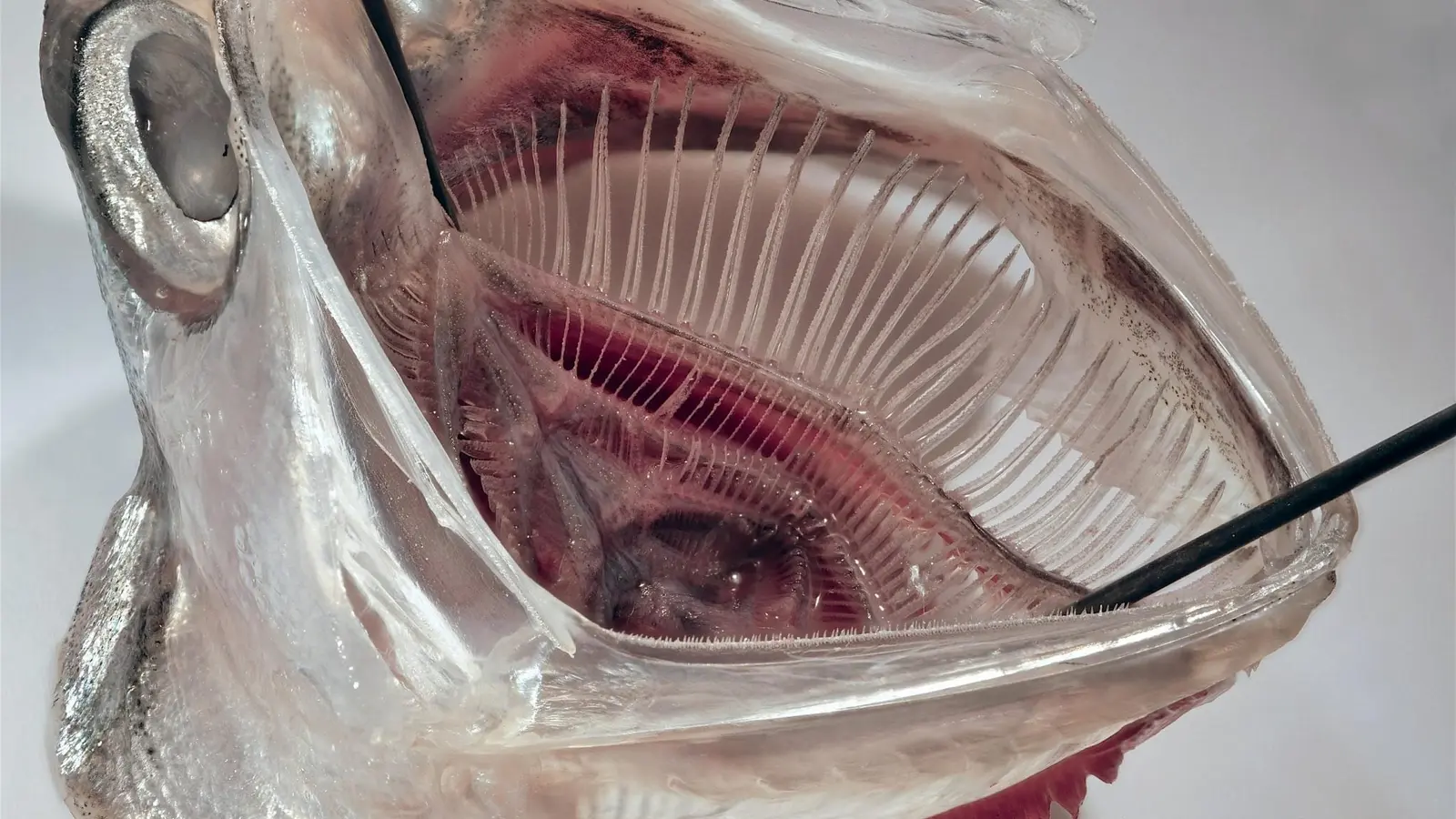
To intercept these particles at the source, a research team led by Dr. Leandra Hamann and Dr. Alexander Blanke examined natural filters in marine filter-feeders such as anchovies, sardines and mackerel. These fish use a gill arch system that combines comb-like arches and tiny tooth-like denticles to create a flexible mesh. The biological design performs a type of cross-flow filtration: water passes through a permeable, funnel-shaped wall while larger particles are guided to the gullet and removed without jamming the sieve.

The gill rakers are covered with denticles forming a mesh structure that catches the particles. Credit: Leandra Hamann
How the filter works
The Bonn team's prototype reproduces three core features of fish gills: a tapered funnel geometry, a mesh composed of comb-like ribs and teeth, and a flow pattern that encourages particles to roll toward a collection channel rather than lodge against the net. In practice, water from a washing machine is directed through the permeable wall of the filter element. Microplastic fibers are retained by the mesh and then swept along the funnel toward a small outlet where they accumulate.
Instead of relying on complex moving parts, the biomimetic filter depends on its geometry and controlled flow paths. The researchers adjusted two variables — mesh spacing and funnel opening angle — and used laboratory experiments plus computational flow simulations to identify an optimal combination. The result: a simple, low-cost element that captured over 99% of plastic fibers in washing effluent during initial trials.

The filter element in the center imitates the gill arch system of the fish. The filter housing enables periodic cleaning and installation in washing machines. Credit: Christian Reuß/Leandra Hamann
Practical deployment and waste handling
Collected fibers are funneled to a small receptacle and periodically removed. The team envisions a maintenance cycle in which the accumulated material is suctioned from the outlet several times per minute and pressed to remove excess water, producing a compact plastic pellet. This pellet could be emptied every few dozen washes and discarded as general waste or processed further in recycling streams.
The advantage of this approach is twofold: high capture efficiency and a self-cleaning flow that greatly reduces clogging. Existing domestic filters frequently suffer interruption from blockages or impose high resistance on wastewater lines. The gill-inspired design promises low energy cost, simple manufacturing and easier retrofitting by appliance makers.
Scientific context and health concerns
The work, published in npj Emerging Contaminants, adds to a growing field of biomimetic filtration and domestic pollution control. Beyond laundry, cross-flow filtration concepts are widely used in industry for processes that require continuous separation without rapid fouling.
Microplastics are more than an environmental nuisance. Analytical studies have detected plastic particles in human tissues — including breast milk, placenta and even brain samples — raising questions about long-term health impacts. While causation and risk thresholds are still active areas of research, reducing the flow of fibers from households to the environment removes a plausible exposure pathway and buys time for public health and toxicology studies to catch up.
Implications, patents and next steps
The University of Bonn team, together with the Fraunhofer Institute for Environmental, Safety and Energy Technology UMSICHT, has filed patent protection in Germany and begun the process of EU-wide patenting. Their next aim is industry uptake: appliance manufacturers would need to adapt washing-machine designs to integrate the filter element and a simple collection outlet.
Implementation at scale could significantly reduce the textile-derived microplastic load that reaches wastewater plants and agricultural land. As the researchers note, the filter's lack of complex mechanics keeps manufacturing costs down and simplifies home maintenance — important considerations for widespread adoption.

Front Dr. Leandra Hamann, right Dr. Alexander Blanke, center material researcher Christian Reuß, left biologist Dr. Hendrik Herzog. Credit: Peter Rühr/Uni Bonn
Expert Insight
“Adapting biological architectures for household pollution control is a promising path,” says Dr. Maya Reynolds, an environmental engineer specializing in urban water systems. “The gill-arch model is clever because it couples high separation efficiency with a self-cleaning flow regime — two essential features for domestic use. If manufacturers can integrate this design into mass-produced machines without causing significant changes in cost or energy use, the public-health and environmental benefits could be substantial.”
Next challenges and broader prospects
Before commercial rollout, the filter will face additional tests: long-term durability under real wash cycles, effectiveness across fabric types and detergents, compatibility with different machine models and standards for safe disposal or recycling of collected pellets. Regulators and standards bodies may also set performance thresholds for domestic filters, and lifecycle analyses will be needed to confirm net environmental gains.
Still, the study demonstrates how targeted biomimicry — translating a time-tested natural solution into practical engineering — can address a modern pollution problem at its source. As clothing fibers continue to dominate microplastic inventories, interception at the washing machine offers one of the most direct ways to reduce environmental release.

“My work centers on sustainability, energy, and environmental science — examining how innovation can lead to a greener future.”

Discussion
Leave a Comment