
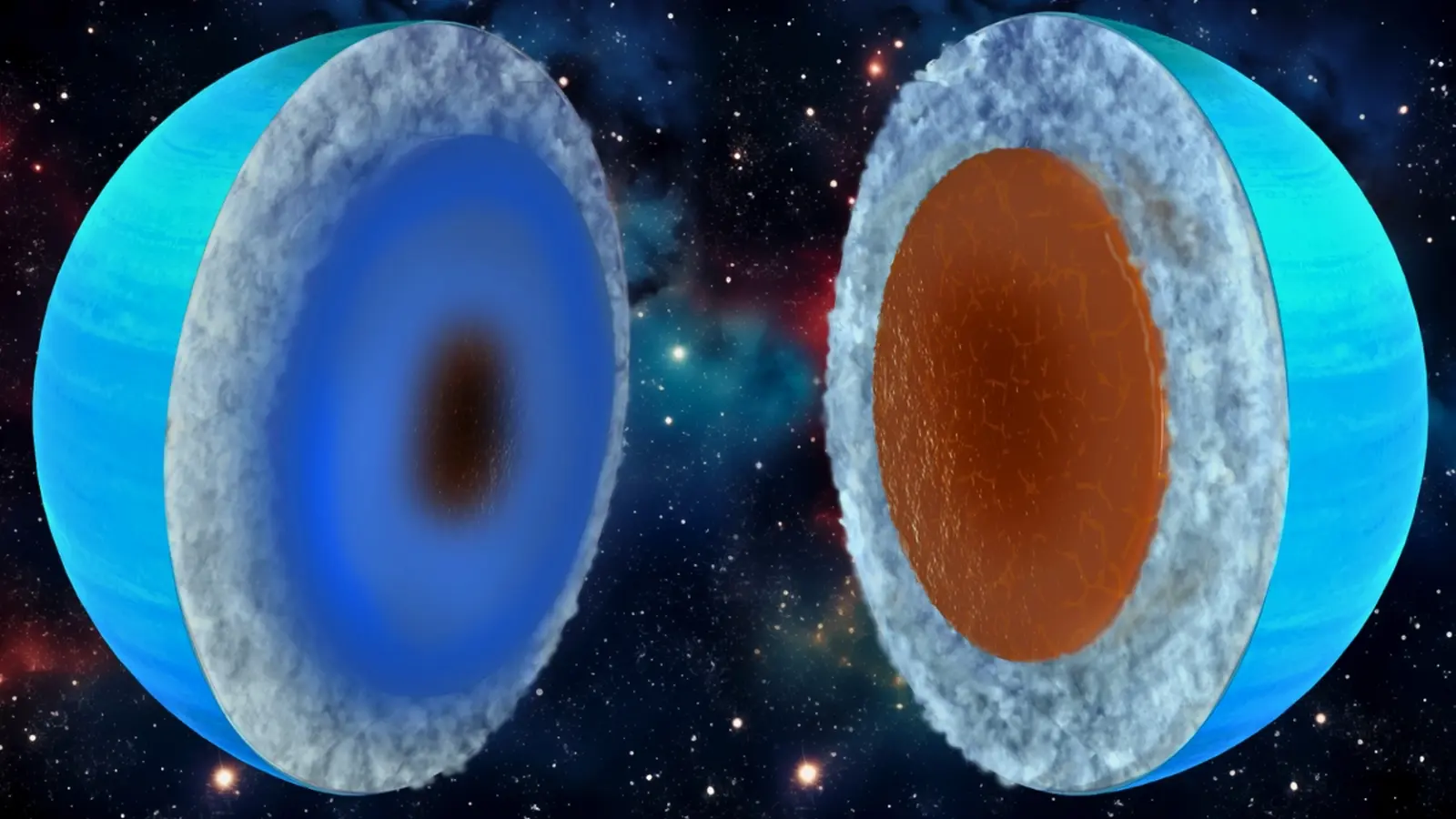
New modeling from researchers at the University of Zurich and NCCR PlanetS suggests that Uranus and Neptune — long labeled 'ice giants' — may instead have interiors dominated by rock-like materials and active convection. If confirmed, this reinterpretation would reshape how we classify the outer planets and explain puzzling features such as their odd magnetic fields.
Rethinking the 'Ice Giant' label
For decades planetary scientists have grouped the Solar System's planets into simple categories: small, rocky terrestrials close to the Sun, and large, volatile-rich giants beyond the frost line. Jupiter and Saturn became the archetypal gas giants, while Uranus and Neptune were classed as ice giants because models assumed large fractions of water, methane and ammonia — volatiles that become high-pressure ices deep inside those planets.
But new work by Luca Morf and Ravit Helled challenges that tidy picture. Rather than starting from strong compositional assumptions, their team generated thousands of random density profiles for Uranus and Neptune and retained only those that matched observed gravitational fields and planetary mass and radius constraints. This hybrid approach blends empirical agnosticism with physical consistency, letting the data guide which interior structures remain plausible.

Voyager 2 images of Uranus (left) and Neptune. (NASA/JPL-Caltech)
How the models differ and what they imply
The UZH-NCCR models find that a best-fit interior is not necessarily dominated by bulk water 'ice' layers. Instead, substantial rock-rich material — heavier silicates and metals — can reproduce the measured gravity fields while still matching radius and mass. In other words, depending on assumptions about density profiles and material behavior at extreme pressure, Uranus and Neptune could be 'rock giants' as readily as 'ice giants'.
Convection vs. layered stability
Another important outcome is dynamical: the simulations allow for convective mixing inside the planets. Convection is the process by which hot, buoyant material rises and cooler material sinks, an engine of heat transport found in Earth's mantle and in stellar interiors. If Uranus and Neptune support deep convection, their interiors would be actively recycled rather than statically layered — a scenario that affects thermal evolution and magnetic field generation.
Magnetic fields and 'ionic water'
The new models also offer a plausible explanation for the peculiar magnetic fields of Uranus and Neptune. Both planets have magnetic fields that are strongly non-dipolar and tilted, with multiple poles and complex geometries. Morf and Helled's interiors can include layers of high-pressure, electrically conducting 'ionic water' where dynamo action takes place. This places the dynamo region off-center and in stratified shells, naturally producing the observed non-dipolar, multipolar fields. Their calculations further suggest Uranus's dynamo layer could lie deeper than Neptune's — a subtle structural difference that may help explain their distinct magnetism.
Why this matters for planetary science and missions
Only Voyager 2 has visited Uranus and Neptune up close, and those flybys in 1986 and 1989 left many open questions. Without precise gravitational, magnetic and atmospheric data from dedicated orbiters or probes, interior models remain under-constrained and multiple scenarios stay viable. The UZH study underscores how sensitive conclusions are to model assumptions and highlights the scientific return of future missions that can measure gravity harmonics, magnetic fields at different latitudes, and atmospheric composition with higher precision.
Beyond Solar System taxonomy, the debate matters for exoplanet studies. Uranus- and Neptune-sized planets are common around other stars, and interpreting their radii and masses requires models of interior composition and thermal history. If rock-dominated interiors are more common than previously assumed, that would affect our estimates of volatile inventories, formation pathways, and habitability-related processes in the outer reaches of planetary systems.
Expert Insight
'The distinction between ice and rock giants may be more semantic than real,' says Dr. Elena Park, a planetary scientist not involved in the study. 'What matters for planetary evolution and magnetic dynamos is how materials behave at hundreds of gigapascals of pressure and whether heat can escape. These new, agnostic models force us to think less in labels and more in measurable structure — which only targeted missions can settle.'
Conclusion
Morf and Helled's work does not definitively rename Uranus and Neptune as rock giants, but it reframes the question. By removing heavy prior assumptions and letting observational constraints shape interior solutions, the study opens alternative, physically consistent scenarios that better match some oddities of the planets, like their magnetic fields. The results strengthen the case for dedicated Uranus and Neptune missions that can collect the gravity, magnetic and atmospheric data needed to resolve whether these outer worlds are icy relics or rock-heavy, convective bodies — or something in between.

“My work centers on sustainability, energy, and environmental science — examining how innovation can lead to a greener future.”

Discussion
Leave a Comment