
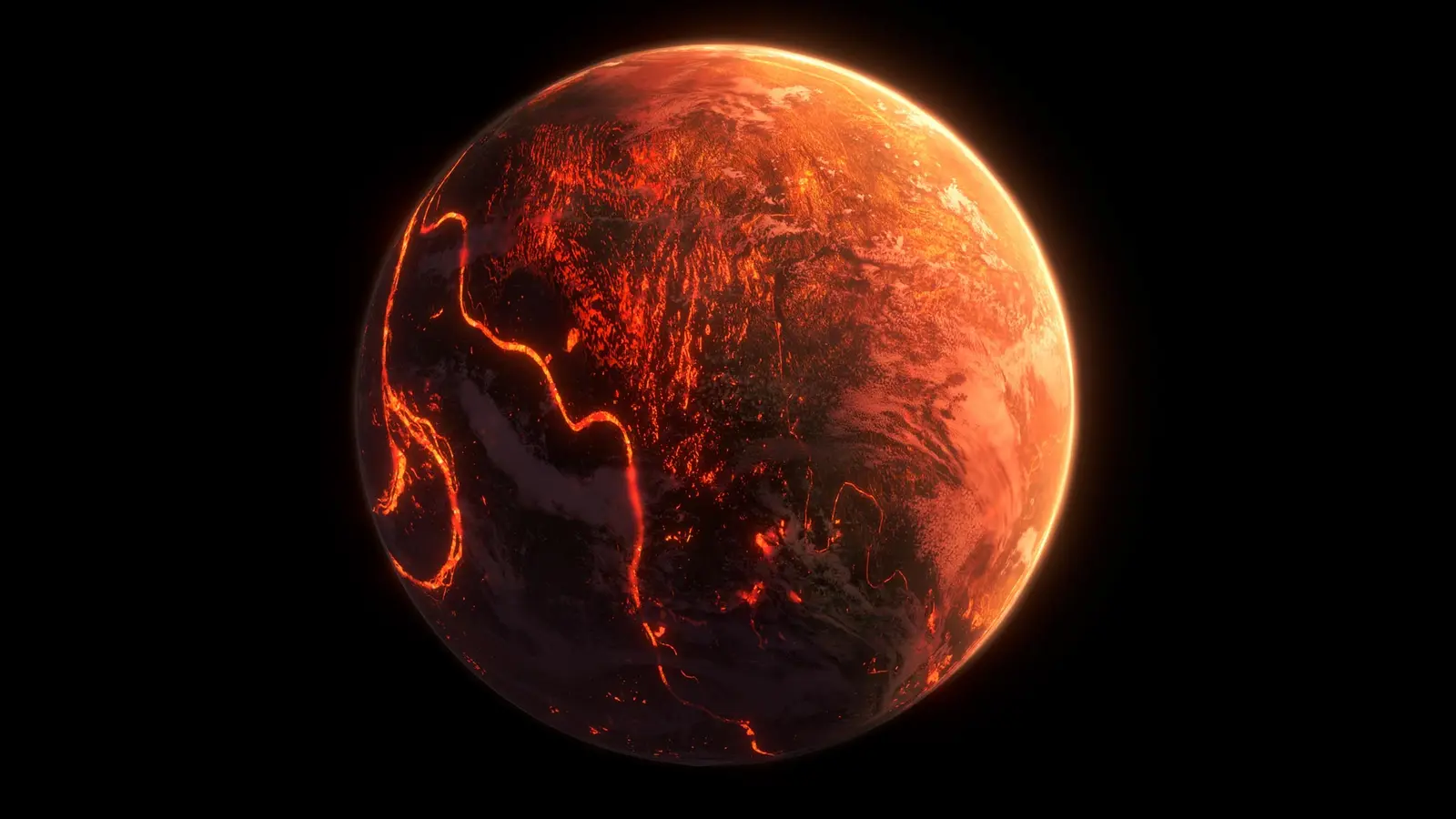
New experiments show that during Earth’s molten infancy, vast amounts of water could have been captured deep inside the mantle rather than lost to space. That hidden reservoir—locked into the mineral bridgmanite as the planet cooled—may have played a decisive role in making Earth habitable.
Bridgmanite: the planet’s microscopic water vault
About 4.6 billion years ago, Earth was a chaotic, incandescent world. Frequent, massive impacts kept the surface and much of the interior molten, forming a global magma ocean in which liquid surface water could not exist. Yet today nearly 70% of the planet is covered by oceans. How did water survive that blistering era?
Recent work led by Prof. Zhixue Du at the Guangzhou Institute of Geochemistry (GIGCAS) provides a compelling answer: bridgmanite, the dominant mineral in the lower mantle, can incorporate and retain water at the atomic level. Previously, bridgmanite was widely considered nearly dry under deep-mantle conditions, but Du’s team found that its capacity to host water grows with temperature—meaning the hottest phase of Earth’s early history was paradoxically the best time for the mantle to lock away water.
Laboratory breakthroughs that recreated deep-mantle extremes
To test how much water bridgmanite could hold, researchers needed to do two difficult things: reproduce conditions more than 660 kilometers beneath the surface and measure water in samples far smaller than a human hair. The team built a custom diamond anvil cell with laser heating and high-temperature imaging to reach equilibrium temperatures near ~4,100 °C—conditions that better match the ancient magma ocean than many earlier, lower-temperature experiments.

Probing water in a tiny experiment sample
Analytically, the project combined several state-of-the-art tools: cryogenic three-dimensional electron diffraction, NanoSIMS for high-resolution isotopic and elemental mapping, and atom probe tomography (APT) to reveal chemistry at near-atomic scales. Together these instruments acted like microscopic “chemical CT scanners” and “mass spectrometers,” allowing the team to visualize water distribution inside minute bridgmanite crystals and confirm that water is structurally dissolved within the mineral lattice.
Key findings: a hotter mantle means a wetter interior
The experiments demonstrated that bridgmanite’s water partition coefficient—the measure of how much water the mineral takes up relative to the melt—increases with temperature. In practical terms, this overturns earlier assumptions: during the magma ocean phase, as bridgmanite crystallized from cooling magma, it was capable of sequestering far more water than previously thought.
Using crystallization models, the team showed that the early lower mantle could have become the largest water reservoir in the solid Earth. Their simulations suggest the storage potential of that sequestered reservoir is between five and 100 times greater than earlier estimates. In absolute terms, the early solid mantle might have contained 0.08 to 1 times the volume of Earth’s modern oceans—a reservoir large enough to influence long-term climate and geodynamics.
How hidden water shaped Earth’s evolution
Water inside the mantle is not merely a passive inventory. Dissolved water lowers melting temperatures and reduces rock viscosity, effectively lubricating mantle convection and promoting plate motion. The presence of a deep, water-rich reservoir during Earth’s formative stages could have jump-started internal circulation, encouraged early plate tectonics, and supported sustained volcanic outgassing—processes that contributed to building an atmosphere and cycling water back to the surface over hundreds of millions of years.
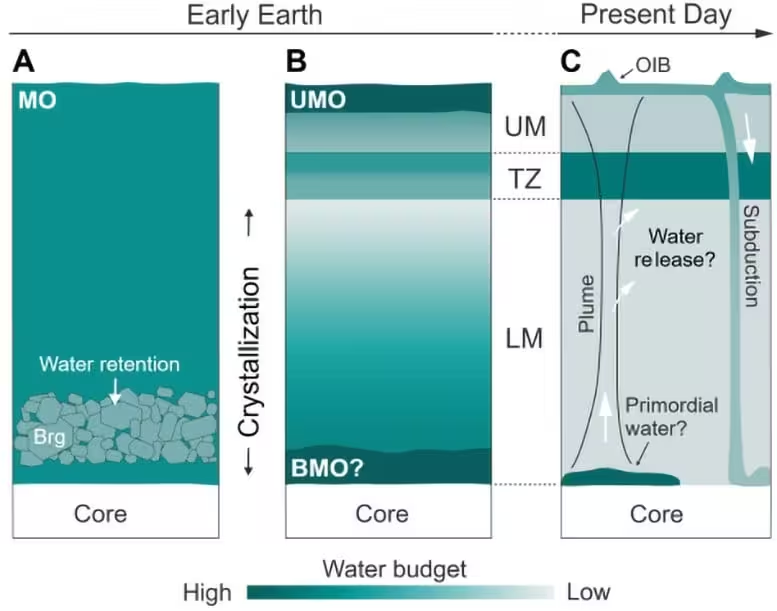
Evolution of deep water from the early Earth to the present day
Over geological time, some of that buried water would have been transported upward by mantle plumes and magmatic processes, gradually replenishing the surface oceans and helping form the primordial atmosphere. In this view, the water “seeded” into bridgmanite during the magma ocean phase provided a persistent, internal source that eased Earth’s transition from a molten furnace to a temperate, life-bearing planet.
Implications for planetary science and habitability
These results matter for more than Earth history. Understanding how minerals store volatiles under extreme conditions informs models of other terrestrial planets and exoplanets. If a common mantle mineral like bridgmanite can trap large water inventories when a planet is hottest, then rocky planets experiencing early magma oceans may retain volatiles long enough to later develop atmospheres and surface water—key ingredients for habitability.
For Earth scientists, the findings prompt a reevaluation of global water budgets and mantle dynamics. They also highlight the sensitivity of geochemical cycles to temperature during early planetary differentiation, and the importance of high-pressure, high-temperature experiments in constraining those processes.
Expert Insight
“This study changes the narrative about where Earth’s water resided during its most violent phases,” says Dr. Maria Alvarez, a planetary geophysicist not involved with the research. “By showing that bridgmanite is a viable, temperature-dependent reservoir, the team provides a mechanistic link between early crystallization, mantle dynamics, and the later emergence of surface oceans. It helps explain how Earth could retain the building blocks of habitability despite extreme early heating.”
Dr. Alvarez adds that the experimental approach—combining ultra-high-temperature diamond anvil experiments with NanoSIMS and APT—sets a new standard for probing volatile behavior at planetary interior conditions.
Conclusion
By demonstrating that bridgmanite can trap substantial water at magma-ocean temperatures, the new research offers a robust pathway for how Earth preserved its water through a violent youth. The idea of a deep, initially hidden water reservoir reframes our understanding of planetary evolution, linking microscopic mineral behavior to global-scale processes that made Earth habitable. Future work that couples these experimental constraints with geodynamic and isotopic models will refine estimates of how much water was stored and later recycled to the surface—an important step toward a unified history of Earth’s water.

“My work centers on sustainability, energy, and environmental science — examining how innovation can lead to a greener future.”

Discussion
Leave a Comment