
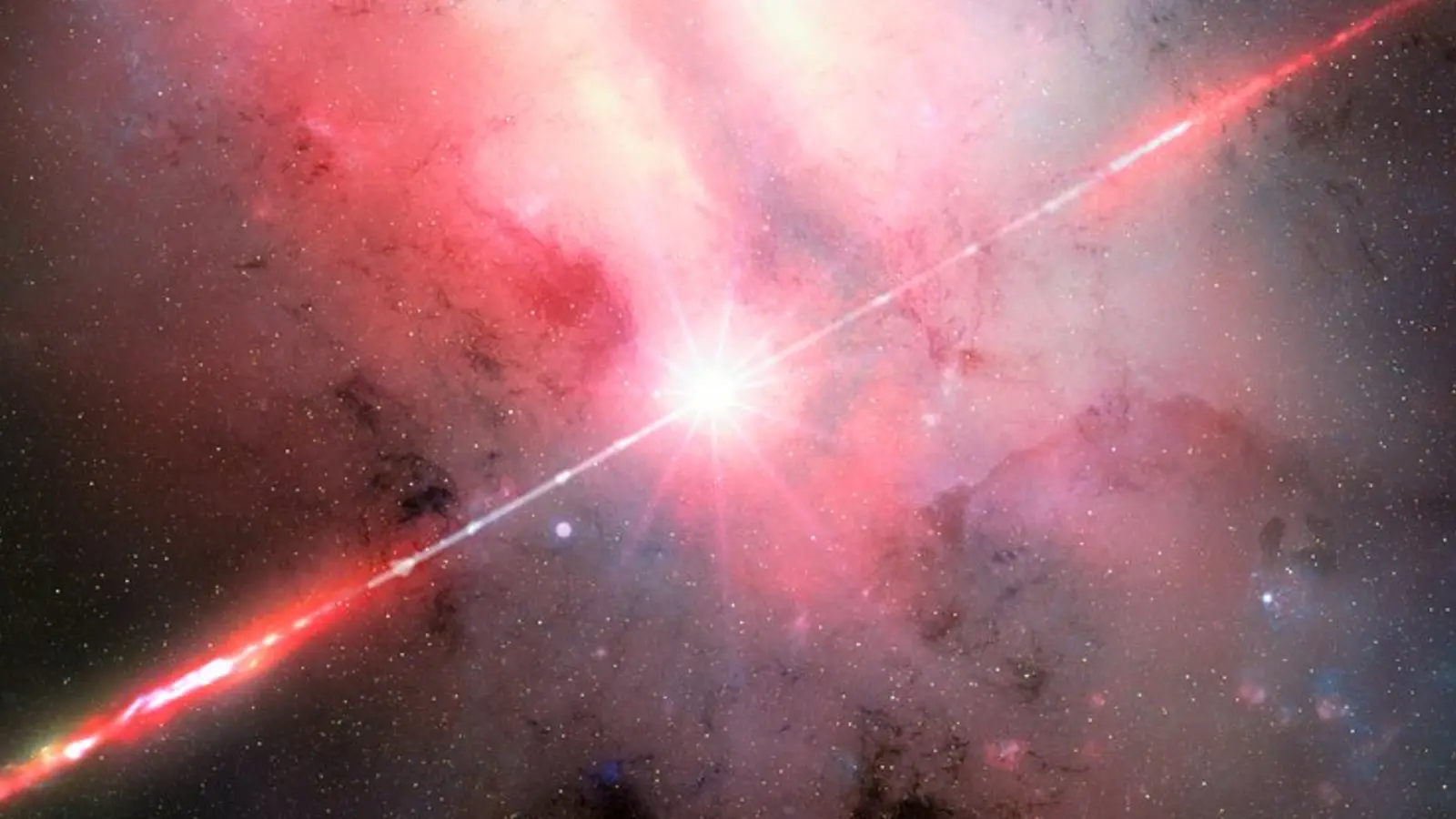
On 2 July 2025 astronomers recorded a gamma-ray burst unlike any seen before: GRB 250702B produced repeated high-energy flares that continued for more than seven hours. The event, now the longest-duration GRB on record, was traced to a massive, extremely dust-rich galaxy and forced researchers to re-examine how the most violent explosions in the Universe can unfold.
How the record was made: a worldwide observational effort
The initial detection of GRB 250702B came from NASA’s Fermi Gamma-ray Space Telescope, which registered prolonged, intermittent gamma-ray emission rather than the single, short flash expected for most GRBs. X-ray follow-up from space-based instruments narrowed the sky position, prompting a rapid, coordinated campaign from observatories around the globe.
Ground-based facilities played a crucial role. Early infrared observations from the European Southern Observatory’s Very Large Telescope (VLT) confirmed the source lies well beyond the Milky Way, settling an early ambiguity about whether the phenomenon was local or extragalactic. From roughly 15 hours after the first burst and continuing for about 18 days, a team led by Jonathan Carney (University of North Carolina at Chapel Hill) tracked the fading afterglow with three powerful ground telescopes: the NSF Víctor M. Blanco 4-meter Telescope at Cerro Tololo, and the twin 8.1-meter Gemini North and Gemini South telescopes. Those datasets were later augmented with Keck observations and archival data from Hubble, other radio and X-ray facilities.

This artist’s illustration, which shows a high-speed jet of material being launched from a source that is embedded in a very dusty galaxy, depicts GRB 250702B — the longest gamma-ray burst that astronomers have ever observed. This powerful, extragalactic explosion was first detected on 2 July 2025. It exhibited repeated bursts that lasted over seven hours. Credit: NOIRLab/NSF/AURA/M. Garlick
Tracking the afterglow and peering through dust
Gamma-ray bursts typically emit a prompt flash of gamma rays followed by an afterglow that fades through X-ray, optical, infrared and radio wavelengths. The afterglow provides a laboratory for understanding the burst’s energy, jet structure and local environment. For GRB 250702B the challenge was that much of the emission was absorbed or obscured by dust.
Visible-light instruments struggled to detect the host galaxy or the afterglow. Gemini North managed the only close-to-visible detection of the host, but it required nearly two hours of exposure to tease faint light through the intervening dust. Blanco’s wide-field infrared imager (NEWFIRM) and the Dark Energy Camera (DECam), plus the Gemini Multi-Object Spectrographs (GMOS) on Gemini North and South, provided complementary imaging and spectra. Combining these ground-based data with space-based measurements allowed the team to chart the afterglow’s decay and constrain the physical properties of the explosion.
This video begins with the stellar field around the host galaxy of GRB 250702B — the longest gamma-ray burst that astronomers have ever observed. Credit: International Gemini Observatory/CTIO/NOIRLab/DOE/NSF/AURA/N. Bartmann (NSF NOIRLab) Image processing: M. Zamani & D. de Martin (NSF NOIRLab) Music: Stellardrone – Billions and Billions
Analysis shows the burst region is surrounded by a very large column of dust. In practical terms, that means visible photons are scattered or absorbed, so infrared and longer-wavelength observations were pivotal. The dust is not predominantly in our own Milky Way; most extinction appears to originate inside the GRB’s host galaxy, which the observations indicate is unusually massive compared to typical GRB hosts. A dense, dusty lane along the line of sight seems to cloak the site of the explosion, complicating attempts to measure emission that would otherwise reveal the progenitor’s nature.
What the data say: a relativistic jet in a dense environment
From timing, brightness evolution and spectral data, the team interprets the initial gamma-ray emission as the product of a narrow, relativistic jet plowing into dense surrounding material. Relativistic jets are streams of particles accelerated to velocities close to the speed of light; when such a jet collides with ambient gas it produces shocks that emit gamma rays and then a multiwavelength afterglow. The prolonged, repeating nature of GRB 250702B’s high-energy output suggests either extended central-engine activity or multiple episodes of energy injection into the jet.
Understanding the host and environment is as important as characterizing the jet. The host’s high stellar mass and heavy dust content stand out: most long-duration GRBs have been tied to low-mass, relatively dust-poor star-forming galaxies. Here, however, the environment is denser and more extinguished, implying the progenitor was embedded in an uncommon niche. These environmental clues impose tight constraints on theoretical models: any viable explanation must produce sustained gamma-ray emission and a relativistic jet, while also being consistent with heavy local extinction.

Left: The stellar field around the host galaxy of GRB 250702B — the longest gamma-ray burst that astronomers have ever observed. Right: Close-up view of the host galaxy taken with the Gemini North telescope. This image is the result of over two hours of observation, yet the host galaxy appears extremely faint due to the large amount of dust surrounding it. Credit: International Gemini Observatory/CTIO/NOIRLab/DOE/NSF/AURA Image processing: M. Zamani & D. de Martin (NSF NOIRLab)
Possible origins: why GRB 250702B defies tidy classification
Since the first gamma-ray bursts were cataloged in the 1970s, astronomers have developed several source classes. Short GRBs are generally linked to compact-object mergers (neutron star binaries), while long GRBs are often tied to the collapse of massive stars. A handful of very long-duration events (lasting thousands of seconds) have been proposed to originate from exotic channels such as the collapse of a blue supergiant, tidal disruption events (TDEs) where a star is torn apart by a massive black hole, or the birth of a magnetar. Yet GRB 250702B does not fit neatly into these standard boxes.
Based on the multiwavelength observations, researchers outline three plausible scenarios that remain consistent with the data:
- A compact-object (black hole) merging into a star that has been stripped of hydrogen (a helium-rich envelope), triggering a prolonged accretion phase and sustained jet activity;
- A micro-tidal disruption event in which a star or sub-stellar body (for example a massive planet or brown dwarf) is disrupted by a stellar-mass compact object (neutron star or small black hole), producing repeated accretion episodes and intermittent gamma-ray flares;
- A tidal disruption by an intermediate-mass black hole (IMBH), in which a star falling into a 10^2–10^5 solar-mass black hole launches a relativistic jet — if confirmed, this would be the first direct observation of a jet from an IMBH consuming a star.
All three scenarios can plausibly produce an extended, multi-hour gamma-ray signal and are consistent with a dusty, massive host. Crucially, none is yet conclusively favored: additional late-time observations, more sensitive radio monitoring and deep spectroscopy aimed at pinpointing the host’s redshift and chemical composition will be necessary to discriminate between these origins.
Expert Insight
“GRB 250702B is a rare laboratory,” says Dr. Elena Moreno, an astrophysicist not involved in the study. “Its duration and the dusty, massive host push us to consider channels we usually dismiss for most GRBs. If the jet comes from an intermediate-mass black hole, we’d be witnessing a phenomenon that bridges stellar and supermassive black hole physics — that would be extraordinary.”
“Operationally, this event highlights the power of rapid coordination among gamma-ray satellites and flexible ground-based facilities,” adds Dr. Moreno. “Instruments like Blanco, Gemini and Keck are essential for overcoming extinction and catching the afterglow while it’s still detectable.”
Broader implications and next steps
GRB 250702B both expands the known diversity of gamma-ray bursts and emphasizes gaps in our theoretical framework. Confirming any of the proposed origins would carry implications for stellar evolution, black hole demographics and the mechanisms that produce relativistic jets. For example, detecting a jet associated with an intermediate-mass black hole would provide a rare observational window into a population of black holes that has been elusive to date.
Future work will focus on securing deeper spectra to measure the host galaxy’s redshift and metal content, continued radio monitoring to search for late-time jet signatures, and targeted searches through archival data for similar long-duration, repeating transients that might have been overlooked. Continued upgrades to transient alert systems and rapid-response scheduling at major observatories will also be essential to capture the full evolution of similarly unusual events.
Conclusion
GRB 250702B stands out as a cosmic outlier: a seven-hour gamma-ray burst embedded in a dense, dust-rich galaxy that refuses to conform to standard models. The event underscores the need for multiwavelength follow-up and coordinated international observing campaigns. As telescopes push deeper and our alert networks become faster, astronomers will be better equipped to decipher such extreme phenomena — and perhaps to catch the next record-breaker before its light slips away.

“The cosmos has always fascinated me. I write about space missions, astronomy, and the technologies pushing humanity beyond Earth.”

Discussion
Leave a Comment