
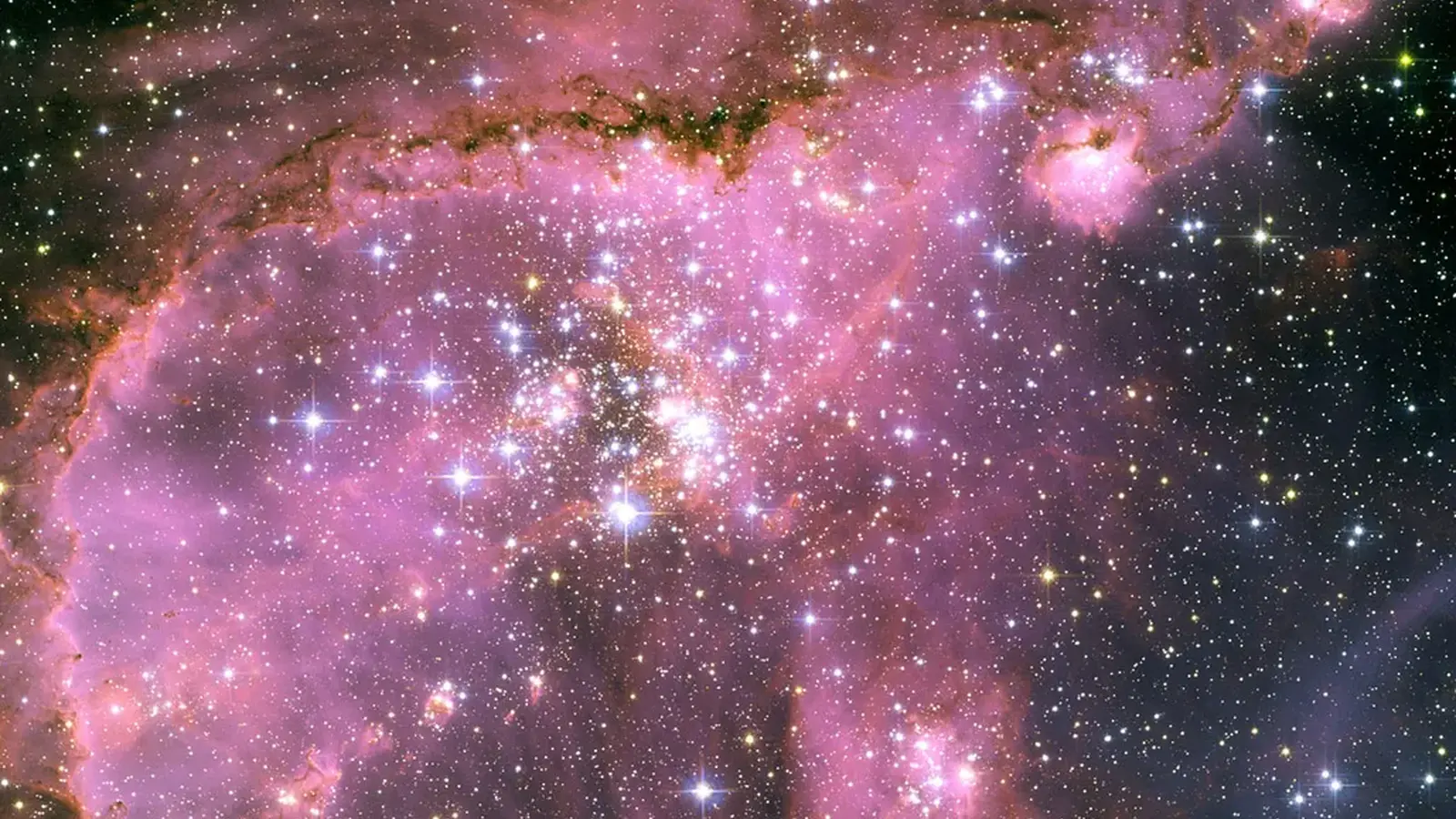
Pristine relics: what astronomers mean by "metal-poor"
The Universe began with a simple chemical palette: hydrogen and helium produced during Big Bang nucleosynthesis, with minute traces of lithium and a few light isotopes. All heavier elements — carbon, oxygen, iron and beyond — were forged later inside stars or during explosive stellar deaths. For astronomers, any element heavier than helium is generically called a "metal." A star's metallicity (the abundance of these elements relative to hydrogen) therefore provides a direct clue to its ancestry: lower metallicity generally implies formation earlier in cosmic history.
Measuring metallicity uses spectroscopy: light from a star is dispersed into its component wavelengths and absorption lines reveal the chemical fingerprints of different elements. Very low values of [Fe/H] (iron relative to hydrogen) and characteristic abundance ratios such as [C/Fe] or [Mg/Fe] indicate pollution by only one or a few earlier supernovae, or even direct inheritance from the first generation of stars. Those first-generation, or Population III, stars are believed to have been massive and short-lived, seeding the interstellar medium with the first heavy elements.
Discovery of SDSS J0715-7334 and what makes it exceptional
Astronomers have identified a red giant star, SDSS J0715-7334, in the halo of the Large Magellanic Cloud (LMC) whose chemical signature is among the lowest metallicities yet measured. Spectroscopic analysis shows iron and carbon abundances so small that many distant, extremely metal-poor galaxies still contain roughly ten times more metals. That makes SDSS J0715-7334 the nearest analogue we have to a primordial, almost pristine star.
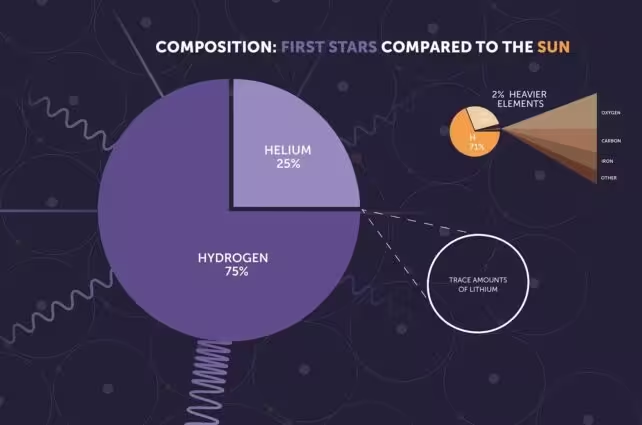
Illustration showing the fraction of elements for a first-generation star vs the Sun. First-generation stars are almost entirely hydrogen and helium, while the Sun also contains heavier elements astronomers call metals. (NASA/ESA/CSA/STScI)
Detailed abundance ratios indicate SDSS J0715-7334 likely belongs to the second generation of stars, formed from gas enriched by a single massive progenitor. Modeling of the observed ratios — especially magnesium, iron and other alpha elements — suggests that the enriching supernova had a progenitor mass near ~30 solar masses. That is notable: theoretical expectations for Population III stars often emphasize extremely large masses (hundreds of solar masses), so a lower-mass, metal-producing supernova provides a different view of early chemical enrichment.
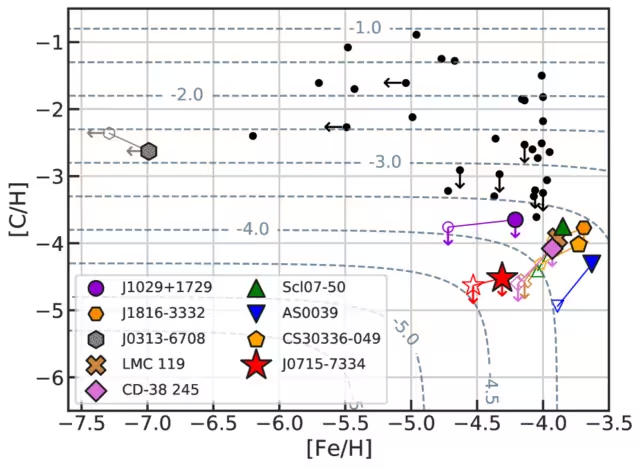
A log graph plotting low metallicity stars by their carbon abundance vs their iron abundance. SDSS J0715-7334 is seen to have the lowest of both. (Ji, et al, arXiv)
Another striking property is the star's exceptionally low carbon abundance. Massive early stars typically produce significant carbon and oxygen through the CNO cycle during helium burning. The low carbon content in SDSS J0715-7334 implies that the natal cloud experienced efficient dust cooling, allowing small, low-mass stars to form early on. Dust-assisted cooling is one of the pathways — alongside fine-structure cooling by C and O — that can lower gas temperatures and let fragments collapse into long-lived, low-mass stars.
Implications for early star formation and nearby searches
Finding such a chemically primitive star within the LMC halo is important for multiple reasons. First, it demonstrates that relics of the first few stellar generations can survive in the local Universe, accessible to high-resolution spectroscopy. Second, the inferred progenitor mass and abundance pattern inform models of the initial mass function (IMF) for the earliest stars and the types of supernovae that seeded subsequent generations.
Kinematics add another piece of the puzzle: SDSS J0715-7334's motion within the LMC indicates it is not a transient interloper from the Milky Way but likely formed in-place in the dwarf galaxy's halo. That strengthens the case that satellite galaxies like the LMC are promising hunting grounds for more ancient, metal-poor stars.
Observationally, this discovery leverages wide-field surveys and follow-up high-resolution spectroscopy. Future facilities — including extremely large telescopes (ELTs) and space observatories like the James Webb Space Telescope (JWST) for complementary high-redshift studies — will enable a two-pronged approach: locate metal-poor stars nearby and compare their chemical signatures to those of distant, low-metallicity galaxies visible in the early Universe.
Expert Insight
"Local fossil stars provide a direct chemical record of the first supernovae," says Dr. Elena Márquez, an astrophysicist specializing in stellar archaeology. "SDSS J0715-7334 is a rare laboratory: its low-carbon, low-iron pattern tells us that dust cooling played a significant role early on, and that some first-generation remnants came from progenitors less massive than once expected. Systematic searches in dwarf galaxy halos will expand this sample and refine our models of early chemical evolution."
Conclusion
SDSS J0715-7334 stands out as one of the most chemically pristine stars identified and, critically, it lies within our galactic neighborhood in the Large Magellanic Cloud. Its unique abundance pattern sharpens our understanding of how the first heavy elements were produced and mixed into subsequent generations, and it highlights satellite galaxies as fertile territory for finding more near-pristine stars. Continued spectroscopic surveys and next-generation telescopes will allow astronomers to build a more complete census of these stellar fossils and to directly link local chemical records with observations of the high-redshift Universe.

“The cosmos has always fascinated me. I write about space missions, astronomy, and the technologies pushing humanity beyond Earth.”

Discussion
Leave a Comment