
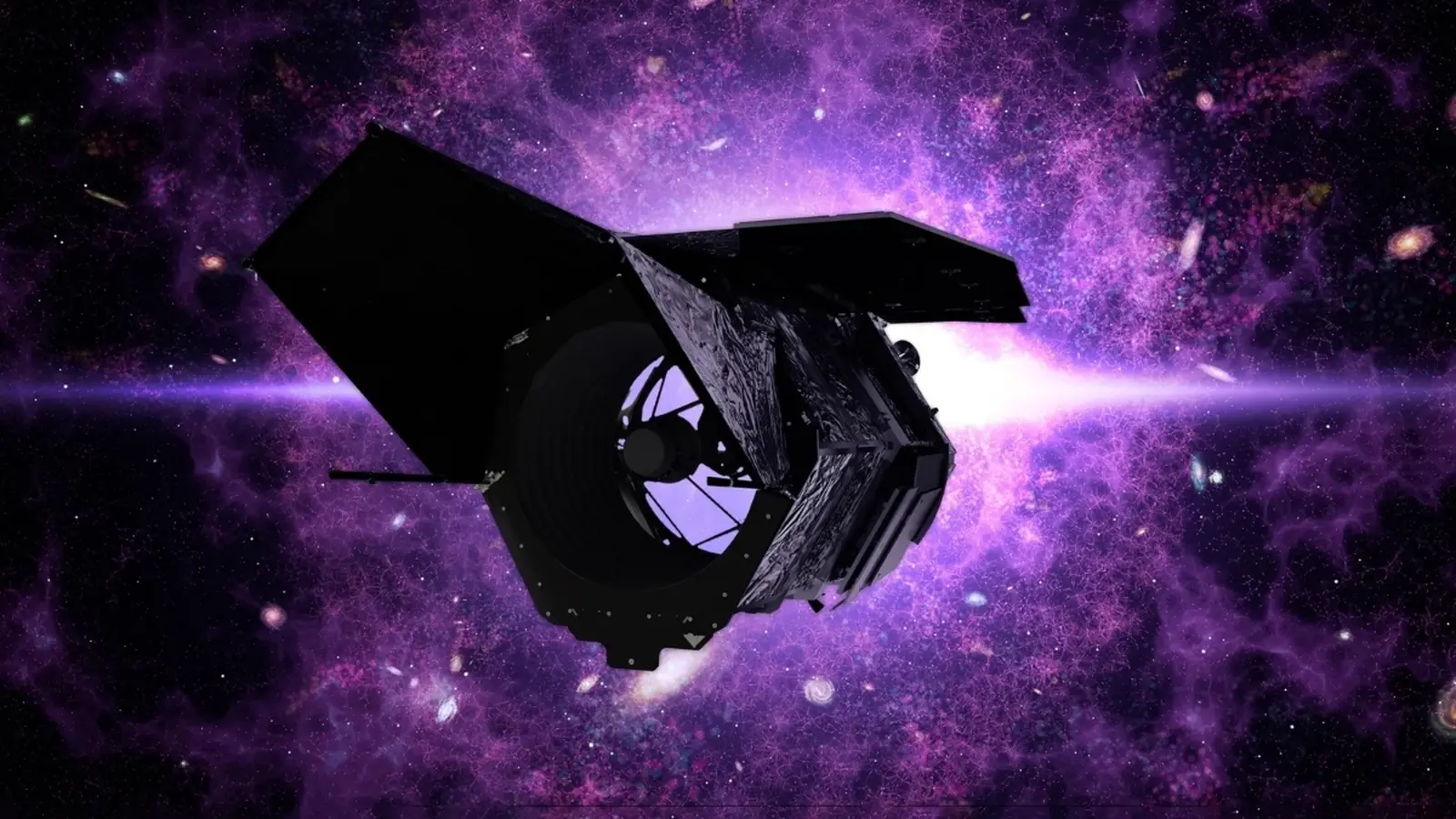
NASA’s Nancy Grace Roman Space Telescope has reached a major milestone: its two main segments are now integrated and the observatory is moving into final testing. Designed as a wide-field infrared surveyor with a cutting-edge coronagraph, Roman aims to map large swaths of the sky, probe dark energy, and push direct imaging of exoplanets to new levels.
Assembly complete — what that milestone means
On November 25th, engineers at Goddard Space Flight Center joined the Nancy Grace Roman Telescope’s two primary sections inside a large, controlled clean room. That integration marks a major programmatic checkpoint: the spacecraft transitions from discrete hardware to a functioning observatory that can undergo system-level tests. According to NASA’s timeline, Roman could be ready for launch as early as Fall 2026, with a current target window in May 2027 for a SpaceX Falcon Heavy ride to the Sun–Earth L2 point.
Completing assembly is more than symbolic. It enables thermal-vacuum tests, electromagnetic compatibility checks, and end-to-end instrument calibrations that must succeed before the telescope ships to the launch site. Those tests simulate the harsh environment of space and verify that systems such as the Solar Array Sun Shield (SASS), attitude control, communications, and the two science instruments operate together as intended.

NASA's Nancy Grace Roman Space Telescope is now fully assembled following the integration of its two major segments on Nov. 25 at the agency's Goddard Space Flight Center in Greenbelt, Md. The telescope's Solar Array Sun Shield (SASS) is prominent in this image. (NASA/Jolearra Tshiteya)
Two instruments, complementary roles
Roman carries a focused instrument suite: the Wide-Field Instrument (WFI) and the Coronagraph Instrument (CGI). This combination gives the mission both breadth and precision. The WFI is a 288-megapixel infrared camera that will deliver an imaging field roughly 100 times larger than the Hubble Space Telescope’s—crucial for surveys that require statistical power rather than singular, deep pointings. The coronagraph is an experimental, high-contrast imager and spectrometer built to block starlight and reveal faint planets and circumstellar material near bright stars.
WFI’s wide-field mapping capability is central to Roman’s cosmology and exoplanet work. By surveying vast regions of the sky in the infrared, Roman will trace the distribution of galaxies and galaxy clusters across cosmic time, detect supernovae in large numbers for distance measurements, and provide a census of stars and stellar populations in our galaxy. The telescope’s broad coverage is what allows Roman to tackle dark energy research with unprecedented statistical reach.
What the coronagraph will test
- Active coronagraph technologies that combine masks, deformable mirrors, and precision wavefront control;
- Multiple observing modes to demonstrate spectral characterization of exoplanets;
- A pathfinder demonstration for future flagship missions that aim to image Earth-like planets directly.
The CGI will be the first active coronagraph deployed in space to test these techniques on a science-class observatory. It’s not only a technology demonstration: the instrument could directly image and obtain spectra of nearby, bright exoplanets and of disks where planets are forming.
Science goals: dark energy, exoplanets, and unexpected discoveries
Roman’s mission priorities are ambitious but focused. The telescope is explicitly designed to advance four major science areas: understanding dark energy, completing an exoplanet census (especially via microlensing), imaging exoplanets with the coronagraph, and searching for compact objects including primordial black holes. Each of these goals leverages the observatory’s combination of sensitivity, angular resolution, and unusually wide field.
For dark energy studies, Roman will map the large-scale structure of the Universe and measure how that structure evolves. Large-area infrared surveys let astronomers detect remote galaxies and galaxy clusters whose distribution carries imprints of the cosmic expansion history. Because dark energy’s effects are subtle, Roman’s statistical power—surveying a sky area Hubble would take decades to match—makes it uniquely suited for refining measurements of cosmic acceleration.
On exoplanets, Roman will pursue two complementary approaches. One is gravitational microlensing: monitoring dense star fields to catch the brief brightening that signals a lensing planet. This technique is most sensitive to cold, distant planets and can reveal populations inaccessible to transit or radial-velocity surveys. In its primary five-year mission Roman is expected to discover thousands of microlensing exoplanets, including objects in the outer regions of planetary systems.
The coronagraph offers the second path: direct imaging of nearby exoplanets and circumstellar material. While CGI is a technology demonstrator, it will test hardware and observing strategies that could later enable missions specifically designed to image Earth-like planets in reflected starlight.
Data volume, mission lifetime, and operational constraints
Roman is built for sustained surveys. Over its five-year primary mission the telescope is projected to produce roughly 20,000 terabytes (20 petabytes) of imaging and spectroscopic data—equivalent to decades’ worth of traditional survey output compressed into a short time. Those datasets will be publicly available so the broader astronomy community can mine them for discoveries well beyond the mission’s core objectives.
Unlike cryogenic infrared telescopes that depend on expendable coolants, Roman uses passive thermal control and cryo-stable materials so it won’t be limited by coolant depletion. The principal consumable that does limit mission duration is propellant: fuel is required to maintain the telescope’s orbit near L2 and to perform pointing and momentum management. If propellant use is efficient, Roman could operate well beyond its five-year primary mission in an extended phase, as many observatories have.
In practical terms, Roman’s data deluge will demand robust ground infrastructure, calibrated pipelines, and archival systems. The mission’s success depends not just on the observatory, but on data processing that turns raw pixels into science-ready catalogs and calibrated spectra for the community.
Timeline, launch vehicle, and programmatic context
After assembly, Roman will undergo environmental and systems testing at Goddard before shipping to Kennedy Space Center for final launch preparations. The current manifest calls for a May 2027 launch aboard a SpaceX Falcon Heavy, though the program notes Roman could be ready as early as Fall 2026. Given the complexity of space telescope programs and the history of schedule slips for observatories such as Hubble and JWST, hitting an early date would be an impressive achievement.
Once launched, Roman will travel to the Sun–Earth L2 halo orbit, roughly 1.5 million kilometers from Earth, where thermal stability and uninterrupted fields of view favour infrared surveys and high-contrast imaging. From L2 the spacecraft can maintain steady thermal and power conditions while downlinking the massive datasets through the Deep Space Network and mission ground systems.
Expert Insight
“Roman represents a deliberate design choice: maximize survey speed and statistical reach rather than pursue the deepest single-pointing exposures,” says Dr. Maria Chen, an astrophysicist who studies galaxy evolution and was previously a mission scientist on a space survey instrument. “That means Roman will produce the kinds of population-level measurements we need to tackle dark energy and exoplanet demographics. And because the coronagraph will test active wavefront control in space, it also serves as an investment in the technologies we’ll need for future direct-imaging missions targeting Earth analogs.”
Dr. Chen adds, “From an operational standpoint, the data management challenge is as important as the hardware. Building pipelines that deliver reliable, calibrated products quickly will let scientists—and citizen scientists—start discoveries almost immediately.”
Related technologies and future prospects
Roman’s coronagraph employs deformable mirrors and precision masks to sculpt the telescope’s point spread function and suppress starlight. These techniques, paired with improved detectors and wavefront sensing, are critical stepping stones toward missions that could directly image habitable-zone planets orbiting Sun-like stars. Lessons learned from CGI will influence design choices for future flagship missions such as HabEx or LUVOIR concepts.
On the survey side, Roman’s WFI will complement observations from ground-based facilities and other space telescopes. By combining Roman’s wide, deep infrared maps with optical and radio surveys, scientists will refine photometric redshifts, identify transient events early, and assemble multiwavelength views of galaxy evolution, supernova progenitors, and star-forming environments.
Roman is likely to produce unexpected results—new classes of transients, rare gravitational lensing events, or serendipitous detections of faint solar system objects. Historically, every major telescope opened a new parameter space and revealed surprises that reoriented research priorities; Roman is expected to do the same.
Conclusion
The Nancy Grace Roman Space Telescope arrives at the final stretch of its pre-launch journey with a clear scientific mandate: survey large volumes of the Universe, probe the physics behind cosmic acceleration, and demonstrate high-contrast imaging for exoplanet science. If testing and integration continue to go smoothly, it may lift off sooner than planned, delivering a torrent of data that will fuel discoveries for decades. For scientists and the public alike, Roman promises both deliberate, programmatic advances in cosmology and the excitement of the unexpected—new worlds, new transients, and new clues about our place in the cosmos.

“The cosmos has always fascinated me. I write about space missions, astronomy, and the technologies pushing humanity beyond Earth.”

Discussion
Leave a Comment