
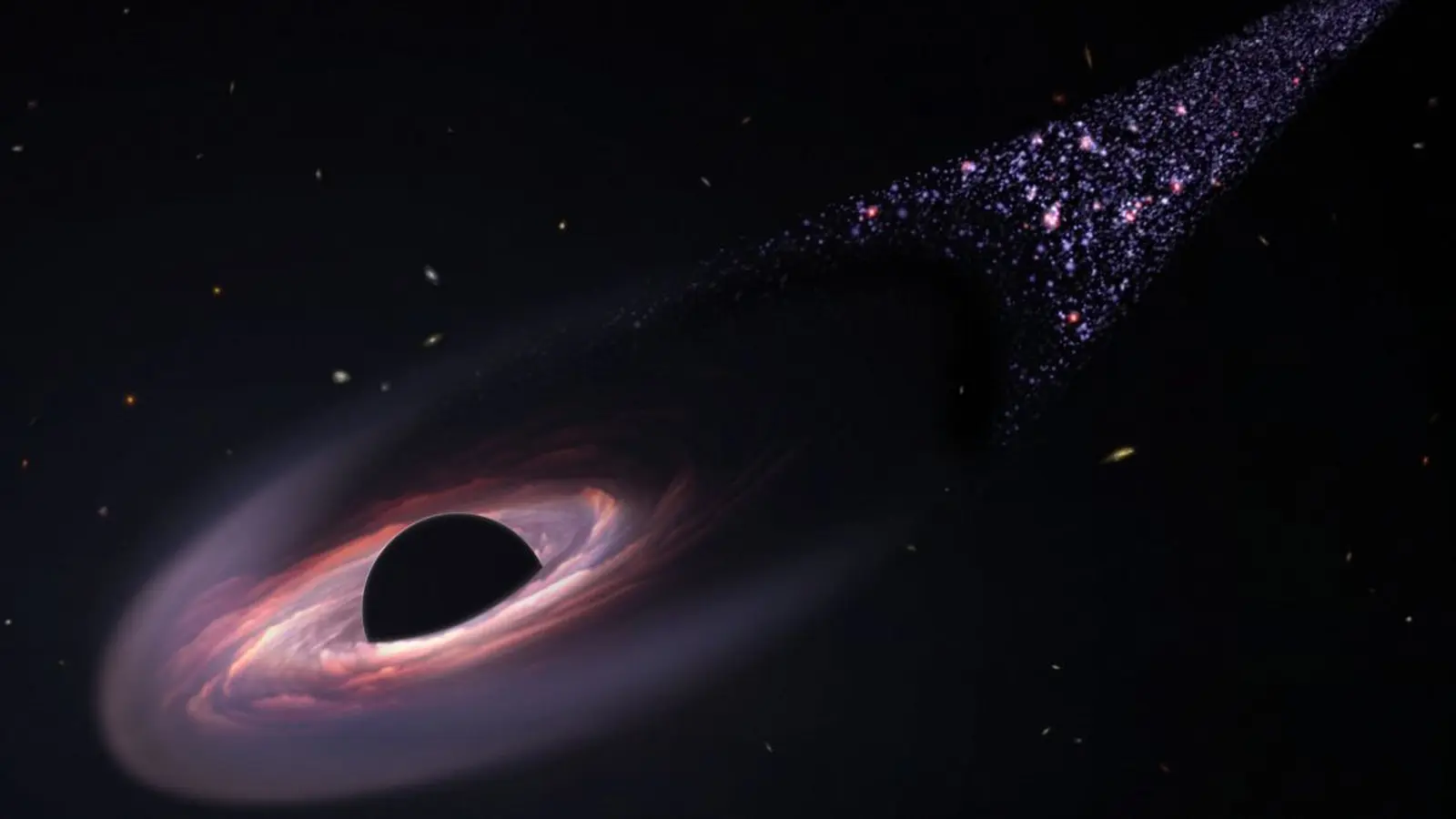
A team of astronomers has identified a supermassive black hole moving fast enough to leave its home galaxy behind. Cataloged as RBH-1, this object matches long-standing theoretical predictions that the most massive black holes can be ejected after dramatic galactic interactions.
How a supermassive black hole can be flung free
For decades, theorists have suggested two main ways a supermassive black hole (SMBH) might be expelled from its galaxy: complex three-body gravitational interactions or a recoil produced when two SMBHs merge and emit gravitational waves asymmetrically. The new observations favor the second scenario. When two galaxies merge, their central black holes can eventually coalesce. If the newly formed single black hole emits gravitational waves more strongly in one direction than another, conservation of momentum gives the remnant a powerful kick — a phenomenon called gravitational wave recoil.
Evidence pointing to a merged pair
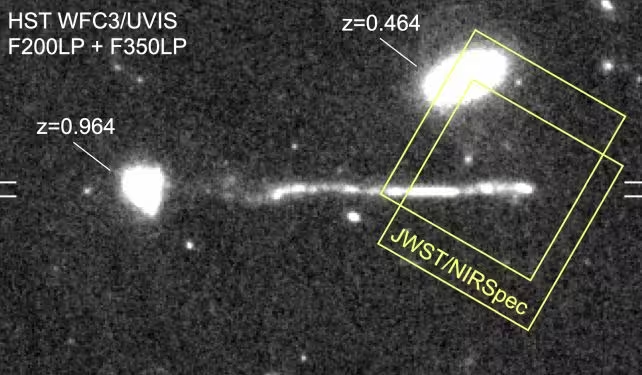
With improved measurements of RBH-1's speed and the mass of the stellar system it left behind, researchers conclude the object is consistent with a merged-black-hole recoil rather than a three-body slingshot. The measured velocity and the comparatively light parent galaxy agree with models that predict how far and how fast a recoiling SMBH can travel after its host galaxies combine.
The discovery paper names the object RBH-1 and presents it as the first confirmed example of a runaway supermassive black hole. If upheld, this observation provides direct empirical support for a prediction made roughly 50 years ago: that SMBHs can escape their hosts through gravitational-wave recoil or violent multi-body encounters.

Why this matters
Confirming a recoiling SMBH carries several scientific implications. It validates aspects of general relativity in the strong-field regime, offers constraints on black hole merger dynamics and gravitational-wave emission, and affects our understanding of galaxy evolution — particularly the growth of central black holes and the dynamics of galactic cores. Future surveys and gravitational-wave observatories could uncover more such objects, helping to map how often these dramatic kicks occur.
While the team’s analysis favors a two-body merger recoil, they note that further follow-up — including deeper imaging and spectroscopic studies — will refine the velocity, trajectory, and environment of RBH-1, and help rule out alternative scenarios definitively.

“The cosmos has always fascinated me. I write about space missions, astronomy, and the technologies pushing humanity beyond Earth.”

Discussion
Leave a Comment