
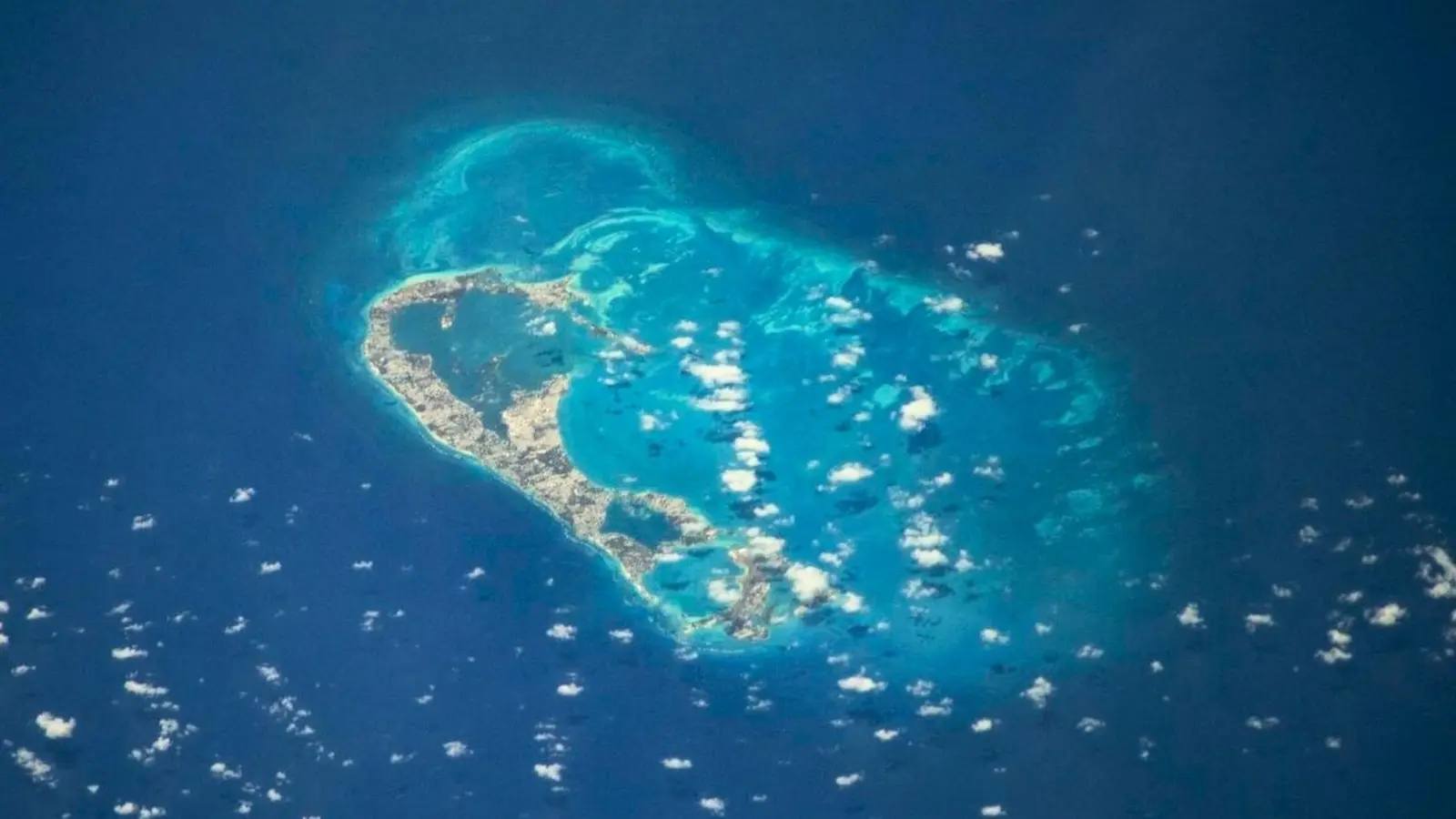
Bermuda’s bright shores and pink sands sit atop a geological puzzle: a broad swell of oceanic crust that should long ago have sunk below sea level. New seismic analysis suggests the islands owe their continued elevation not to an active mantle plume but to a thick, buoyant layer of rock emplaced beneath the crust during ancient volcanism.
A buoyant underplate explains Bermuda's persistent swell
The Bermuda archipelago — 181 islands formed around 33 million years ago — is the remnant of volcanic activity on the Atlantic seafloor. Where classic volcanic island chains such as Hawaii show a clear plume track, progressive ages of volcanoes, and ongoing mantle upwelling, Bermuda lacks these signatures. Seafloor mapping shows a bathymetric swell beneath the islands, but geologists have struggled to explain how that swell survives without an active deep plume to support it.
Seismologists William Frazer (Carnegie Science) and Jeffrey Park (Yale University) revisited the problem by combing through seismic records of waves passing beneath Bermuda. Because seismic waves travel at different speeds depending on temperature and rock density, their arrival times encode information about deep structure. Frazer and Park found anomalous signals consistent with a relatively low-density, roughly 20-kilometer-thick layer sitting beneath the oceanic crust.

This illustration shows the underplate that could be helping Bermuda 'float' above water.
"We identify features associated with a ~20-kilometer-thick layer of rock below the oceanic crust that has not yet been reported," the authors write. Their interpretation is that volcanic emplacement some 30–35 million years ago left a dense accumulation of mafic material at shallow mantle depths — an underplate — whose lower density and buoyancy continue to support the crustal swell. In effect, the underplate does the job a mantle plume would normally perform, holding the islands higher than the surrounding seafloor.
Seismic methods, interpretations and implications
Detecting an underplate requires careful seismic tomography and waveform analysis. Frazer and Park analyzed how earthquake-generated waves slowed and sped up as they traversed regions beneath Bermuda; slower travel times imply less dense or hotter materials, while faster times indicate denser rock. Their models favor a sedimented yet solid layer thick enough to modify crustal buoyancy without requiring present-day volcanic activity.
Why this matters
- Geological context: If underplating is confirmed, Bermuda becomes a textbook case of how volcanic emplacement can create long-lived crustal support without a deep thermal plume.
- Sea-level and hazard implications: The underplate can delay subsidence of islands, but it does not halt global sea-level rise — islands remain vulnerable to future inundation.
- Broader relevance: Similar mechanisms may explain other enigmatic swells on oceanic plates where plume evidence is absent.
The work, published in Geophysical Research Letters, reframes Bermuda’s geology and highlights how seismic tomography can reveal subtle but decisive features hidden beneath the seafloor. By reading the Earth’s natural vibrations, scientists can piece together the long, dynamic history that keeps some islands unexpectedly high.

“The cosmos has always fascinated me. I write about space missions, astronomy, and the technologies pushing humanity beyond Earth.”

Discussion
Leave a Comment