
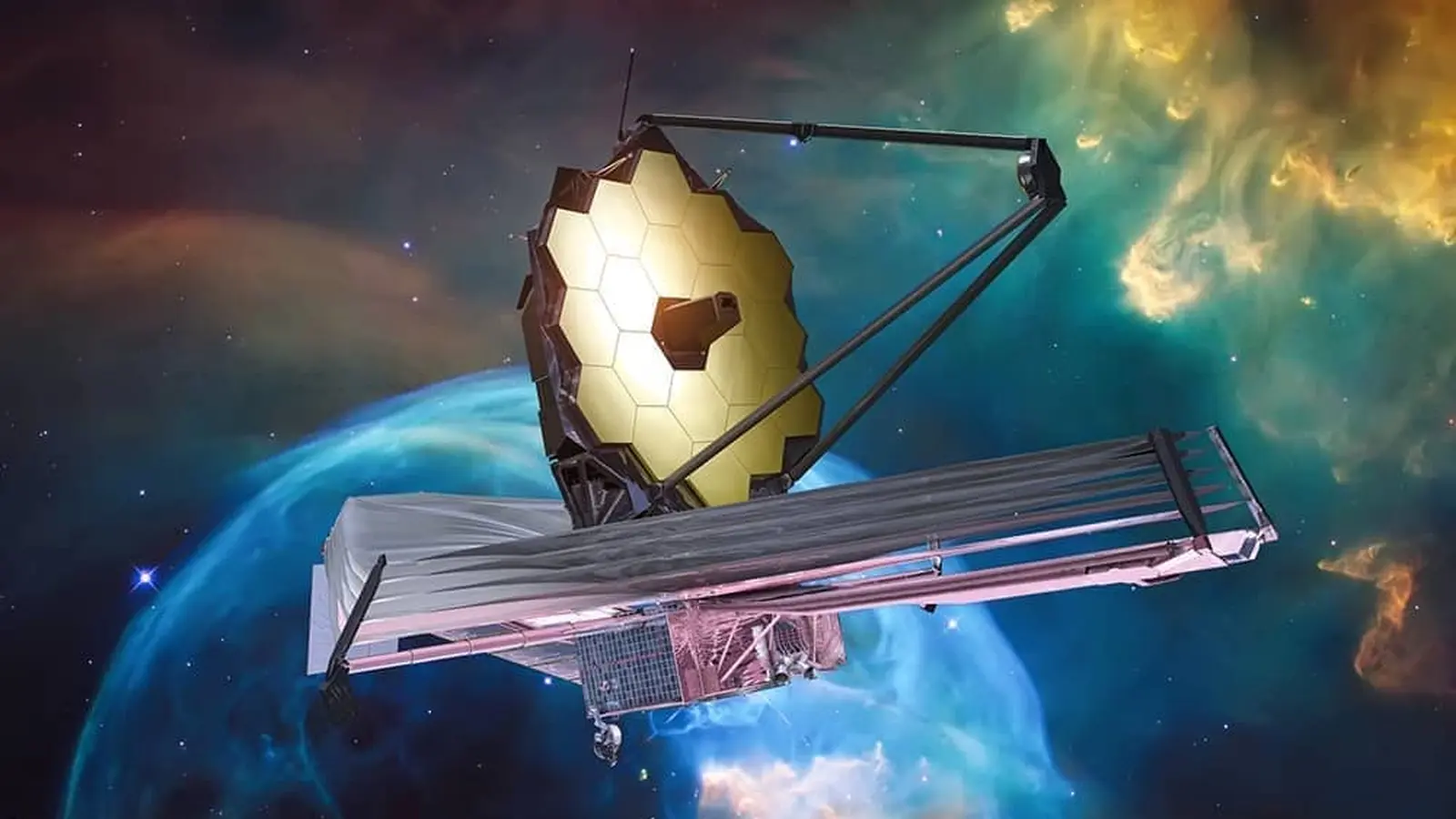
An international team of astronomers has used the James Webb Space Telescope to identify the most distant supernova yet observed, offering a rare window into how massive stars died during the universe’s infancy. The explosion, tied to the gamma‑ray burst GRB 250314A, occurred when the cosmos was roughly 730 million years old—deep inside the epoch known as reionisation.

This is an artist’s concept of one of brightest explosions ever seen in space. Called a Luminous Fast Blue Optical Transient (LFBOT), it shines intensely in blue light and evolves rapidly, reaching peak brightness and fading again in a matter of days, unlike supernovae which take weeks or months to dim. Credit: NASA, ESA, NSF’s NOIRLab, Mark Garlick , Mahdi Zamani
Spotting a stellar death at the edge of time
The discovery began with a powerful flash: on 14 March 2025 the space-based SVOM observatory recorded a long-duration gamma‑ray burst (GRB), catalogued as GRB 250314A. Ground-based follow-up with the European Southern Observatory’s Very Large Telescope (ESO/VLT) measured a redshift consistent with a source existing when the universe was only about 730 million years old. Those initial detections flagged a candidate event from the epoch of reionisation—the period when the first stars and galaxies ionised neutral hydrogen and reshaped the intergalactic medium.
Crucially, the James Webb Space Telescope (JWST) performed targeted imaging with its Near-Infrared Camera (NIRCam) roughly 110 days after the GRB. By measuring the fading infrared light at the GRB position and separating it from the much fainter glow of the host galaxy, astronomers identified a supernova associated with the burst: the first robust detection of such an explosion at this extreme distance.
Why this supernova matters
Supernovae associated with long GRBs are thought to mark the collapse of very massive, rapidly rotating stars. What surprised researchers was how familiar this distant explosion looked. Its brightness and spectral behavior closely resemble SN 1998bw, the archetype GRB‑associated supernova observed in the local universe. That likeness suggests that the progenitor star that produced GRB 250314A and its supernova was not dramatically different from similar stars nearby today, despite the low-metallicity conditions expected in the early universe.
This result challenges a common expectation: many models predicted that early stars, forming in metal-poor environments, might produce markedly different explosions—potentially brighter, bluer, or otherwise atypical. Instead, the Webb observations imply continuity in the physics of massive-star death over cosmic time. The team also ruled out a much brighter category such as a superluminous supernova (SLSN) at this location.
Observations, models and what came next
The effort combined instruments and expertise across observatories and nations. SVOM first alerted astronomers with high-energy gamma‑ray measurements. ESO’s VLT provided spectroscopic confirmation of the source distance. JWST’s NIRCam then resolved the faint transient signal from the host galaxy light, using models informed by the local population of GRB‑linked supernovae to predict the expected infrared emission at that epoch. The match between model and measurement was unexpectedly good, giving confidence that the transient is indeed a classic GRB supernova in the reionisation era.
Detecting and characterising such an event requires precise timing and deep infrared sensitivity—capabilities that JWST was built to deliver. By observing about 110 days after the burst, astronomers were able to catch the supernova while it was still distinguishable from the background galaxy. The team plans further JWST observations in the coming one to two years; by then the supernova light should have faded by more than two magnitudes, enabling a clearer view of the faint host galaxy and a definitive separation of the transient’s contribution.
Scientific implications
Finding a GRB‑associated supernova so early in cosmic history helps anchor models of stellar evolution, nucleosynthesis, and the initial mass function of early star formation. If massive stars in the early universe die in ways similar to those nearby, then some processes—core collapse physics, angular momentum retention, and jet production that powers GRBs—may be robust across a wide range of metallicities and environments. This in turn constrains theoretical models for the first generations of stars and their influence on reionisation and chemical enrichment.
Expert Insight
Dr. Fiona Hayes, an astrophysicist (fictional, for context), reflects: "This detection is a milestone. It tells us that the engines powering gamma‑ray bursts and their associated supernovae were already operating less than a billion years after the Big Bang. JWST gives us the sensitivity to test whether early stellar deaths differed fundamentally from those we see in our cosmic neighborhood—and so far, they look remarkably similar."
Conclusion
The identification of a supernova linked to GRB 250314A with JWST pushes the observational frontier deeper into the early universe. It provides a valuable data point in the epoch of reionisation, helping astronomers test how massive stars formed, evolved, and died when the first galaxies were assembling. Planned follow-up JWST imaging will refine properties of the faint host galaxy and confirm the transient’s full contribution, while future coordinated surveys will seek more such explosions to build a statistical picture of stellar death across cosmic time.

“The cosmos has always fascinated me. I write about space missions, astronomy, and the technologies pushing humanity beyond Earth.”

Discussion
Leave a Comment