
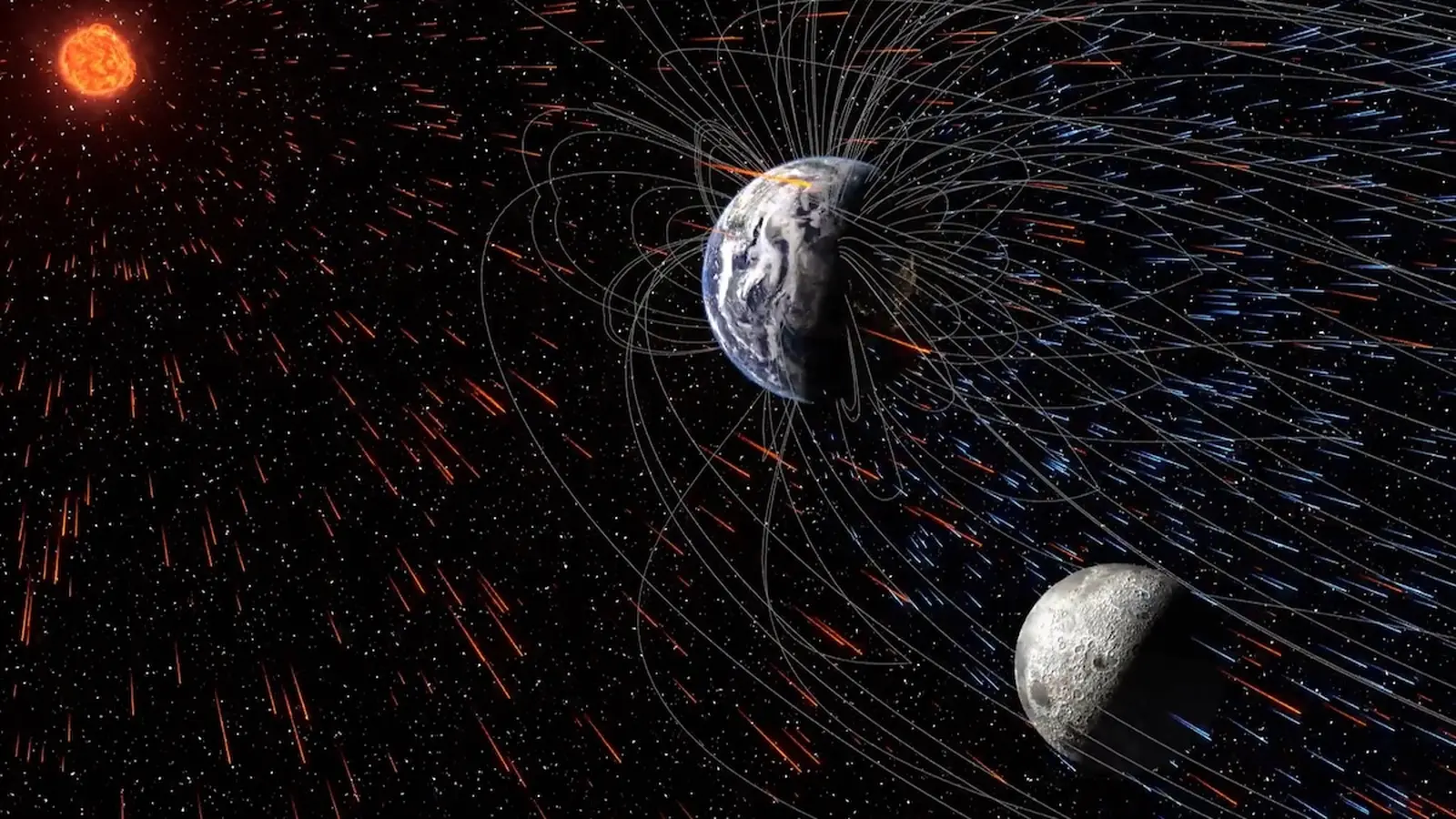
New simulations suggest Earth's magnetic field funnels atmospheric particles all the way to the Moon, depositing volatile elements in the lunar soil and leaving a record of our planet's changing atmosphere.
How Earth may be seeding the lunar surface
For decades, scientists have been puzzled by unexpectedly high levels of volatile elements—including nitrogen and oxygen—in the lunar regolith returned by the Apollo missions. The solar wind and micrometeoroid impacts explain some of that inventory, but not all, particularly for nitrogen. A recent study led by astrophysicists at the University of Rochester reevaluates an older idea: that particles from Earth’s atmosphere could reach the Moon, even after the planet developed a protective magnetic field.
The common assumption had been simple. Before Earth had a strong magnetosphere, atmospheric escape to space—and therefore to the Moon—might have been relatively easy. But once the geomagnetic field formed, it should have corralled charged particles and limited atmospheric leakage. The new work tested that intuition using detailed simulations of two end-member scenarios: an early Earth with no magnetic field and a stronger ancient solar wind, and a modern Earth with a robust magnetosphere but a weaker solar wind.
Magnetotail mechanics: a surprising delivery system
Rather than blocking escape entirely, the simulations show the modern Earth scenario better matches the lunar volatile record. The mechanism is subtle but physical: charged particles—ions torn from the upper atmosphere by solar wind interactions—can be accelerated and guided along Earth's magnetic field lines into the magnetotail, an elongated region shaped like a comet's tail by the constant pressure of the solar wind. When the Moon traverses that magnetotail, it can sweep up and retain some of those atmospheric particles.

An illustration of Earth's magnetotail, and how it can funnel particles, such as oxygen, to the Moon.
Previous studies had already hinted this delivery system could transport oxygen, contributing to thin layers of water or oxidized minerals—rust—on the lunar surface. The new study suggests the process has been operating for billions of years, slowly enriching the regolith with terrestrial volatiles. Over geological time this steady trickle could leave a stratified archive of Earth's atmospheric composition at different eras.
Scientific context and implications
That archive idea is tantalizing. Earth's atmosphere has experienced dramatic shifts—oxygenation events, changes in greenhouse gases and nitrogen cycles—through deep time. If the Moon has accumulated terrestrial particles consistently, its regolith could preserve snapshots of these changes where Earth's active geology and biosphere have long erased them.
Beyond paleoclimate and planetary science, the findings matter for lunar exploration and resource planning. Oxygen-bearing deposits and bound volatiles could affect in-situ resource utilization strategies for future crewed missions. Knowing the provenance of lunar volatiles also helps refine models of surface chemistry, water formation, and space weathering across the Earth–Moon system.
The research, published in Nature Communications Earth & Environment, emphasizes how planetary magnetic fields and the solar wind interact in complex ways. Rather than a simple shield, Earth's magnetosphere acts as both protector and conveyor—sending pieces of our atmosphere outward and leaving traces on our nearest neighbor.

“My work centers on sustainability, energy, and environmental science — examining how innovation can lead to a greener future.”

Discussion
Leave a Comment