
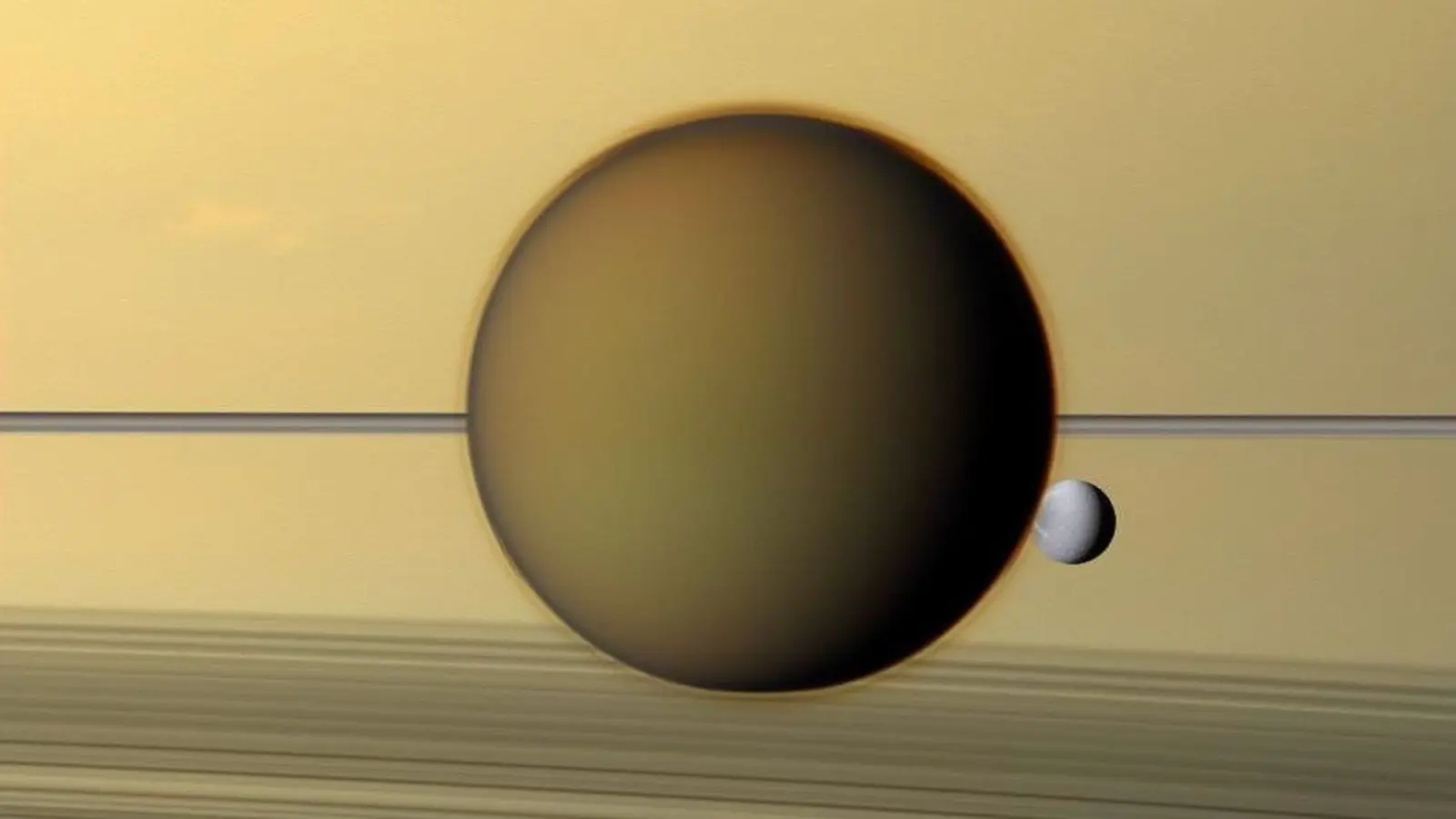
New analysis of NASA Cassini data suggests Saturn’s largest moon, Titan, might not hide a global subsurface ocean after all. Instead of a continuous sea of liquid water beneath its frozen shell, researchers now propose a cooler, slushy interior punctuated by warm pockets of water that cycle nutrients from the rocky core toward the surface.
How Cassini first pointed to an ocean
When Cassini began dozens of close flybys of Titan in 2004, measurements quickly built a picture of a geologically active moon. By 2008, the strongest interpretation from those flybys was that Titan contained a global subsurface ocean. The key evidence came from tidal flexing: as Titan orbits Saturn, the giant planet’s gravity tugs the moon, stretching and compressing it. That deformation changes Titan’s gravitational field and subtly alters Cassini’s velocity.
Engineers measured those speed changes via tiny Doppler shifts in radio signals beamed between Cassini and Earth. The magnitude of the observed tidal response was interpreted as too large for a completely rigid icy interior, implying a decoupling layer — interpreted as liquid water — beneath the outer shell.

Artist's impression of the Cassini spacecraft at Titan.
A different interpretation: ice, slush and localized warmth
Published December 17, 2025, a fresh re-examination of the same Cassini Doppler records offers an alternate explanation. Researchers at JPL applied new noise-removal and signal-processing techniques to the archival data and found evidence consistent with higher energy dissipation than previously recognized. That pattern fits a model in which Titan’s interior is dominated by ice mixed with water — a slushy, partially molten ensemble rather than a single global ocean.
In practice that means Titan could still flex under Saturn’s pull, but much of the tidal energy would be absorbed by the slushy matrix and converted to heat locally rather than sustaining a global liquid layer. In other words, the moon can behave like a flexible body without requiring a continuous subsurface ocean.
“This research underscores the power of archival planetary science data,” said Julie Castillo-Rogez of the Jet Propulsion Laboratory. “The data these amazing spacecraft collect lives on, so discoveries can be made years, or even decades, later as analysis techniques get more sophisticated.”
Implications for habitability and chemistry
Might this revision dim the prospects for life on Titan? Not necessarily. Rather than a deadening blow, the slush model suggests a dynamic internal plumbing. JPL postdoc Flavio Petricca points out that localized pockets of liquid water — possibly as warm as roughly 20°C (68°F) — could circulate from the rocky core up through high-pressure icy layers. Those warm pockets would ferry dissolved minerals and chemical building blocks into the hydrocarbon-rich outer shell, where complex organic chemistry proceeds in Titan’s dense atmosphere and methane-ethane lakes.
For astrobiologists, that scenario is intriguing. A global ocean is one type of habitable environment; transient or spatially limited aqueous regions are another. On Titan, organics on the surface and periodic access to liquid water below could create niches where prebiotic chemistry, and perhaps microbial life, might arise or persist — if the necessary conditions align.

Mosaic image of Titan's polar methane lakes, from Cassini radar data.
Mission context and what comes next
Titan will remain a priority for planetary science. Its thick nitrogen atmosphere, abundant organic molecules, and extensive methane-ethane lakes make it one of the most Earth-like yet alien worlds we know. NASA’s Dragonfly mission, a rotorcraft lander scheduled for launch around 2028, is designed to explore multiple sites across Titan’s diverse surface and sample prebiotic chemistry directly. Dragonfly’s findings could test whether nutrient-carrying water pockets have ever reached the surface or influenced surface chemistry.
Beyond Dragonfly, the new interpretation highlights how reprocessing archival datasets with advanced methods can reshape scientific narratives without new spacecraft. The Cassini archive remains a resource for future researchers as signal-processing tools and theoretical models continue to evolve.
Expert Insight
Dr. Ana Martínez, a planetary geophysicist not involved with the study, commented: “The slush model is a realistic middle ground. It preserves many of the observational facts while changing the scale and distribution of liquid water. That matters for questions of habitability — chemistry is sensitive to how and when water is available, not just whether it exists somewhere in the moon.”
Whether Titan hosts a global ocean or a patchwork of warm water pockets, the moon continues to challenge our ideas about where habitable environments can arise. Reanalysis of Cassini’s data has opened a new chapter in Titan science, and upcoming missions will test these ideas on the ground — or the frozen methane seas.

“My work centers on sustainability, energy, and environmental science — examining how innovation can lead to a greener future.”

Discussion
Leave a Comment