
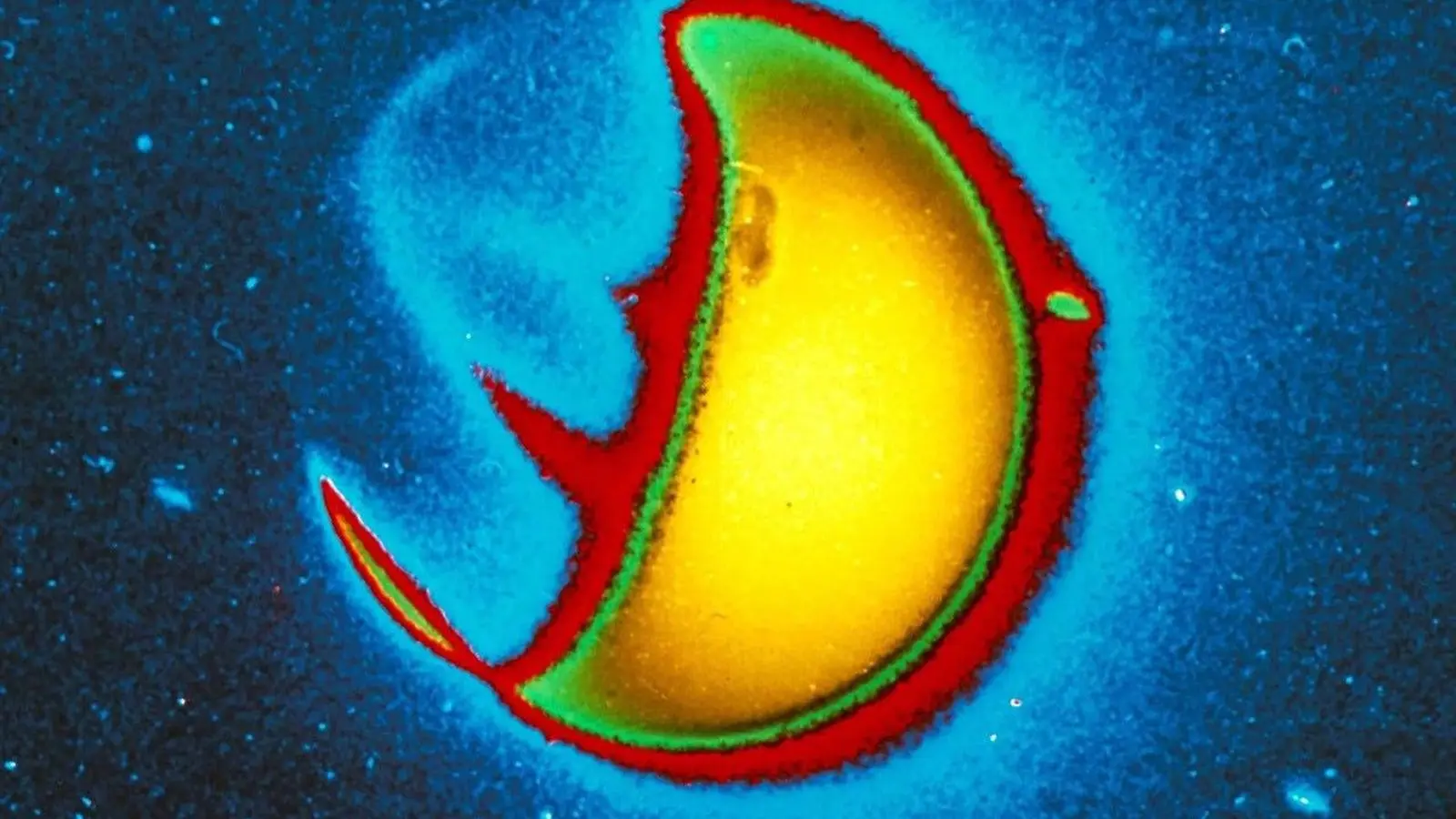
NASA’s Carruthers Geocorona Observatory is set to reveal one of Earth’s most elusive features: a faint ultraviolet glow marking the planet’s outermost atmospheric layer. From a vantage point nearly a million miles sunward at the Sun–Earth Lagrange point L1, Carruthers will produce the first continuous movies of the geocorona, mapping hydrogen as it drifts from the atmosphere into space and responds to solar storms.
Seeing Earth's invisible edge
The exosphere—the topmost layer of Earth’s atmosphere—begins roughly 300 miles above the surface and is dominated by very light atoms, primarily hydrogen. These atoms rarely collide with each other and can travel long distances before being pulled back by gravity or escaping into space. Because neutral hydrogen scatters solar ultraviolet (UV) radiation, it creates an extremely faint UV glow known as the geocorona. That glow is the only direct tracer for where Earth’s atmosphere transitions into interplanetary space.
Direct observations of the geocorona have been rare. In 1972, George Carruthers’ far-ultraviolet camera captured the first lunar-based images of this dim halo during Apollo 16. Those early pictures hinted that Earth’s hydrogen envelope reached far beyond what scientists had expected at the time—but the snapshots were limited in field of view and duration. The Carruthers Geocorona Observatory, named in honor of the pioneering instrument developer, will expand that view from still frames to long, continuous sequences.

Apollo 16 astronaut John Young is pictured on the lunar surface with George Carruthers’ gold-plated Far Ultraviolet Camera/Spectrograph, the first Moon-based observatory. The Lunar Module “Orion” is on the right and the Lunar Roving Vehicle is parked in the background next to the American flag. Credit: NASA
Why the geocorona matters for space weather and habitability
Although tenuous, the exosphere stands between Earth and incoming solar output. When the Sun emits eruptions—solar flares, coronal mass ejections, high-speed solar wind streams—those disturbances first encounter the geocorona. The interaction can change the density, shape, and flow of hydrogen and other light atoms, which in turn alters how energy and charged particles propagate through near-Earth space. Understanding these processes improves space weather forecasting, helping protect satellites, communications, and the health of astronauts on Artemis missions and future crewed flights to Mars.
Beyond operational safety, the geocorona is part of Earth’s long-term atmospheric evolution. Hydrogen escape plays a role in the gradual loss of water—because water molecules broken down by photochemistry produce hydrogen that can escape to space. By quantifying hydrogen flow out of Earth’s atmosphere and measuring how solar activity modulates that escape, scientists get clues about why Earth retained enough water to sustain life while other planets did not. These measurements therefore inform comparative planetology and the hunt for habitable exoplanets.

Artist’s concept of the five Sun-Earth Lagrange points in space. At Lagrange points, the gravitational pull of two large masses counteract, allowing spacecraft to reduce fuel consumption needed to remain in position. The L1 point of the Earth-Sun system affords an uninterrupted view of the Sun and will be home to three new heliophysics missions in 2025: NASA’s Interstellar Mapping and Acceleration Probe (IMAP), NASA’s Carruthers Geocorona Observatory, and NOAA’s Space Weather Follow-On – Lagrange 1 (SWFO – L1). Credit: NASA’s Conceptual Image Lab/Krystofer Kim
Mission architecture and instruments
Launched on September 24, 2025, aboard a SpaceX Falcon 9 from Cape Canaveral, Carruthers rides to space alongside NASA’s IMAP and NOAA’s SWFO-L1. The spacecraft—designed and built by BAE Systems and managed by NASA’s Goddard Space Flight Center—weighs about 531 pounds and is roughly the size of a small loveseat. After a four-month cruise to L1 and a month of instrument checkouts, Carruthers began a planned two-year science phase in March 2026.
From its L1 vantage—approximately 1 million miles sunward of Earth—Carruthers carries two complementary ultraviolet imagers: a near-field imager with zoom capability for detailed views near the planet, and a wide-field imager to capture the full, extended envelope of hydrogen atoms. Operating in the far-ultraviolet, these cameras will map the scattering of solar Lyman-alpha radiation by neutral hydrogen, providing spatially continuous, time-resolved maps of the geocorona as it swells, shifts, and sometimes streams away.
By combining both imagers, scientists can track hydrogen from its denser regions close to Earth out into the outer exosphere—capturing transient changes driven by solar wind pressure, magnetic reconnection events, or enhanced ionization during solar storms. Continuous movies will allow researchers to see the exosphere’s dynamics on timescales from minutes to seasons, rather than relying on scattered snapshots.
Scientific context: Earth as a laboratory for planetary atmospheres
Earth is the only known world with a living biosphere, and it’s the best testbed for atmospheric physics. Studying how hydrogen and other species escape from Earth helps calibrate models used to infer atmospheric loss on Mars, Venus, and exoplanets. For example: how do stellar activity levels and planetary magnetic fields modulate escape? What physical processes dominate—thermal escape, sputtering from charged particles, or blow-off during extreme stellar events? Data from Carruthers will feed models that translate local measurements into broader planetary contexts.
These insights are essential for exoplanet characterization. Observations of distant planets often detect signatures of escaping atmospheres—extending comet-like tails of hydrogen. Interpreting those signatures requires robust, tested physics from a planet we can study up-close. Carruthers will therefore play a double role: improving near-Earth space operations and informing the search for habitable worlds.
Expert Insight
“Imaging the geocorona in continuous motion is a game-changer,” says Dr. Elena Martínez, a hypothetical heliophysicist who studies planetary atmospheres. “Static images hint at structure, but movies reveal processes—how the exosphere breathes in response to solar forcing, how pockets of hydrogen are nudged into escape trajectories. Those dynamics are what determine atmospheric longevity and the near-Earth particle environment.”
“From an engineering perspective,” Martínez adds, “these data will help refine radiation and drag models used to design spacecraft for cislunar space. For mission planners and astronaut safety officers, that’s directly actionable knowledge.”
Related technology and future prospects
Carruthers builds on decades of ultraviolet instrumentation, from sounding rockets to lunar camera deployments. Advances in UV detectors, stray-light suppression, and wide-field optics made the mission possible at modest size and cost. The mission’s instruments will complement other heliophysics missions at L1 and in Earth orbit, offering simultaneous context: in-situ solar wind monitors measure incoming conditions while Carruthers images how the exosphere responds.
Looking forward, the approach of continuous remote sensing at strategic vantage points may become a template for monitoring other planetary exospheres. Small, targeted imagers could watch Mars’ seasonal escape, Venus’ response to solar forcing, or even map extended neutral clouds around moons and comets. For Earth, long-term monitoring could reveal subtle trends in atmospheric escape tied to secular changes in solar behavior or Earth’s composition.
Conclusion
By filming Earth’s hydrogen halo from a unique L1 perspective, the Carruthers Geocorona Observatory will transform how we observe the boundary between atmosphere and space. Its continuous UV movies will refine space weather forecasts, improve protections for spacecraft and crews, and deepen our understanding of atmospheric escape—a process that shapes planetary habitability across the galaxy. In short, Carruthers turns the faintest glow around our planet into a powerful new dataset for space science and exploration.

“My work centers on sustainability, energy, and environmental science — examining how innovation can lead to a greener future.”

Discussion
Leave a Comment