
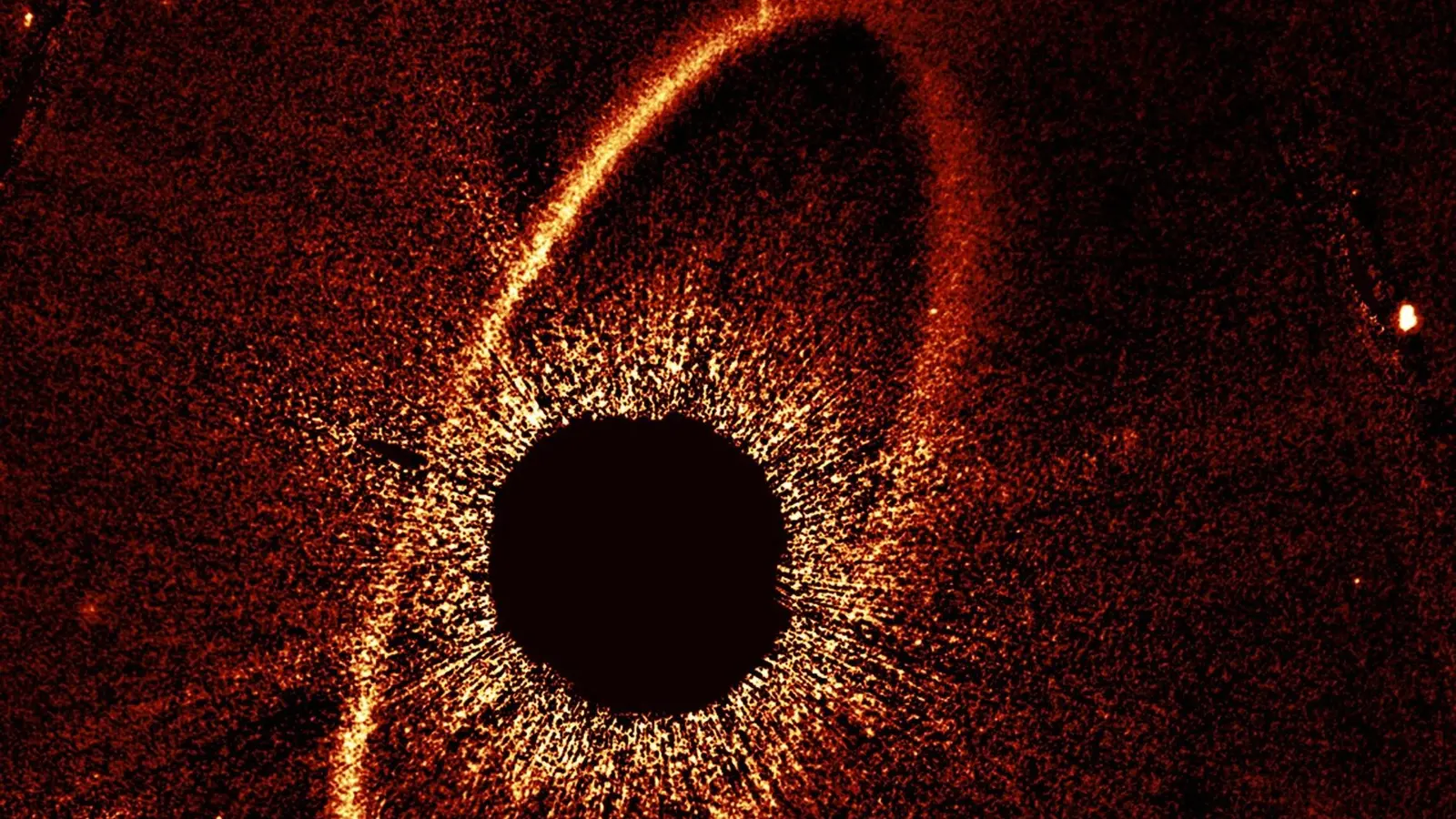
An unexpected point of light has appeared in the debris ring around Fomalhaut, a nearby young star just 25 light-years from Earth. New Hubble observations suggest we are witnessing the aftermath of a catastrophic collision between two asteroid-sized bodies — an event that illuminates the raw processes that can lead to planet formation.
A rare, recorded collision in a neighboring system
Fomalhaut, only about 440 million years old, is surrounded by a broad debris disk left over from its formation. That disk has long been of interest to astronomers studying how planetesimals — the building blocks of planets — evolve. In 2023 the Hubble Space Telescope recorded a bright new source in the outer ring of that disk. The feature resembled a planet in reflected starlight, but careful comparison with archival images revealed it had not been present before.
Researchers led by Paul Kalas (UC Berkeley) and colleagues designated this new source Fomalhaut cs2 (circumstellar source 2). It joins a previously detected transient, once labelled Fomalhaut b or informally Dagon, which earlier observations showed to be a bright but short-lived dust cloud rather than a bona fide planet. The team’s analysis indicates both cs1 (Dagon) and cs2 were produced by violent collisions between similar-sized bodies roughly 60 kilometers (about 37 miles) across.
"This is the first time we've seen a point of light suddenly appear in an exoplanetary system in this way," Kalas said in discussing the discovery, noting that the light source is absent from older Hubble frames. The implication: rather than a stable planet, cs2 is likely an evolving debris cloud created when two large planetesimals smashed together and vaporized a significant amount of rock and dust.

Hubble Space Telescope positions of cs1 in 2012 and cs2 in 2023.
Why two collisions matter: statistics, not just spectacle
Catastrophic impacts in a debris disk are not unexpected, but prior models predicted collisions of this scale to be extremely rare — perhaps once every 100,000 years at a given location. Observing two such events within a 20-year observational window at similar positions in Fomalhaut’s outer ring challenges that estimate. With a second data point, astronomers can begin to move from anecdote to statistical inference.
Mark Wyatt (University of Cambridge) notes that repeated collisions permit direct estimates of both the sizes of the colliding bodies and their population density. From the brightness and evolution of the dust clouds, the research team inferred the destroyed planetesimals were each about 60 km across. From collisional rates and debris brightness they estimate on the order of 300 million similar objects may orbit within Fomalhaut’s disk — a rich reservoir of building blocks for larger worlds.
Seeing multiple collisions clustered in one zone is also a clue to the disk’s internal dynamics. Concentric gaps and asymmetries in the ring suggest some unseen agents — perhaps nascent planets — are gravitationally shepherding material and stirring up relative velocities, which in turn increases collision rates. JWST (James Webb Space Telescope) imaging in 2023 additionally revealed a large dust knot in the same outer ring, which was interpreted as another possible collisional result.
What the debris tells us about composition and evolution
When two planetesimals collide at high speed, the energy released shatters and vaporizes rock. The resulting dust cloud reflects starlight and can mimic a small planet for years, slowly dispersing as radiation pressure and orbital dynamics carry grains away. By tracking changes in shape, brightness, and motion over subsequent observations, astronomers can infer grain sizes, velocities, and even some compositional hints.
For instance, a dust cloud that reddens with time may indicate an abundance of finer grains or differing mineralogy; a cloud that becomes more extended or develops a comet-like tail signals the role of stellar radiation pressure in shaping the debris. The Hubble team plans to monitor cs2 with both Hubble and JWST to follow these subtle changes and to test whether cs2 evolves the same way cs1 did before fading.
Observational strategy and future missions
The detection underlines the importance of long-term, multi-epoch imaging for understanding dynamic planetary systems. Direct imaging missions that aim to find exoplanets by reflected light must account for transient dust phenomena that can masquerade as planets. This makes cadence — the timing and frequency of observations — as critical as raw sensitivity.
Hubble’s archival depth allowed astronomers to confirm cs2’s absence in earlier epochs, while JWST’s infrared capabilities provide complementary information on cooler dust and thermal emission. Future ground- and space-based observatories with high-contrast imaging and coronagraphs or starshades will refine our ability to differentiate between true planets and collisional debris.
Expert Insight
"Fomalhaut is a rare living laboratory," says Dr. Leila Moreno, an astrophysicist specializing in planet formation. "Repeated collisions at the same radius suggest we’re seeing the aftermath of dynamical stirring — perhaps due to unseen planets sculpting the disk. Following how these dust clouds evolve gives us a window into the material properties of planetesimals and the timeline of planet assembly."
Moreno adds that multi-wavelength follow-up is essential: "Optical imaging shows reflected light, while infrared and submillimeter observations reveal the thermal behavior and mass of the debris. Together they let us reconstruct the impact — its energy, mass involved, and the likely outcomes for planet growth in the system."
Conclusion
The new Hubble detection of Fomalhaut cs2 — together with the earlier cs1/Dagon event — transforms a single curiosity into a measurable phenomenon. Two recorded collisions at roughly the same disk location enable better estimates of planetesimal sizes and numbers, and suggest a dynamically active environment where planet formation may still be ongoing. Continued monitoring with Hubble, JWST, and future observatories will chart how these dust clouds disperse and will help distinguish transient debris from true planets, sharpening our picture of how planetary systems assemble and evolve.

“My work centers on sustainability, energy, and environmental science — examining how innovation can lead to a greener future.”

Discussion
Leave a Comment